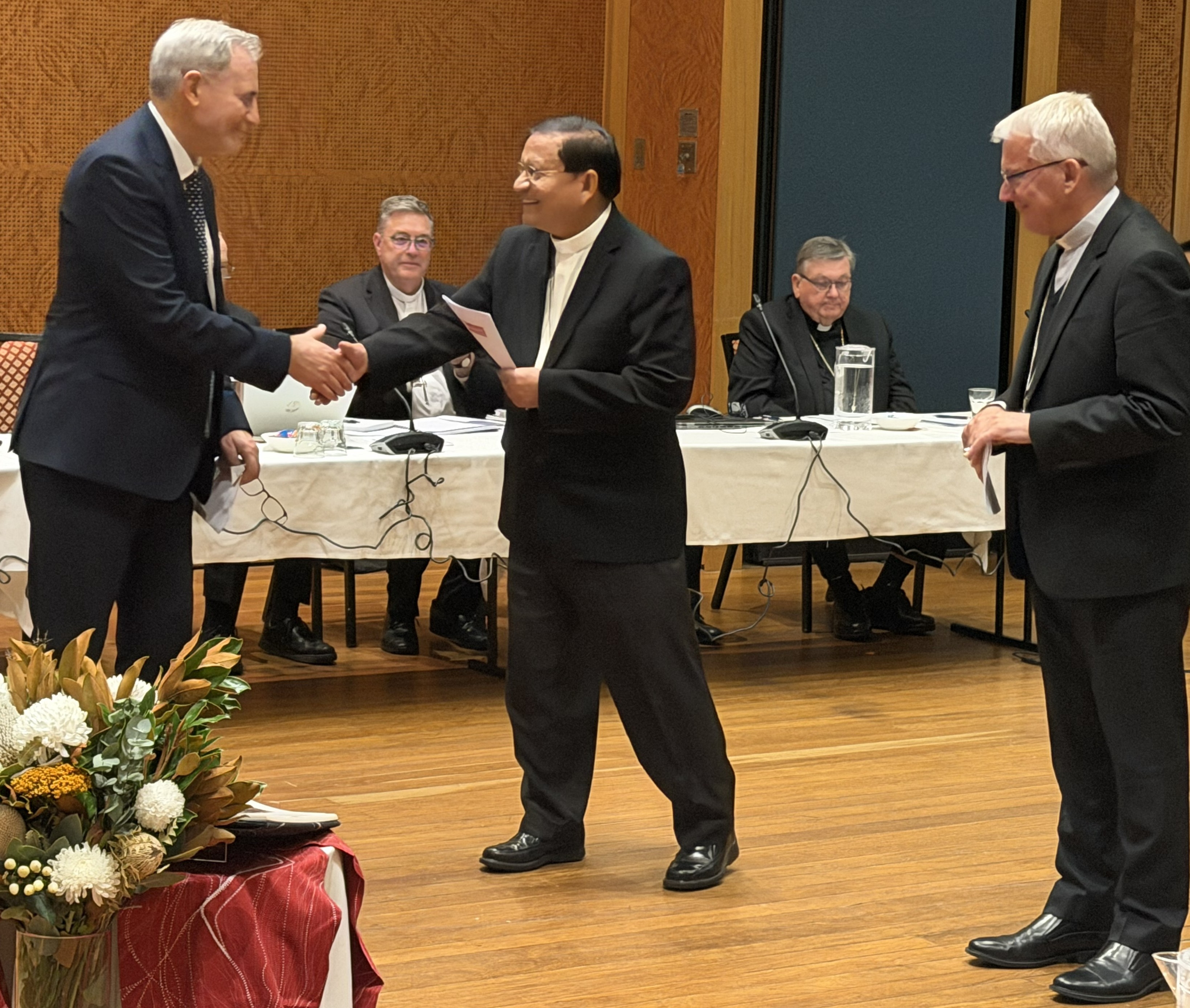
Pope Leo XIV reunites with his eighth grade classmates
(RNS) — Nancy Ross was a graduate student at the University of Cambridge when she got engaged to her now-husband, also a student there. They had met in their ward, or congregation of the Church of Jesus Christ of Latter-day Saints, and planned to be wed in an LDS temple for eternity rather than merely having a civil marriage that would be binding for this life only.
To do that, they went to the temple some weeks before the planned marriage ceremony to undergo certain preparatory rites for adults of their religion. Ross felt excited to get married and was wondering about how to wear the Mormon temple garments she would receive to use as underwear afterward.
Years earlier, her mother had been instructed to wear her garment top underneath her bra, so the garment would be next to the skin. But Ross was hearing from younger women that the rules had shifted, and it was now permissible to put on the bra first, then the garment over the top of it. She was “a very rule-following kind of person,” she said, so she took advantage of a moment in the temple when the woman instructing other women on garment wear and care asked if there were any questions.
“I asked the temple matron in the London Temple, ‘What’s appropriate here? What’s not appropriate here?’ I was told that it was a very rude question,” Ross said. “And that was kind of gutting because all I needed was an answer, and I was fully prepared to do whatever the answer was.”
Ross said she left the temple confused and with “deep feelings of shame,” unsure why her earnest question had brought recrimination but no guidance.
“I learned from that point that I was going to have to figure it out,” she said. “In Mormonism, there are a lot of rules, but there were also these strange ambiguities, and I was going to have to resolve them on my own without anyone giving permission or flexibility.”
She’d have to resolve those gray areas in silence because of the secrecy that surrounds many aspects of the LDS temple.
Today, Ross is a professor at Utah Tech University, formerly Dixie College, and has converted to the Community of Christ, formerly the Reorganized Church of Jesus Christ of Latter Day Saints, another Christian denomination that traces its heritage to Joseph Smith. Last month, she and two other scholars, Jessica Finnigan and Larissa Kanno Kindred, published “Mormon Garments: Sacred and Secret.” Released by the University of Illinois Press, the book uses survey findings and delves into the authors’ own experiences to better understand the meanings and functions behind Mormon garments.
Like Ross, Finnigan and Kindred also used to be members of the Utah-based LDS Church. Like her, they also eventually left it.
“I think Nancy’s story perfectly illustrates how much silence there is around this topic,” Finnigan said in a group Zoom interview with RNS. “The church comes out with statements like, ‘This is a practice between you and the Lord,’ but that’s a really nice idea that breaks down very quickly in practice. You’re not getting any places to talk about it. Your bishop’s not talking about it, really. The Relief Society (LDS women’s organization) is not talking about it. And even in the temple, it’s roulette, right?”
Ross and Finnigan thought Mormons might be more willing to talk about garments through an anonymous online survey, so they recruited respondents using social media. They hoped to receive 500 responses and were swamped with over 4,500 — a giant number for a niche population.
The data they gathered is not statistically representative of Mormons, but it does represent a wide range of experiences and patterns.
“I think the reason we have this huge number of responses is that it needs to be witnessed,” said Kindred, a psychology doctoral student at Tennessee State University, who came to the project after the survey was fielded. “One of the basic human needs is to have our experiences validated, and one of the sources of trauma is when that can never happen. Damage happens when we don’t talk about it.”
Among people who answered the survey, women in particular had a lot to say about garments.
For “conforming” women — or those who were active in the church and felt very positive about their involvement — the survey indicated they liked the meaning of the garments, but not necessarily how they served as underwear, Ross said.
Meanwhile, “non-conforming” women and men alike objected to the social pressure of garments, and especially when other members would check whether they were wearing them. Garment lines are visible to fellow members who know what to look for, which results in a kind of informal group surveillance. There’s also formal surveillance, since bishops and stake presidents ask about garment compliance in temple recommend interviews. “They (non-conforming members) don’t like feeling controlled, and that by not wearing your garments, you lose belonging,” Finnigan explained.
Women were also 200 times more likely than men to name medical problems as an obstacle to wearing garments. Ross said that in an open-ended question about how people felt about wearing garments, 200 women “referenced all of these sources of physical pain and physical discomfort stemming from common issues, gynecological issues like UTIs and yeast infections. But they also ran through many other different kinds of complications, like MS, different skin conditions and changes in the body from pregnancy. There were so many difficult physical issues that garment design and the rules around garments don’t adequately address.”
Only one man wrote about a medical problem that made wearing garments difficult. He’d had testicular cancer and had to wear a pad, and he said garments made that very hard to do.
The survey also asked respondents to comment on how they feel when other people complain about their garments. Ross said that conforming men — the fully believing, practicing men who are often called to leadership positions in the church — were the most judgmental about other people’s complaints.
“Their starting point was that it’s really easy to wear garments, right? Like, if you can’t wear garments, you’re not a very good church member and there’s something morally suspect. You’re not right with God,” Ross said. “That was painful to read alongside people who were pouring their hearts out and had clearly been in distress for a long time. They have been trying to navigate this demanding religious practice largely in silence, taking on all of the burdens of trying to meet the needs of their bodies and their religious requirements.”
Finnigan noted that the church’s rules about garment wearing have not traditionally made exceptions for health, a departure from the church’s longstanding exceptions to its expected church-wide fast on the first Sunday of each month. Pregnant women, nursing mothers, the elderly and the infirm have long been exempted from fasting but not from wearing garments.
However, the issue was addressed in August 2024, when an addition to the church’s handbook clarified that sometimes, medical conditions or devices “may make it difficult for members to wear one or both parts of the garment.” The new policy stated that in such cases, the member’s “religious status is not affected” if they do not wear the garments, “as long as the member remains worthy.”
The church also made headlines two months later when it announced new garment options for women, including a sleeveless tank top and an open skirt.
Kindred said the changes likely came about because of increased online discussions about, and media scrutiny surrounding, garments, including conversations about this survey’s findings. Mormons in general are getting more comfortable talking about garments — though some holdouts prefer the old days of silence and secrecy.
“There are always some people who say, ‘I don’t think this should be talked about. You guys are all inappropriate, and maybe if you would stop talking about this, then you would maybe understand the meaning of your garments better,’” Kindred said, adding there’s still “intense invalidation” happening within the community, especially because the church hasn’t admitted it may have been insensitive about garments in the past.
“The church never says, ‘Hey, yes, maybe we were being too rigid. That wasn’t necessary — we apologize and now we’ve learned a new way to do this,’” Kindred said. “The church believes in continuing revelation, so I feel like they could do that, but somehow they don’t do that.”
(AP) — Leaders of Jehovah’s Witnesses are modifying their prohibition on receiving blood transfusions on religious grounds, now allowing members to decide whether to allow their own blood to be drawn and stored in advance for such things as a scheduled surgery with a risk of significant blood loss.
But the organization is retaining its wider prohibition against receiving transfusions of others’ blood — a procedure routinely used with patients after accidents, violence or other blood loss. This long-held prohibition is one of the most distinctive and controversial teachings of the movement, which is headquartered in New York state and well-known for its assertive public proselytizing.
The Governing Body of Jehovah’s Witnesses announced what it called a “clarification” of its teaching on Friday, saying it came after extensive prayer and consideration.
“Each Christian must decide for himself how his own blood will be used in all medical and surgical care,” Governing Body member Gerrit Lösch said in a video statement posted Friday on the denomination’s website. “This includes whether to allow his own blood to be removed, stored, and then given back to him. What does this mean? Some Christians may decide that they would allow their blood to be stored and then be given back to them, others may object.”
Jehovah’s Witnesses, who emerged in 19th century America, share many Christian beliefs but diverge from most other churches on key theological issues, such as the nature of Jesus and biblical prophecy. They are almost alone in their beliefs about blood transfusions. Jehovah’s Witnesses reported a U.S. membership of 1.3 million in 2025, with a worldwide membership of 9.2 million in more than 200 countries and territories.
News of the imminent policy change leaked out in recent days on Reddit and other social media forums for former Jehovah’s Witnesses.
Some ex-members — who are critical of the religious organization’s policies and assert it is insular and authoritarian — say the policy shift has some value but is inadequate. Many commenters questioned why the ban on transfusions wasn’t lifted entirely for one of the same reasons cited by Lösch regarding the use of one’s own blood, that the Bible doesn’t comment on it.
“I don’t think it goes far enough, but it’s a significant change,” said Mitch Melin of Washington state, a former member who has worked to bring awareness to what he calls the “darker side” of the organization. The longstanding blood policy has led to “senseless loss of life,” he said.
Melin said those who defy such a policy “could be shunned” by the church.
“They’re softening this to a conscience matter when it involves your own blood,” he said in an email. “From my perspective, it doesn’t go far enough. If one of Jehovah’s Witnesses faces a medical emergency with significant blood loss, or if a child requires multiple transfusions to treat certain types of cancers, this policy change does not grant them complete freedom of conscience to accept potentially life-saving interventions involving donated blood.”
He also noted that in a worldwide church, many members live in countries that lack access to providers who could store their own blood.
Using a patient’s own blood for medical treatment
Autologous blood is blood donated by a patient who can receive it back if a transfusion is needed during or after surgery. Medical experts say the blood can be taken from 6 weeks to 5 days before surgery. It’s thrown away if it’s not needed during or after surgery. It can be done at some hospitals or blood banks.
Donating one’s own blood can make a person anemic or have a lower blood count, experts warn. But there’s a lower risk of having a reaction because your body recognizes your own blood, and there’s no risk of contracting infectious disease from a different donor.
Jehovah’s Witnesses’ historic teachings on blood transfusions stem from biblical passages requiring believers to “abstain … from blood,” which they interpret as applying not just to food but to transfusions. While they teach that many detailed dietary laws in the Old Testament portion of the Bible no longer apply, they say this prohibition on partaking of blood is upheld as a universal principle for believers in other Bible passages.
The organization has parsed the implications of this teaching in the past. It has previously determined, for example, that medical procedures that temporarily remove blood but quickly return it to the body — such as kidney dialysis, in which blood is filtered of impurities — are acceptable. But they had distinguished that from removing blood and storing it for an extended period before returning it.
In 2000, an official publication, The Watchtower, stated: “Hence, we do not donate blood, nor do we store for transfusion our blood. That practice conflicts with God’s law.”
Lösch did not detail what prompted the change in the organization’s stance. He did refer to the increasing types of medical interventions available, although blood transfusions have long been used. He said that “the Bible does not comment on the use of a person’s own blood in medical and surgical care.”
In a press statement, the Jehovah’s Witnesses emphasized that their “core belief regarding the sanctity of blood remains unchanged.” They said many medical providers have been respecting members’ health-care directives.
___
AP medicine and science reporter Laura Ungar contributed.
___
Associated Press religion coverage receives support through the AP’s collaboration with The Conversation US, with funding from Lilly Endowment Inc. The AP is solely responsible for this content.
ST. PAUL, Minn. (AP) — Clergy will be allowed to minister to immigrants in a holding facility at the headquarters of the Trump administration’s enforcement surge in Minnesota, a federal judge ruled Friday.
U.S. District Judge Jerry Blackwell granted an injunction requested by Minnesota branches of the Evangelical Lutheran Church in America, the United Church of Christ, and a Catholic priest who had sued the Department of Homeland Security.
Under his ruling, clergy will be allowed in-person pastoral visits to all detainees at the Bishop Henry Whipple Federal Building in Minneapolis, the site of frequent protests over roughly the 3,000 federal officers who had surged into the state at the height of the crackdown.
Blackwell said the plaintiffs had met their burden of proving that they’re likely to succeed when the case reaches a final conclusion, and that restrictions on the religious freedom of clergy to minister to detainees constitutes “irreparable harm.”
He ordered both sides to meet within four business days to try to agree on details for how to provide access that takes into account the government’s legitimate security concerns, and then submit a plan within seven business days, or competing proposals if they can’t agree.
Bishop Jennifer Nagel, of the Minneapolis Synod of the Evangelical Lutheran Church in America, was turned away from Whipple when she tried to go to visit with detainees on Ash Wednesday. She told reporters after the hearing that serving people in crisis is fundamental in many religions.
“The trauma that families are going through, and individuals are going through, at these times is exorbitant. And so to be able to meet people in those needs, that’s very much at the core, the heart and soul of what we do as ministers of all different traditions,” Nagel said.
The lawsuit alleges the Whipple building, named for Minnesota’s first Episcopal bishop, a 19th-century advocate for human rights, “now stands in stark contrast to its namesake’s legacy.” It says the building has “become the epicenter of systematic deprivation of fundamental constitutional and legal rights by the federal government.”
Government attorneys noted that Operation Metro Surge officially ended on Feb. 12. They also said the number of new detentions has since subsided, so temporary restrictions on visitors have been eased, and clergy visits have been allowed for over two weeks.
But Blackwell agreed with attorneys for the plaintiffs who argued that the issue isn’t moot, because the government still doesn’t have a formal plan requiring access that sets out who decides the conditions under which clergy are admitted.
Catholic and Episcopal bishops in Minnesota, other Christian and Jewish clergy, and the Minnesota Council of Churches also formally supported the request. The courtroom was filled with Lutheran, United Church of Christ, Unitarian Universalist, Jewish and other clergy.
Clergy across the country have been pushing for more access to immigration detention facilities, especially during the holy seasons of Lent and Ramadan. It’s a longstanding practice for faith leaders to minister to detainees. but it has become far more contentious amid the current immigration crackdown.
It took a similar lawsuit for two Catholic priests and a nun to gain entry into an ICE facility in the Chicago suburb of Broadview on Ash Wednesday last month. And Muslim and Christian clergy in Texas have struggled to get into large Immigration and Customs Enforcement detention facilities there.
Tauria Rich, a senior local ICE official who oversees Whipple, said in a filing this week that visitors to Whipple are rare, and that any clergy requests are handled on a case-by-case basis. She said one clergy member had attempted to visit in early March, but left because no detainees were present. The visit would have been allowed if any detainees had been there, she said.
ICE calls the building a short-term holding facility, and not the kind of long-term detention center where clergy visits are normally allowed.
It’s not just clergy who’ve struggled to get in. Three members of Congress from Minnesota were turned away when they tried to inspect the facility. Once they did get in, they reported poor conditions.
Access has also been an issue for attorneys. Homeland Security was ordered by a different federal judge last month to give new detainees at Whipple immediate access to counsel before they’re taken elsewhere. That judge held a hearing this week to consider whether to convert her temporary order into a more permanent injunction. Her ruling is pending.
PARIS (AP) — When Iran erupted in nationwide protests at the end of 2025, Shayan Ghadimi’s mother returned to the country from Paris to see the uprising for herself.
Her absence — and the struggle to stay in touch through the bloody crackdown that followed and now the Iran war — hang over the family. Like many Iranians outside the country, they will mark the normally festive Persian new year, known as Nowruz, with heavy hearts — or not at all.
Ghadimi’s 70-year-old mother had watched the early protests on TV. “We could see the market closed, the people in the street. She said, ‘I want to be there,’” the 41-year-old Ghadimi said of her mother, as she prepared to serve lunches in the spice-scented restaurant she runs in Paris.
“Now, she is all alone … with no way to stay in contact, watching the sky. I cannot imagine the state she is in,” Ghadimi said.
An Iranian cultural center in Paris that organizes music events for Nowruz says it’s in mourning. In the United States, some Iranian American communities also canceled or scaled back festivities.
Nowruz, or “new day” in Farsi, coincides with the spring equinox and is celebrated from Afghanistan to Turkey. Iranians of diverse faiths mark Nowruz — which is rooted in Zoroastrian tradition dating back millennia — despite occasional efforts by hard-liners to discourage it.
Celebrating together for comfort
Shakiba Edighoffer, grocery shopping in Paris for Nowruz, said she and Iranian friends are on a “kind of emotional roller coaster” as the war rages. Israel and the United States are attacking Iran’s leaders and military while the Islamic Republic fires missiles and drones at Israel and Gulf Arab states.
“You hear news about this or that leader of the Islamic Republic being eliminated … about executions or bombings,” the makeup artist said.
With communications largely severed, trying to find out how family and friends are faring under bombardments is stressful.
Celebrating Nowruz “helps us cope, at least a little, with the psychological pressure,” Edighoffer said. “All these oppressors want is for us to be sad, to forget our millennia-old Persian and Iranian traditions.”
“We must not give them that victory.”
In Tehran, little celebration
Too scared to venture far from her Tehran neighborhood, the Iranian woman said she had nearly forgotten it was Nowruz.
There are no decorations in the streets, and the only reminder was when she spotted her friend’s mother holding a hyacinth, a flower associated with spring.
“That’s how distracted I’ve been. I only found out by chance,” said the woman in voice messages to The Associated Press, speaking on condition of anonymity for fear of reprisals.
The traditional family shopping trip to the market about 9 kilometers (5 1/2 miles) away, was out of the question, she said.
So for the traditional new year spread, Haft-Seen, she had to use what was available at home. A central tradition of new year celebrations, Haft-Seen involves seven items that include garlic, vinegar, sumac, apples and sprouting greens — symbolizing new beginnings and hope.
“Why do you want to set it up, just forget it!’” the woman recalled her mother saying. But determined to distract from the grim mood, the family made do.
When it was all over, one tradition remained the same. She and her mother burned espand — aromatic seeds — meant to ward against the evil eye.
Tears of anguish and of joy
Some of the diners who come to Ghadimi’s Paris restaurant for flame-grilled kebabs and spiced rice to celebrate hope the war will bring a new dawn. Other can’t see past the deaths and destruction wrought by Israeli and U.S. strikes.
“I have people in tears. I have people who cry for joy. They say, ‘Did you see? They are coming. We are going to be saved.’ Others say, ‘Our country is being destroyed,’” she said.
Since her mother returned to Iran in January, they’ve only managed to speak to each other twice.
“Quite honestly, I don’t try anymore. Because it stresses me out, if I try calling and can’t get hold of her,” she said. “My sister calls 100 times a day and can’t reach her.”
Her mother had a return ticket and had promised to be back for Nowruz.
But when they last spoke, about a week ago, her mother said those plans had changed. Having lived through the 1979 Islamic Revolution, she wants to see Iran’s next chapter.
“I am staying here until the end,” her mother told her.
___
Associated Press journalists Sarah El Deeb in Beirut, John Leicester in Paris and Sahar Ameri in Berlin contributed.