(The Conversation) — President Donald Trump and Pope Leo XIV, the U.S.-born head of the Catholic Church, had an unusual and acrimonious public exchange over the weekend.
In a scathing attack on Truth Social, the social media platform he launched in 2022, Trump accused the pope of being “WEAK on Crime and terrible for Foreign Policy.” The lengthy post on April 12, 2026, told Leo to “focus on being a Great Pope, not a Politician.”
Later that night, Trump told reporters that he was “not a big fan of Pope Leo” and did not think the pope was “doing a very good job.” Leo has repeatedly called for peace amid wars in the Middle East and described Trump’s April 7 threat to destroy Iranian civilization as “truly unacceptable.”
Several hours later, aboard a papal flight to Algiers – where he will begin a 10-day trip to Africa – Leo told reporters that he did not want to get into a debate with Trump, and that his words were not “meant as attacks on anyone.” But striking a firm note, he said he had “no fear” of the Trump administration.
“I do not look at my role as being political, a politician,” the pope said, adding, “I will continue to speak out loudly against war, looking to promote peace, promoting dialogue and multilateral relationships among states, to look for just solutions to problems. Too many people are suffering in the world today. Too many innocent people are being killed. And I think someone has to stand up and say, ‘There’s a better way to do this.’”
The public nature of Trump’s criticism may feel unprecedented. But there have long been tensions between the United States and the Vatican’s effort to seek peace, as scholars writing for The Conversation have shown in past articles.
1. History of anti-Catholicism
In February 2016, Pope Francis criticized Trump’s campaign pledge of building a wall on the U.S.-Mexico border. Back then, too, Trump attacked Francis for being a “very political person.”
Temple University historian David Mislin wrote how the comments suggesting that the pope was interfering in U.S. politics reminded some commentators of an “older religious bigotry.”
During the 19th century, when large numbers of Catholics immigrated to the U.S., they were looked at with suspicion. Some Americans claimed that “Catholics maintained allegiance to the church first and to American values and institutions second,” Mislin explained.
“Anti-Catholic cartoons suggested that Catholics would use political power to dismantle the nation’s institutions,” he added.
It was once “unthinkable” for American presidents to be seen with the pope. Dwight Eisenhower became the first U.S. president to visit the Vatican in 1959.
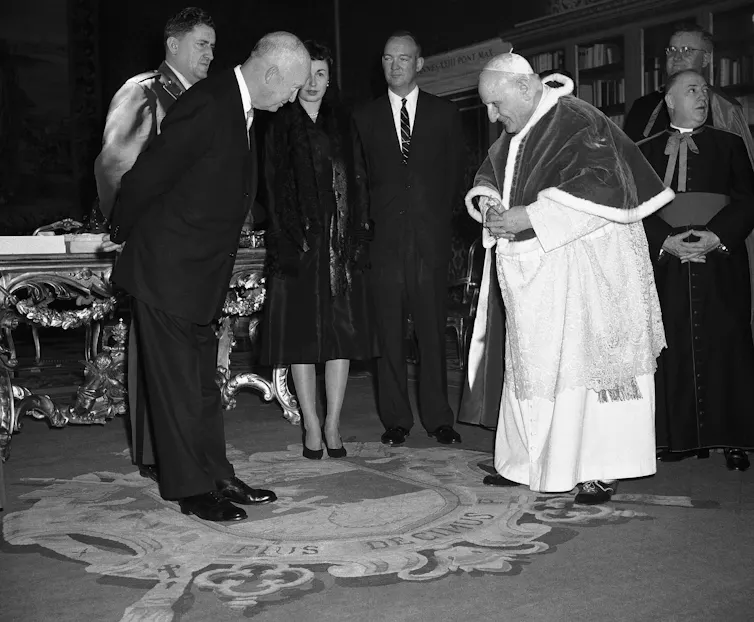
President Dwight Eisenhower with Pope John XXIII on Dec. 6, 1959, at the Vatican.
AP Photo
Read more:
Why it was once unthinkable for the president to be seen with the pope
2. Mutual influence
It was only in 1984 – under President Ronald Reagan – that the U.S. and the Vatican established diplomatic relations, as church historian Massimo Faggioli noted in an 2015 article.
Faggioli, a professor at Trinity College Dublin, wrote in the lead-up to Francis’ trip to the United States. That visit reflected “a story about change in religion and politics,” he noted – about relations between the papacy and the Catholic Church, on one side, and the United States, on the other.
Francis addressed Congress on this trip, which, according to Faggioli, “would have shocked most Americans only 30 years ago.”
He also noted how much world Catholicism had been influenced by American ideas in recent years, becoming “much more American than it used to be – and much more American than Italian, for that matter.” Catholic teachings “on religious freedom and democracy and the new sensibility on the role of women in the Church came to Rome largely thanks to the experience of Catholics in the United States,” Faggioli wrote.
His broader point was that the Vatican and the U.S. have had an influence on each other – something that can be “seen only over a long period of time.”
Read more:
Why should we care about Pope Francis’ visit to the US?
3. How Francis changed church’s foreign policy
Part of the change – at least at the Vatican end – is reflected in the church’s relationship with political power, as Loughborough University researcher Massimo D’Angelo pointed out.
Francis’ predecessor, Joseph Ratzinger – who became Pope Benedict XVI – may have often seen political alliances as a necessity for the church’s survival in times of secular decline. “Francis rejected this approach,” D’Angelo wrote.
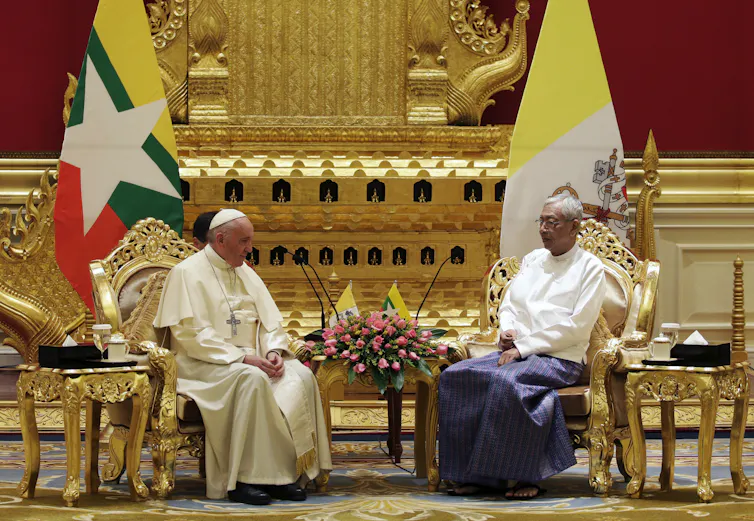
Pope Francis talks to Myanmar’s President Htin Kyaw during their meeting at the Presidential Palace in Naypyitaw, Myanmar, on Nov. 28, 2017.
Max Rossi/Pool Photo via AP
“The sacred must not be instrumentalised by the profane,” Francis stated in Kazakhstan in 2022. In other words, religion should not be a tool in the hands of the powerful. Francis also made constant appeals for peace amid the Ukraine and Gaza wars, though he avoided direct condemnation – which, at times, led to some criticism.
Even so, as D’Angelo said, it was “another major transformation” in how the church related with political power.
Read more:
How Pope Francis changed the Catholic Church’s foreign policy
4. Shared principles
Trump’s Truth Social post accused Leo of “catering to the radical left.” Mark Yenson, a religious studies scholar at Western University in Canada, explained why such terms may not be applicable in the context of the papacy, where “conservative” and “liberal” labels don’t work the same way as in polarized American politics.
Many Americans viewed Benedict as more conservative than Francis, his successor. Yet some of the two popes’ history suggests that they appealed to shared principles, which were theological rather than political, Yenson wrote in 2025. These were “not reducible to liberal versus conservative categories.”
As he wrote, “The role of the pope, highlighted in Francis’ teaching on ecology, is to inspire a different kind of social and moral imagination, one not reducible to particular ideological positions.”
Leo, like Francis, has been critical of the Trump administration. Yenson reminds readers that the pope’s choice of name hearkens to Pope Leo XIII, who initiated modern Catholic social teaching and emphasized peace and justice. Additionally, he wrote, Leo’s “career as a missionary, bishop and Vatican cardinal outside of the U.S. means that his context is not confined to the polarizations of the U.S. Catholic Church and its bishops.”
Far from an isolated spat, Trump and Leo’s exchange might well show a recurring dynamic – in which papal intervention on global issues is rarely seen as neutral.
Read more:
Is Pope Leo XIV liberal or conservative? Why these labels don’t work for popes
This story is a roundup of articles from The Conversation’s archives.
(Kalpana Jain, Senior Religion + Ethics Editor, Director of the Global Religion Journalism Initiative, The Conversation. The views expressed in this commentary do not necessarily reflect those of Religion News Service.)

Original Source: