(The Conversation) — Alarm over the war of words between President Donald Trump and Pope Leo XIV has escalated with remarkable speed, from The New York Times to the Daily Beast and local television.
The pope has repeatedly called for peace in the Middle East since the start of the Iran war, insisting that “God does not bless any conflict” and warning against the “delusion of omnipotence.”
On April 12, in a lengthy social media post, Trump derided Leo as “WEAK on Crime, and terrible for Foreign Policy,” telling him to “focus on being a Great Pope, not a Politician.” His Truth Social account posted, then deleted, a Christ-like image of Trump appearing to heal a man.
At stake in this public feud is an old question: Can a religious leader challenge political power, especially a ruler of one of the most powerful countries in the world?
As a medieval historian and lead editor of “The Cambridge History of the Papacy,” I cannot help but see a familiar pattern.
For many people, Trump’s rant against the pope was shocking. But conflicts between popes and rulers are not an aberration; they’re a durable feature of Western history. Whenever political leaders cloak power in sacred language, or religious leaders publicly denounce political violence, they reenact debates that stretch back more than a millennium. These struggles are not symbolic: They concern who holds ultimate authority over people, souls – and in the end, history itself.
Two powers, intertwined
From its earliest centuries, Christianity was bound up with politics. Roman Emperor Constantine legalized the religion in 313. He later presided over the Council of Nicaea, an important theological assembly, blurring the line between political rule and spiritual authority.
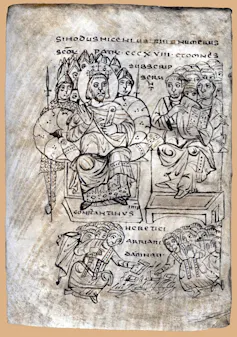
Constantine presides over a burning of books that were deemed heretical at the First Council of Nicaea in 325 C.E.
Pictures From History/Universal Images Group via Getty Images
In the fifth century, Pope Gelasius I articulated a rival vision: that the world was governed by two powers, priestly and royal. Ultimately, he argued, spiritual authority outweighed political power, because it promised eternal salvation. Gelasius’ theory did not resolve the tension between the two, but it established a lasting framework for Christian political thought.
The relationship between these two powers shifted decisively in the year 800, when Pope Leo III crowned Charlemagne, a Frankish king, emperor on Christmas Day. This act was not merely ceremonial. It implied that imperial authority in the West came from the church and that political legitimacy required papal sanction.
The coronation followed years of political instability in Rome and the papacy’s increasing reliance on the Franks for military protection. After Leo was elected pope in 795, opponents attacked him, and he found shelter at the court of Charlemagne. The king returned to Rome with Leo and asserted his legitimacy. In turn, Leo crowned Charlemagne. Doing so asserted his own role as a maker of emperors, while Charlemagne gained a sacred aura.
This moment reshaped medieval political theology. It encouraged rulers to see themselves as guardians of both political order and religious orthodoxy, while popes moved from spiritual counselors to active participants in secular governance. The result was a paradox: Kings invoked God to sanctify conquest, as Charlemagne did in his brutal wars against the Saxons. Meanwhile, churchmen claimed the authority to restrain violence, encouraged just wars and threatened violent behaviors with spiritual sanctions.
Battle over bishops
By the 11th century, however, the papacy increasingly sought to free itself from secular dominance. In particular, popes wanted to select the church’s bishops rather than allowing nobility or a king to do so.
That struggle exploded into the Investiture Controversy, one of the most consequential conflicts of the Middle Ages, and lay crucial groundwork for the Magna Carta, the first document to hold royalty subject to the law. Both events addressed the same fundamental question: Who has the right to grant authority, and what limits exist on political power?
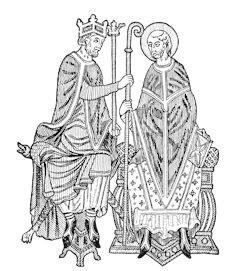
A woodcut depicts a medieval king investing a bishop with the symbols of his position, including his staff, called a crozier.
Philip Van Ness Myers/ReneeWrites via Wikimedia Commons, CC BY
At stake was not merely church administration but sovereignty itself. Bishops were major landholders and political figures; controlling their selection meant controlling wealth, loyalty and governance.
In the push to appoint bishops, popes were insisting that spiritual authority came from the church alone, challenging the idea that kings ruled by unchecked power. It was a decisive attempt to separate spiritual legitimacy from royal control and to place moral constraints on rulers who claimed divine authority.
The Investiture Controversy dragged on for several decades. Finally, in 1122, Pope Calixtus II and Emperor Henry V signed the Concordat of Worms. The agreement granted the pope the right to name bishops and to install their spiritual authority. The emperor, meanwhile, would “invest” them with their “temporalities”: that is, the worldly powers attached to their office, such as land, revenue, jurisdiction and coercion.
Reining in the king
A century later, the Magna Carta pursued a parallel objective.
Its immediate background lay in the conflict over the new archbishop of Canterbury, whom Pope Innocent III had appointed in 1207. King John opposed his choice, prompting Innocent to excommunicate the king and place England under interdict, meaning the English could not participate in church sacraments.
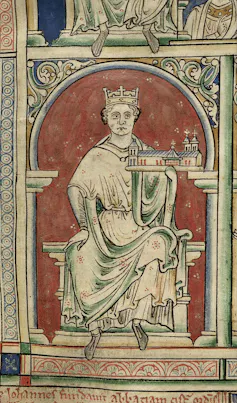
An illustration in the Historia Anglorum, found in the British Library, shows King John of England holding a church.
Fine Art Images/Heritage Images/Getty Images
To appease tensions, John surrendered England to the pope in 1213, turning the kingdom into a papal fief. In return, he received Innocent’s approval for a war against France.
But the arrangement deeply angered English barons, who now found themselves subject not only to their king but also to papal authority. After England’s decisive defeat, John was forced to confront rebellious barons at home.
The result was the Magna Carta, the “Great Charter.” Forced on the king by armed resistance, the document asserted that the king himself was subject to law. It limited royal authority over taxation, justice and punishment, and it famously declared that no free person could be imprisoned or deprived of rights without lawful judgment.
John appealed to the pope, however, who annulled the charter shortly after its issue. Despite this setback, the Magna Carta survived: John’s son Henry III reissued it several times, with its definitive version implemented in 1225.
Taking the long view
Seen in this long perspective, the Trump–Leo confrontation appears less surprising. When a president invokes sacred language or imagery to justify violence, and a pope replies by denying divine sanction, they are reenacting a struggle as old as medieval Christendom: who may speak in God’s name, and who may set limits on power.
The medieval world did not resolve this tension, but it learned to live with it by fracturing authority: first between church and crown, later between rulers and law. What is unsettling today is how easily modern leaders still reach for religious language to evade restraint, and how fragile the institutions meant to check them can appear.
(Joëlle Rollo-Koster, Professor of Medieval History, University of Rhode Island. The views expressed in this commentary do not necessarily reflect those of Religion News Service.)

Original Source: