Sidebar
Religions Around The World
World Religions News
Tarsus diocese restored after more than a century
Texas hospital agrees to end ‘sex-rejecting’ procedures on children and fund detransition clinic
Black church leaders to march in Selma this weekend over Voting Rights Act ruling
(RNS) — Nearly 100 faith and voting rights leaders plan to gather in Selma and Montgomery, Alabama, on Saturday (May 16) as part of a rally in protest of the recent Supreme Court decision that hollowed out a key provision of the 1965 Voting Rights Act.
The “All Roads Lead to the South” rally intends to launch a national movement to counter the ruling’s trickle-down effects on Black Americans’ political power, particularly in Southern states. Organizers expect nearly 5,000 people to attend.
The rally is in response to the April 29 court ruling, which declared Louisiana’s attempt to add a second Black-majority district on its congressional map unconstitutional — effectively gutting the landmark civil-rights era law that prohibits racial discrimination in voting. State legislatures in Tennessee and Alabama have expeditiously redrawn congressional maps in the wake of the decision.
The mobilization event, organized by Black Voters Matter, the National Coalition on Black Civic Participation and the NAACP’s Legal Defense Fund, expects 75 buses of activists from Georgia, Tennessee, Mississippi and other Southern states, with the aim to “channel national awareness, resources, and support to the state and local organizations on the frontlines,” organizers wrote in a press release.
The “No Kings” coalition, which has held three massive national demonstrations in protest of the Trump administration’s policies, plans on joining the rally, and satellite events will be held in Philadelphia; Harrisburg, Pennsylvania; and Poughkeepsie, New York.
The Rev. Bernice A. King, daughter of the Rev. Martin Luther King Jr., will be in attendance, as will the Rev. Jacqueline Lewis, senior pastor of New York’s Middle Church, and Ebonie Riley, senior vice president of the Rev. Al Sharpton’s National Action Network.
King, a lawyer and ordained minister who called the Supreme Court ruling “a shameless assault on Black political power,” said the decision could ignite a surge of mobilization among voting rights activists.
“Every attempt to silence us has only awakened a deeper resolve within us,” she wrote in an email to Religion News Service. “We are the descendants of people who turned oppression into an unstoppable, organized, righteous power.”

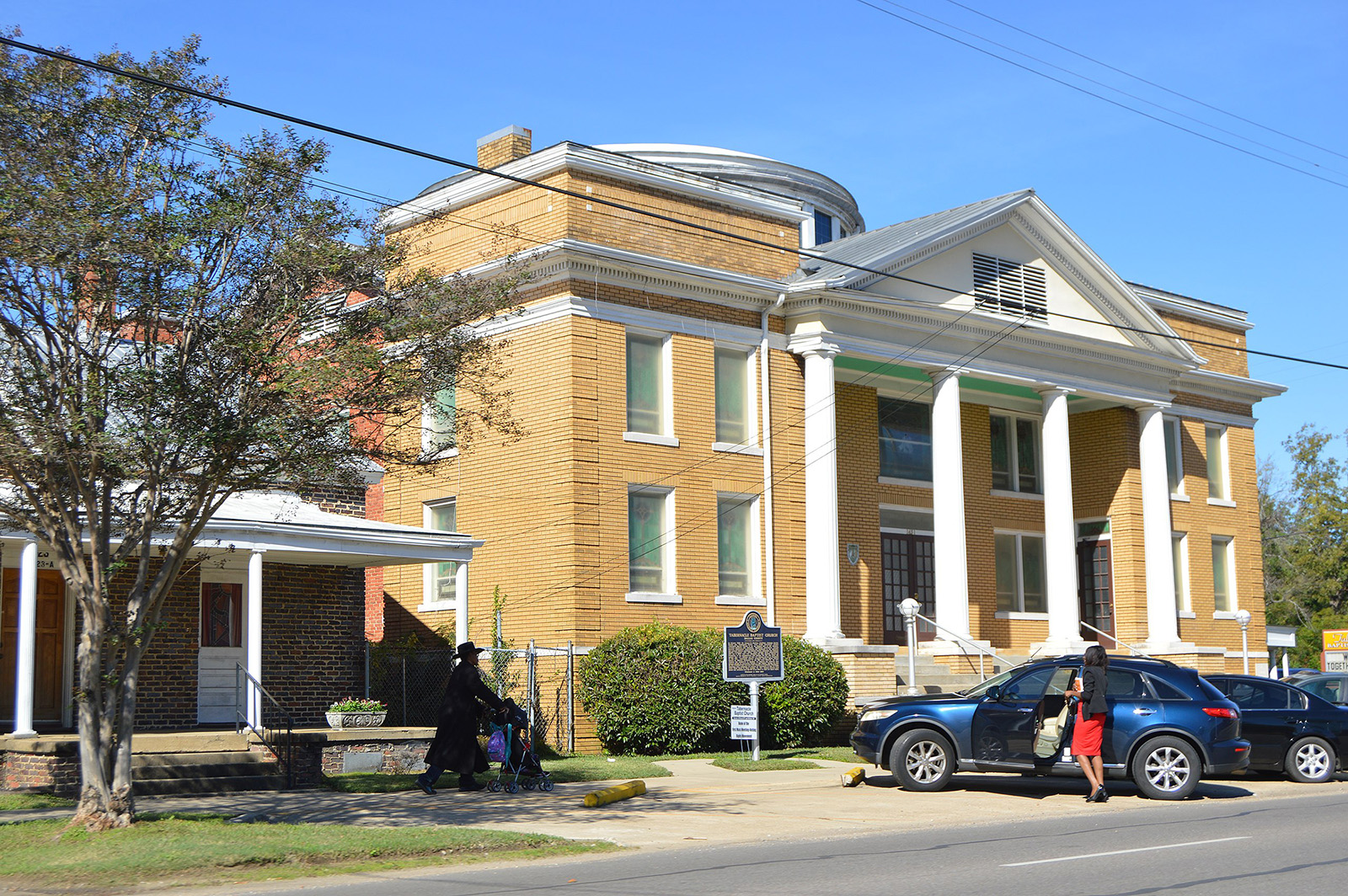
Faith leaders will first gather at Selma’s Historic Tabernacle Baptist Church for a prayer service before marching silently on the Edmund Pettus Bridge and heading to the Alabama State Capitol in Montgomery.
For the Rev. Cece Jones-Davis, a Virginia-based activist and Christian Church (Disciples of Christ) minister, starting the rally in prayer at Historic Tabernacle Church and the bridge places what she referred to as this “particular civil rights journey” within the tradition of civil rights champions who preceded it. The rally, she said, will serve to consolidate the fellowship and mobilization of faith leaders across the country on the voting rights issue.
“We grieve, but we don’t grieve as those who have no hope — no, we’re going to meet the moment and do what’s necessary,” she told RNS in an interview Thursday.
In 1963, Tabernacle Baptist Church hosted the first massive voting rights meeting, while the Edmund Pettus Bridge became the site of Bloody Sunday, when on March 7, 1965, hundreds of demonstrators, including civil rights leader and future congressman John Lewis, tried crossing the bridge before being met with a violent police response. The Rev. Martin Luther King Jr. later led 2,000 marchers across the bridge for a peaceful procession that ended in prayer to avoid confrontation with state troopers.

The Louisiana v. Callais Supreme Court case, in which justices ruled 6-3, with liberal justices dissenting, stemmed from a lawsuit brought before a Western Louisiana court by a group of self-described “non-African American voters” who deemed Louisiana’s decision to introduce a congressional map with two Black-majority districts “racial gerrymandering.” The map was drawn in 2024, after a ruling in a 2022 lawsuit filed by a group of Black voters, who claimed the first map crammed Black voters into a single Black-majority district, compelling the state to draw a new one.
The case, wrote Justice Samuel Alito in his majority opinion, boiled down to whether compliance with the Voting Rights Act’s second section justified intentionally considering race while drawing voting districts. The question, he wrote, had gone “long-unresolved” and had resulted in flawed interpretations of the act. “For over 30 years, the Court has simply assumed for the sake of argument that the answer is yes,” Alito wrote in his opinion.
In early May, the court fast-tracked finalizing its decision, allowing Louisiana to start redrawing a map in time for the midterm election. Justice Ketanji Brown Jackson criticized the decision, saying the court had “spawned chaos” in the state.
Though she called the decision a “real blow” to Black political power, Jones-Davis said she expects today’s movement to tap into lessons and strategies of the 1960s to overcome it.
Pastor Mike McBride, lead pastor at The Way Christian Center, a Pentecostal congregation in Berkeley, California, said gathering in Selma is a way of convening the spirits of Black faith leaders who championed civil rights. The Southern city, he said, “is the hallowed ground of our struggle.”
Before flying from Oakland to Selma on Friday evening, McBride said he will talk with his 96-year-old grandmother and 80-year-old father, who both advocated for civil rights in North Carolina, to learn from their fights and seek advice. He will also fast and pray before the rally to anchor himself in the spirit of the “Black prophetic church tradition.”
“I’ll be bathing myself in both the spirit of my ancestors and progeny,” he said.
The Rev. William D. Watley, a scholar and retired African Methodist Episcopal pastor in Atlanta, said he was in Montgomery to hear Martin Luther King Jr. speak from the Alabama state Capitol steps in 1965, after hopping on a bus from St. Louis, where he was attending college. At 79, he’s not able to return there for Saturday’s event, but he supports it.
“My own participation is one in which I support a younger generation for refusing to accept in their lifetime what my generation, and the generation before me, refused to accept in theirs,” said Watley, author of “Roots of Resistance: The Nonviolent Ethic of Martin Luther King, Jr.”
Jones-Davis said prayerful activism, like that of Black church leaders who campaigned in the 1960s, will help carry the movement.
“Prayer is what, we, as Black church people, have leaned into over and over and over again. It is a part of our tradition to act and pray,” she said. “We’re going to pray from our hearts. We’re going to pray from our history.”
Adelle M. Banks contributed to this story
A horrific Oct. 7 report demands that Jews stop apologizing for their anguish
Warning: This post contains references to sexual violence.
(RNS) — Sitting on my bookshelf at precisely eye level is the saddest book I know. “The Literature of Destruction: Jewish Responses to Catastrophe,” edited by David G. Roskies, who teaches at the Jewish Theological Seminary, is a 700-page anthology of Jewish literary responses to persecution, from the Bible through the Holocaust.
The book consists of sacred text, poetry, fiction, memoirs and art. Its constant theme is, what did it mean for Jews to record, to remember and to return to some semblance of sanity after the catastrophes that faced our people?
But for the past two days, I have been reading a document that challenges the Roskies volume in its impact. A recently released 300-page report by an Israeli researcher commission on the sexual and gender-based violence during the Oct. 7, 2023, Hamas-led attacks on Israel and against hostages held in Gaza is a modern book of Lamentations.
The report’s central conclusion: Hamas’ acts of sexual violence were not merely isolated incidents coming from bad actors. Rather, those actions were systematic, widespread, deliberate and integral to the attack itself — a coordinated tactic used to terrorize victims, families, communities and Israeli society at large.
How do you document such a thing? With 10,000 photographs and video segments; more than 1,800 hours of visual material; more than 400 testimonies from survivors, witnesses, released hostages and experts; and pages upon pages of endorsements from authorities, all over the world.
The report shows that there were 13 recurring patterns of sexual violence, including rape, gang rape, sexual torture and mutilation, executions linked to sexual violence, postmortem sexual abuse and assaults committed in front of family members, for which they needed to invent a new word — kinocide, the systematic targeting, torture and destruction of families as a unit.
Those sadistic assaults happened in homes, on roads, at the Nova music festival and on military bases. They happened to hostages in the tunnels of Gaza. The report establishes that these acts constitute war crimes, crimes against humanity and genocidal acts under international law.
That is as far as I can go before I retreat into silence.
People often say that Oct. 7 was the worst day in Jewish history since the Holocaust. But, in some qualitative respects — not quantitative — it was even worse than the Nazi atrocities.
The Holocaust began with the Einsatzgruppen, German death squads that rounded up Jews in Eastern Europe and shot them. The Einsatzgruppen and auxiliary police often shot women, children and entire communities at close range, sometimes for days on end, which frequently led to psychological distress, breakdowns, heavy drinking and even suicides among the perpetrators.
But after the Wannsee Conference, which planned the “Final Solution,” the Nazis sought to streamline their process of genocide and make it more efficient. The gas chambers meant that there would be physical and psychological distance between the killers and their victims.
Oct. 7 was different. There was no “efficiency” here. The killings were personal. Hamas terrorists had to look into the eyes of their victims before killing them. It more closely resembles the savage acts of the Cossacks than those of the Nazis. It was killing, raping and mutilation for its own sake.
The Nazis also sought to hide their crimes. Not so Hamas: Hamas photographed, filmed, recorded — often on the victims’ own phones — and gleefully and proudly uploaded the crimes, sadistically showing them to victims’ families.
Many of you will say, but what about what Israel did in Gaza and Lebanon? What about Netanyahu, Smotrich and Ben-Gvir?
Many Jews have felt the need to begin conversations about Israel with the requisite confession of sins of the Jewish state. It goes something like this: “Of course, I disagree with the current government, but … ” For some Jews, every day has been Yom Kippur, and that includes me. I cannot begin to count how many conversations I have had with friends that go precisely that way.
But I am done prefacing my grief with a performative critique of my own people in order to earn some kind of moral goodie bag. I will not condemn Israel as a ticket to the right to condemn what Hamas did.
Consider the timing of Nicholas Kristof’s recent New York Times column describing sexual abuses in Israel’s prisons. It would have satisfied those who relish wagging their fingers and saying: “You Jews think that Oct. 7 was a horror. Look at what Israel/Jews do.” But what would they say about the Oct. 7 report?
When people accuse Israel of genocide, they ignore the official, legal definitions of genocide. At best, it is because they have allowed their feelings to take over; they lack a word for what they are seeing in Gaza.
But, at worst, they are saying something worse: “You grandchildren of genocide victims — that is precisely what you are doing. You’re as bad as we are.” And, in this context, “we” often means Europeans, who are using Israel’s actions as a way of exculpating the sins of their continent (for which they are not responsible anyway).
Any psychology major can tell you what this is: displacement.
And some will ask, “Playing the victim card, Jeff?”
No. The state of Israel was born, in part, to let the Jewish people permanently tear up that card. The trauma of Oct. 7 left a massive hole in our soul. And that hole does not get more shallow — it only gets deeper. We will no longer be victims, either to actual violence or the moral violence others inflict upon us.
I think of the students at Columbia University and other places who were reported chanting: “Red, black, green and white, we support Hamas’ fight!” and “Hamas we love you. We support your rockets too.” I think of members of the so-called intellectual class and A-list celebrities who equivocate on the crimes of Hamas and who proudly sport kaffiyehs as a fashion statement.
I am so done with them, because so-called sophisticated people, and the cool kids, can also be savages.
The Catholic Church's response to AI — so far
The US is not a nation-state, much less a Christian one
(RNS) — George Orwell famously defined nationalism as “the habit of identifying oneself with a single nation or other unit, placing it beyond good and evil and recognizing no other duty than that of advancing its interests.” But what exactly is a nation?
The term derives from the Latin natio, meaning breed or species, and was adopted in medieval universities to organize students coming from different places. (At the University of Paris, the principal nations were French, Norman, Picard and English-German.) In due course, the term was applied to entire populations, but geography alone did not suffice to establish national identity. What also counted (or could count) was your native language, your ethnicity or ancestry, and your religion.
Countries defined in terms of a single nation thus came to be called nation-states. A significant dimension of 19th-century nationalism was the desire on the part of nations that lacked a country of their own to have one.
After World War I, various nations in Central and Eastern Europe that had been part of multinational empires, like Russia and Austro-Hungary, were enabled to establish nation-states — Poland for the Poles, Hungary for the Hungarians, Lithuania for Lithuanians, etc. In our time, the breakup of the Soviet Union created comparable nation-states like Kazakhstan, Uzbekistan and Tajikistan.
But what of the people in a given nation-state who belonged to a different nation — Ukrainians or Germans or Jews, for example, living in interwar Poland? They could express their national identity through their own (sometimes state-supported) educational and cultural institutions, and with representation in governmental bodies.
All this is at odds with how the United States has defined itself. Within our borders the only nations in the European sense are Native Americans, many of whom have territory and laws of their own and who in fact identify as nations.
If, in the words of the Pledge of Allegiance, we are “one nation,” it’s because of the terms laid out in our founding documents. Or as Supreme Court Justice Neil Gorsuch told New York Times columnist David French the other day, “We’re a creedal nation, right, David? I mean, we don’t share a religion, we don’t share a race, we share an idea, OK?”
To be sure, many Americans identify with a particular ethnic or racial community, a religious body or a country of origin. And while they are not identified as separate nations, they may be considered adherents of separate nationalisms.
Before the fall of the Soviet Union, there were Ukrainian nationalists raising money for an independent Ukraine. Zionists — Jewish nationalists — support the state of Israel as the Jewish homeland. Black nationalists reject integration in favor of self-determination, economic empowerment and racial solidarity.
Such nationalisms relate to the interests or aspirations of minorities of the population. It’s something else entirely when nationalist claims are made on behalf of the majority. These have to do with defining the United States itself.
Christian nationalism thus has to do with advancing the claim that Christianity has special standing in the country. As religion scholar Jerome Copulsky makes clear in a fine essay on this site, the desire to do so has a long history, in large part because the framers of the Constitution went a long way toward making sure that wasn’t the case — rejecting religious tests for office, barring religious establishments and guaranteeing religious free exercise.
According to White House faith adviser Paula White-Cain, Sunday’s daylong federally underwritten Jubilee of Prayer, Praise & Thanksgiving on the National Mall is about “rededicating the country to God.” The thing is, our nation wasn’t dedicated to God in the first place.