(RNS) — Shortly after the Rev. Paul Joseph Keller, two fellow Catholic priests and a nun were ushered into the Broadview Immigration and Customs Enforcement facility outside Chicago on Thursday (April 2), a guard escorted five immigrant detainees to a space on the other side of a half-door. All were bound with shackles, Keller said. When he asked the guard, who was employed by a private company, if the shackles were necessary, the official apologized, explaining it was the result of being short-staffed.
Keller and his colleagues then looked into the eyes of the detainees — some of which, he said, welled with tears — and did what they came to do: lead a brief, 15-minute Holy Thursday service, complete with prayers, Scripture readings and a reflection. As they concluded, one priest was allowed past the door, where he washed the immigrants’ feet, an ancient Christian ritual.
Speaking to Religion News Service later that day, Keller said the experience of leading the service, which was repeated three times during their visit for a total of 14 detainees, was difficult. But he hopes “seeing the presence of Christ in the prisoner and the stranger” will have an impact not only on those they worshipped with, but also “the people who can witness to it.”
“This is what Jesus has called us to do,” said Keller, a missionary priest.
It was only the second time faith leaders have been allowed into the Broadview facility since President Donald Trump’s administration began barring their entry amid the government’s ongoing mass deportation effort. Clergy access to immigrant detainees has emerged as a major issue in Illinois as well as in Minnesota, where faith leaders were also repeatedly halted by federal officials when they attempted to provide pastoral care and religious rites to detainees held at the Bishop Henry Whipple Federal Building near Minneapolis.
But after months of protests, lawsuits and even public criticism of the U.S. government from Pope Leo XIV, religious leaders in both states were finally granted access to detainees over the past month — both as the result of court orders as the cases continue. In the last week, faith leaders were offered some of their first glimpses into the facilities, making use of a degree of access denied to most people, including members of Congress.

A federal judge ordered the government to allow faith leaders into the Minneapolis-area Whipple building on March 20, and a week later, the Revs. Susie Hayward and Kelly Gallagher were the first faith leaders to enter the building to offer pastoral care. Five men who, according to Hayward, were in the process of being deported accepted their offer, and the two pastors — both ordained within the United Church of Christ — were escorted downstairs to meet them.
They found the men in shackles. Some, Hayward said, were experiencing “spiritual anguish” — especially those separated from their families and children.
“Some of them were Minnesota residents, some had been living in other parts of the country and were put on a flight and brought to the Whipple building in Minnesota,” said Hayward, who denied access to the Whipple building in January. “We were able to pray with them, offer a blessing, hear their stories and their names — and to cry with them.”
Gallagher — who serves as associate conference minister of the UCC’s Minnesota Conference, a plaintiff in the lawsuit — said the moment was mixed with gratitude, camaraderie and “open grief.”
“One person that I met with actually wept,” she said. “There were tears, there was laughter, there was prayer.”
The moment provided a stark contrast to what took place on Thursday, when faith leaders gathered outside Whipple in an effort to offer a Holy Thursday service to immigrants inside. After conducting a worship service outside the facility, Gallagher and representatives from other traditions who are part of the ongoing lawsuit — Bishop Jen Nagel of the Minneapolis Area Synod of the Evangelical Lutheran Church in America, and the Rev. Christopher Collins, a Jesuit priest — entered the building and asked to see detainees.

However, Gallagher said an official told the group there were no detainees inside. In response, the trio of religious leaders prayed with the official before beginning to leave and ran into a family waiting for a lawyer before an immigration court appointment. The faith leaders decided to stay with the family to offer support.
The reason for the apparent absence of detainees at Whipple on Thursday is unclear. Although the Trump administration has reduced the number of Department of Homeland Security agents in Minnesota from its height of 4,000 or more — a shift that came after weeks of protests and the public killings of two U.S. citizens by DHS agents — outgoing DHS Secretary Kristi Noem told members of Congress last month that at least 650 agents were still in the state.
Gallagher said officials told them at least 20 detainees were there when she visited Whipple that first Friday. But Hayward said the other four times faith leaders have attempted to offer pastoral care at the facility since the injunction was handed down — including on Holy Thursday — officials have given a different answer.
“Every visit subsequent to that first one, we have been told that there are no folks detained inside,” Hayward said.
Catholic leaders in Illinois encountered a similar situation in February at the Broadview facility when a judge allowed religious leaders to enter on Ash Wednesday. When they arrived, officials told them no detainees were present — so the faith leaders waited somewhere between one to two hours until a small group of detainees were eventually brought to the facility.
Keller said he and his fellow faith leaders intend to show up at Broadview each day through Easter, taking advantage of the small window when the judge has ordered the government to allow them into the facility. But Keller said the temporary measures are inadequate.
“This is not enough,” he said. “We should be able to go to their cells and to be able to approach them individually to either give them Scripture or pray with them. I have done detention ministry in all kinds of facilities all around the country for many years — that is just standard practice.”
DHS did not immediately respond to a request for comment on this story. But in court filings and past statements, the agency has maintained it is adhering to an internal policy: namely, that clergy are allowed to visit detention facilities, but Broadview and Whipple are a processing center and a field office, respectively — places where immigrants are only held for a short time.
“It is not within standard operating procedure for religious services to be provided in a field office, as detainees are continuously brought in, processed, and transferred out,” a DHS spokesperson told RNS last month, referring to the Whipple building.
But Keller, Hayward, Gallagher and lawyers representing religious groups have disputed those claims. Attorneys have noted Catholic leaders were previously allowed at least some access to the Broadview facility, and parties in both cases have pointed to evidence that immigrants were held in the facilities for days on end at the height of mass deportation operations in the Chicago and Minneapolis regions — not just for short-term processing.
Faith leaders have also challenged Trump’s assertion that those detained as part of the mass deportation effort are the “worst of the worst.” Gallagher pointed to a new analysis of government data by The Intercept, which concluded that roughly two-thirds of those arrested by ICE in Minnesota during Operating Midway Blitz had no criminal background.
And Hayward said she found the government’s efforts to deny faith leaders access to detainees particularly offensive given that the Trump administration has framed itself as a champion of religious people.
“This government, that claims to be a defender of religious freedom, has been violating the religious freedom rights of so many of us to be able to respond to the call of Jesus to care for the captives,” she said.
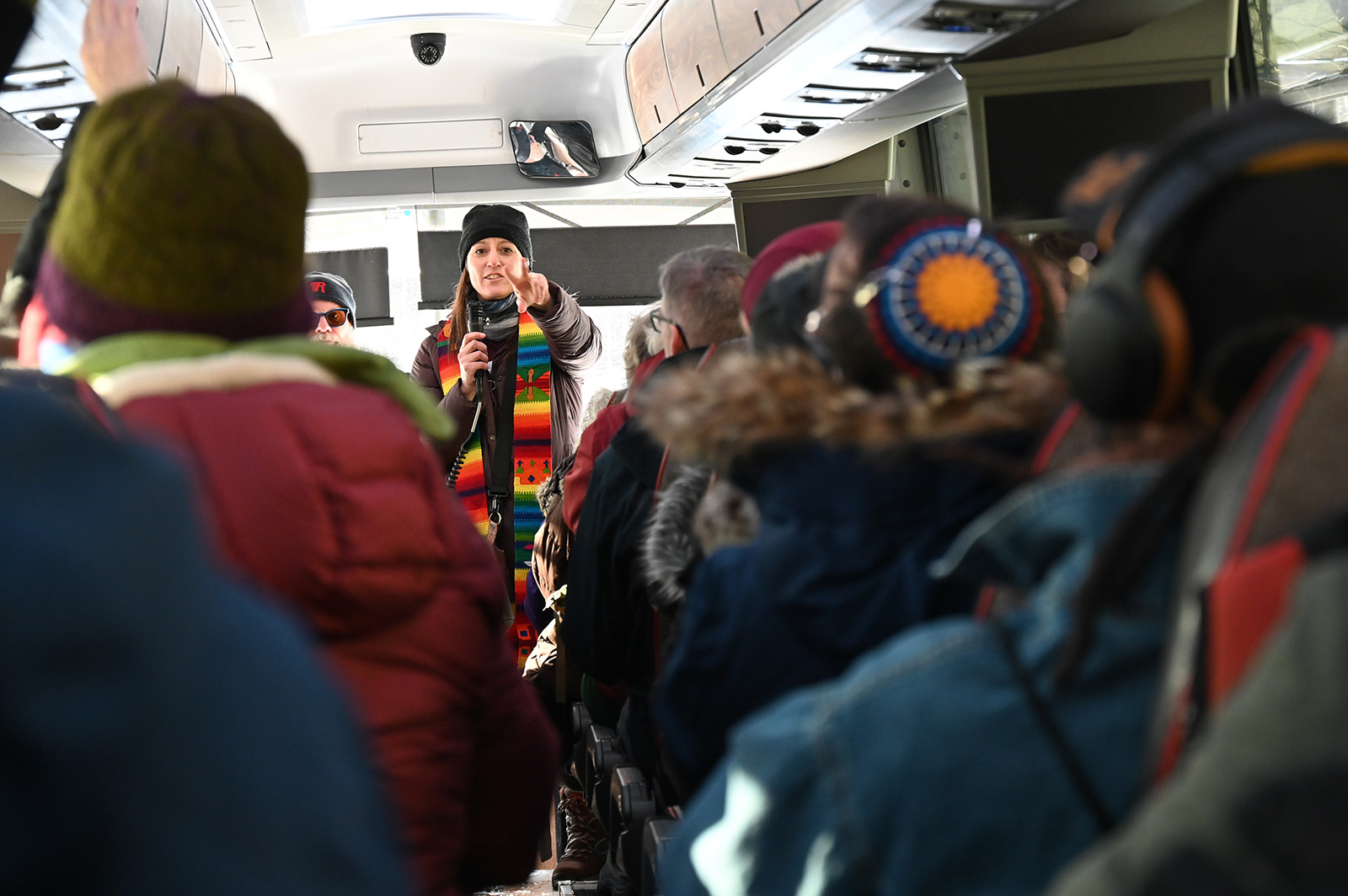
The visits come amid other efforts to draw attention to the plight of immigrants during the Christian celebration of Holy Week. On Friday, around 150 people, including faith leaders and activists, made a 10-mile pilgrimage from Montclair, New Jersey, to Delaney Hall, a 1,100-bed ICE detention facility in Newark.
The event was organized by Pax Christi New Jersey, a Catholic peace movement that has maintained an ongoing presence outside Delaney Hall since shortly after the facility reopened last May.

“That’s the essence of Lent — to make a sacrifice, and hopefully carry that forward throughout the year,” said Kathy O’Leary, the regional director of Pax Christi New Jersey. “Giving up an entire day to do something difficult, like walking 10 miles, is a very public way to draw attention to an issue and to people who are marginalized and oppressed.”
Clergy have been able to access the New Jersey facility, and Cardinal Joseph Tobin, the archbishop of Newark, led Ash Wednesday services for detainees there in February. But critics say pastoral care is still inadequate, which has pushed detainees to organize their own religious services. O’Leary said she heard from one of the visitors to the facility — typically family members of those inside — that detainees had been organizing an unofficial prayer service at 3 p.m. inside the facility’s walls.
Back in Minnesota, Hayward said she and other faith leaders intend to keep trying to offer pastoral care to immigrants, whether or not it coincides with major religious holidays. She recalled Matthew 25, when Christ urged disciples to visit those in prison. But the significance of offering what care she can to immigrant detainees during Holy Week — when Christian tradition teaches that Jesus Christ was tried, convicted, detained and then killed before his eventual resurrection — is not lost on her.
“State violence, unlawful incarceration, unjust detention is what Jesus experienced on Maundy Thursday,” Hayward said. “He was ripped from his community and his family and was put in prison.”
She added: “To be prevented from doing this just fundamental aspect of our faith, of our calling, of our ministry — that makes me so angry.”
Fiona Murphy contributed to this report.
 Notable people and events in the Jewish LA community.