Sidebar
Religions Around The World
World Religions News
Pope Leo uses Spain visit to press Europe on abortion, migration and peace
MADRID (RNS) — In an historic address to the Spanish Parliament on Monday (June 8), Pope Leo XIV gave, by his description, “a calm and firm word” for the respect of human life, from the unborn, to migrants and the elderly. Experts say his message is meant to be a warning to all of Europe.
Human existence is threatened by a “throwaway culture,” Leo said, echoing the words of his predecessor Pope Francis. Leo questioned what future a society that disregards human life can have. “Can a community that casts into the shadows the unborn child, the elderly, the sick, those who suffer in silence, or those who depend entirely on the care of others be called fully just?” he asked.
Defense of human life is not a particular or religious interest, Leo said, “it is a goal of civilization.”
“Every human life must be recognized and safeguarded from conception to its natural end, in every circumstance of its existence,” the pope said, adding that through this principle “the moral greatness of a nation is manifested.”
Spain is among the most socially liberal countries in Europe. Though historically Catholic — and with a majority of Spaniards still self-identifying as Catholic (around 55%) — regular church attendance is far lower and a growing share of the population identifies as atheist, agnostic or unaffiliated. The country is considering following in the footsteps of France and making a Constitutional amendment to protect abortion rights. In 2021, during the Covid-19 pandemic, Spain also legalized euthanasia and medically assisted dying.
Madrid was the first stop in Leo’s weeklong visit to Spain (June 6-12), before traveling on to Barcelona and the Canary Islands. His speech in front of the assembly of Spanish lawmakers, known as Las Cortes, was followed by a 7-minute standing ovation and represented a “historic moment,” according to the editorial director of the Spanish Radio station COPE, José Restán, because no pope had addressed the country’s parliamentarians directly before.
“The pope comes there and speaks to everyone,” Restán said. “I think that from Spain the pope can send a message to all of Europe.”
He pointed to migration, in particular, as many European countries face political tension over immigration policies. This year, the Spanish left-leaning government approved a plan to give legal status to 500,000 undocumented migrants and in 2024 the country naturalized more than 250,000 foreign residents.
“Migration is a reason for strong division and can be used by one side and the other in the next elections,” Restán said. About 9.5 million immigrants live in Spain, about 20% of its nearly 50 million inhabitants, according to Spain’s National Statistics Institute. Most hail from Morocco, Colombia, Romania, Venezuela and Ukraine.
In his speech, Leo framed the migration question as a “moral and legal” issue, stating that discrimination against migrants is a violation of the universal principles of equal human dignity for all. The pope said there are two main issues that must be addressed: creating legal pathways to citizenship with the promotion and integration of migrants in society; and ensuring that people can remain in their native countries by providing safety, dignity and peace.
“A coordinated, supportive, and effective response is indispensable, one capable of guaranteeing protection, welcome, and real opportunities for integration to those who migrate,” Leo said.
Peace was another central theme of the pope’s speech. “It is therefore a cause for concern that, in various parts of the world, and in Europe as well, rearmament is once again being presented as an almost inevitable response to the fragility of the international situation,” he said.
Security, he added, can be achieved thorough “justice, patient dialogue, respect for international law.” The lives of people should take precedence over interests that profit from war, he said. Leo condemned the use of artificial intelligence being used in warfare, stating that lethal action must remain a human responsibility.
Pedro Sanchez, the center-left Prime Minister of Spain, has made the country one of Europe’s loudest voices against the U.S. war on Iran, calling it “unjustifiable” and “illegal.”
While the Catholic Church in Spain has collaborated with Spain’s current government on some issues, there has been friction between the church and state. “On issues such as migration, war and other questions, it may seem that there are points of agreement between some of the statements made by this government and those made by the church,” said Archbishop Luis Argüello of Valladolid, President of the Spanish bishops’ conference.
But on life issues, the archbishop said, the church and Sanchez couldn’t be further apart. “The key to everything is how you conceive of a person,” he said, reaffirming the church’s stance against abortion and euthanasia.
“What is important is that whatever proposals are made, the person be cared for in his or her dignity,” Argüello said.
Leo’s speech started with a lengthy preamble on the history of Spain as a place of culture and science. He mentioned the School of Salamanca, a group of jurists and theologians who in the 16th century laid the groundwork for human rights and international law.
He underlined the need to ensure religious liberty as a “decisive issue for any truly democratic society.” Leo called for respect for families who have a right to choose the education of their children based on their moral, cultural and religious convictions. Spain’s goverment has sought to reduce the role of religion in public schools, which has led to tensions with the local church.
He also appealed for legal protections for the sacramental seal of confession, which has been the subject of debate in some European countries in the aftermath of the sexual abuse crisis.
In the highly polarized political debate in Spain, there is a risk that the pope’s words will become political tools in the weeks to come, said Rafael Rubio, the communications coordinator of the Spanish organizers of the papal trip. “But the message of the pope is too important and had to be made,” he added.
Leo acknowledged the divisions within Spanish society, reflected in many Western countries, and repeated his appeal to “disarm language” and promote a society centered on dialogue and diplomacy.
A quarter of Irish Gen Z will have no children, new report says
I’m in Northern Israel, Reading About Iranian Missiles Coming Our Way
 Maybe hiding the fear was my own personal missile which I sent to the Jew-hating murderers in Tehran.
The post I’m in Northern Israel, Reading About Iranian Missiles Coming Our Way appeared first on Jewish Journal.
The Fearless Democratic Downfall
 Democrats are not only endorsing and choosing quasi-Nazis and actual Islamists at the ballot box. They seem to have also adopted their suicidal tendencies.
The post The Fearless Democratic Downfall appeared first on Jewish Journal.
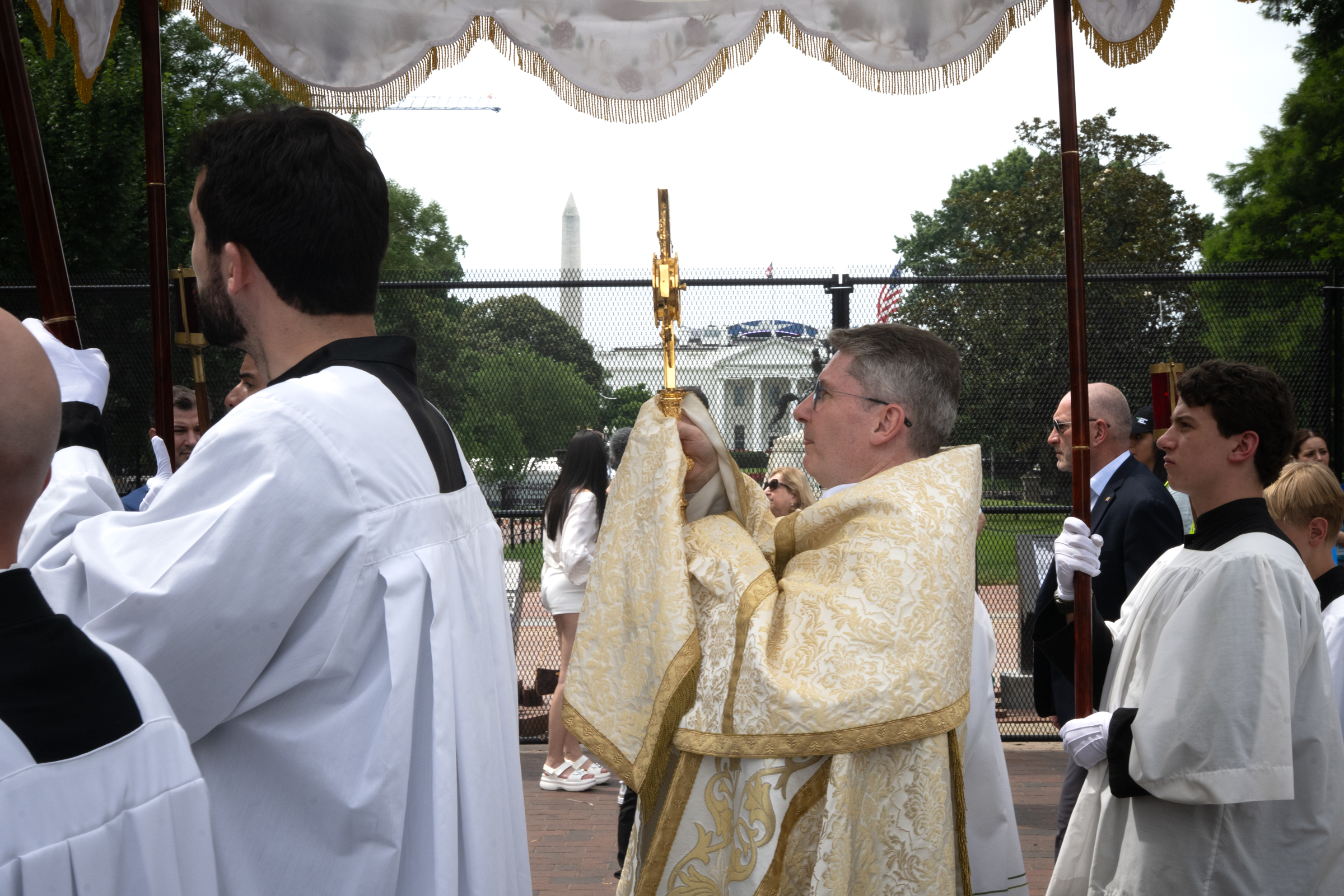
Over 1,000 people process with Jesus Christ in the Eucharist through Washington, D.C.
Pope Leo tells secular Spain not to leave Catholic faith in the ‘museum of the past’
MADRID (RNS) – Over 1.2 million people gathered at Plaza de Cibeles in Madrid on Sunday (June 7) to catch a glimpse of Pope Leo XIV celebrating Mass and leading the Corpus Christi procession, a major celebration where the Eucharist is paraded through the streets.
During his homily, Leo urged Catholics to “remember” and “return” to their faith, using the procession as an opportunity to renew Catholic beliefs in a secularized Spain.
“The task of Spain,” Leo said, is “to ensure that the religiosity which has shaped and defined this country for centuries is not a museum of the past to be visited, but a school of faith from which to draw even today.”
Embracing faith means drawing away from “our selfishness and indifference, of a comfortable, private faith,” he continued. Only this way can Catholics become “builders of a new world,” he said.
The event occurred on the second day of the pope’s week-long trip to Spain, the first major European destination of his pontificate.
While the majority of Spaniards still identify as Catholic, only about 17 to 19% are practicing, while the number of those who identify as nonreligious is growing, according to surveys by the Spanish polling Center for Sociological Research.
But piety in Spain may be witnessing a resurgence. “Corpus Christi and Holy Week continue to be something in Spain that is growing, not declining,” said Sara de la Torre, spokesperson for the Archdiocese of Madrid.
Holy Week processions surrounding Easter continue to draw crowds, with the city of Malaga counting over 2.6 million visitors in 2025 — almost a 23% increase over 2023. Corpus Christi celebrations remain more local, with Toledo hosting the country’s most symbolic celebrations.
“It is always said that (religious processions are) a bit folkloric, a bit formal, a bit cultural, but that the substance is missing. But this is not entirely true,” said José Restán, editorial director of the Spanish Catholic radio station COPE. “Popular religiosity, especially in the south, is a bulwark against secularization.”
Leo celebrated Mass in front of the one of the largest crowds of his pontificate in a square in the political, cultural and economic center of Madrid. A large choir accompanied the celebration. During the procession, a group of priests, lay people, children who had their first communion this year, and all the cardinals and bishops in attendance, accompanied Leo and the Eucharist.
A carpet of flowers paved the entire path of the procession and bystanders threw petals as it passed by.
“Here in Madrid, as in many other parts of Spain, Corpus Christi is more than just another celebration on the liturgical calendar,” the pope said in his homily. “It is a way of returning to the heart of the faith to renew our love and fidelity to God.”
He said that the procession “is not an exhibition, a remnant of folklore or a simple display of beauty,” but an opportunity to “remember precisely so as not to forget who the Lord is” and to “return to him with sincere love.”
For de la Torre, the papal celebration represented something “historic” and the most important stop in the pope’s visit to Spain. “We are aware that the secularized society in which we find ourselves receives the pope perhaps as someone who can confirm people in the faith and encourage others,” she said.