Sidebar
Religions Around The World
World Religions News
Trump attacks Pope Leo for preaching peace
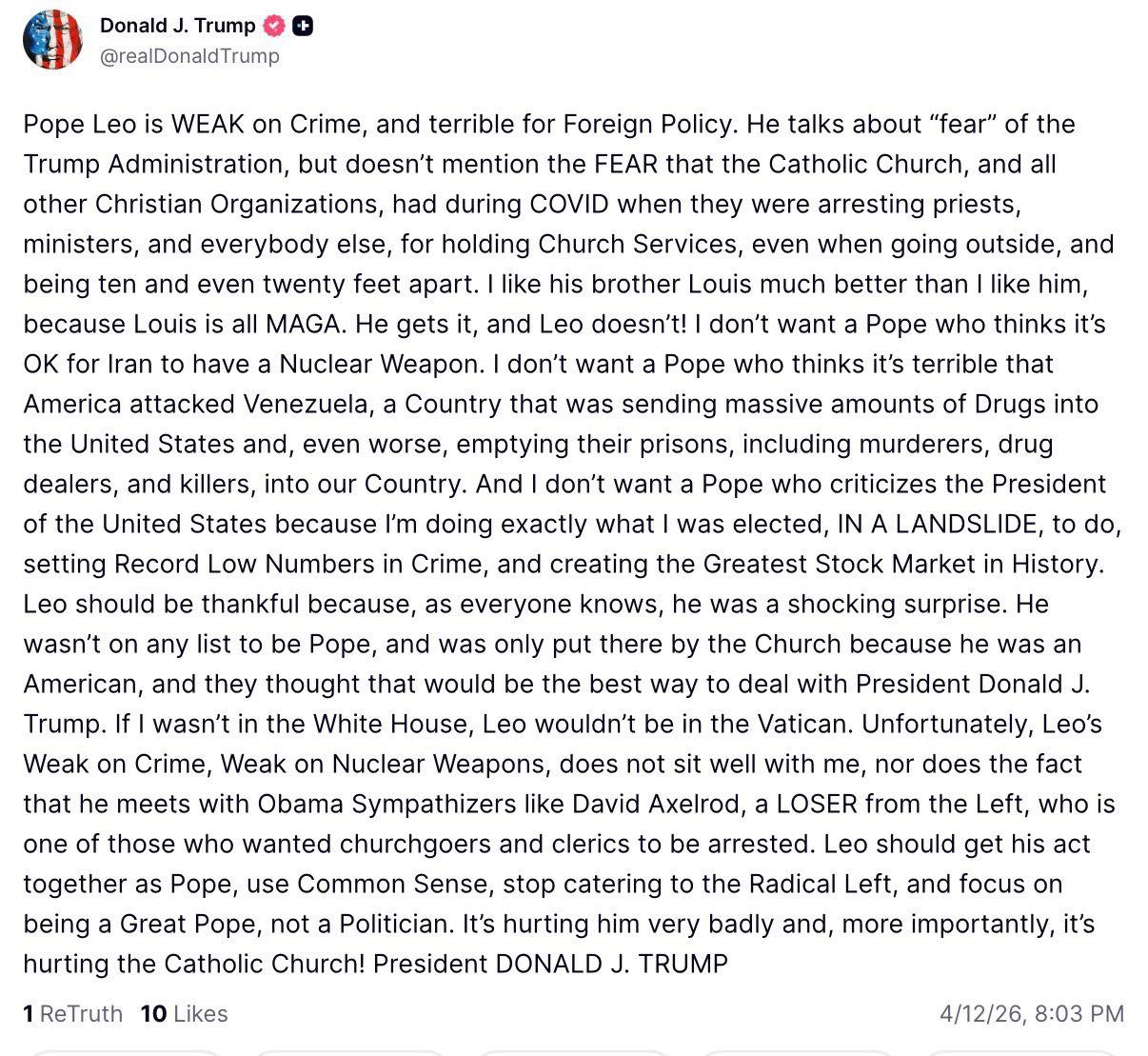
(RNS) — President Donald Trump has attacked Pope Leo even though the pope has gone out of his way not to mention the president when urging nations to avoid war and embrace peace.
“The things that I say,” said the pope, “are certainly not meant as attacks on anyone. The message of the Gospel is very clear: ‘Blessed are the peacemakers.’”
But true to form, Trump took the comments personally and fired back his own. It was not a surprise; this is how the president treats all who do not support him.
“I’m not a fan of Pope Leo,” announced the president. The pope is not “doing a very good job,” said the president. “He’s a very liberal person” and should “stop catering to the Radical Left.”
“Pope Leo is WEAK on Crime, and terrible for Foreign Policy,” the president wrote in a social media post. “I don’t want a Pope who thinks it’s OK for Iran to have a Nuclear Weapon.”
Nor was it surprising that the president posted his attack around the same time that three American cardinals were praising Pope Leo and attacking the war on CBS’ “60 Minutes.” Trump cannot stand being upstaged.

The pope, on the other hand, at a prayer vigil at St. Peter’s Basilica on Saturday (April 11), did not name names when he urged an end to war.
Pope Leo prayed for peace and described the kingdom of God as “a kingdom in which there is no sword, no drone, no vengeance, no trivialization of evil, no unjust profit, but only dignity, understanding and forgiveness. It is here that we find a bulwark against that delusion of omnipotence that surrounds us and is becoming increasingly unpredictable and aggressive.”
He noted that “war divides; hope unites. Arrogance tramples upon others; love lifts up. Idolatry blinds us; the living God enlightens.”
“Enough of the idolatry of self and money!” the pope cried. “Enough of the display of power! Enough of war! True strength is shown in serving life.”
To the leaders of nations, he said, “Stop! It is time for peace! Sit at the table of dialogue and mediation, not at the table where rearmament is planned and deadly actions are decided!”
At a Mass for Peace on the same day, Cardinal Robert McElroy of Washington, D.C., did not mince words: “We are in the midst of an immoral war. We entered this war not out of necessity but rather choice. We failed to ardently pursue the pathway of negotiation to its end before turning to war.
“We had no clear intention,” said the cardinal, “instead darting from unconditional surrender to regime change to the degradation of conventional weapons to the removal of nuclear materials. And we blinded ourselves to the cascade of global destructiveness that would likely flow from our attacks — the expansion of the war far beyond Iran, the disruption of the world economy, and the loss of life.”
“Each of these policy failures,” explained the cardinal, “is equally a moral failure, which, under Catholic just war principles, renders both the initiation of this war and any continuation of it morally illegitimate.”
The cardinal went on to say, as citizens, “we must advocate for peace with our representatives and leaders.
“For it is very possible,” he noted, “that the negotiations will fail because of recalcitrance on one or both sides, and our president will move to reenter this immoral war. At that critical juncture,” he continued, “as disciples of Jesus Christ called to be peacemakers in the world, we must answer vocally and in unison: No. Not in our name. Not at this moment. Not with our country.”
In John’s Gospel, the first words of risen Jesus are “Peace be with you.” But this peace is not a peace of stillness, it is not a peace of sleep. Immediately after wishing the disciples peace, Jesus says, “As the Father has sent me, so I send you.”
As Christians we have the same mission as Jesus had from his Father. That mission is to spread the good news of the Father’s love, of the Father’s mercy and forgiveness. Our mission, like that of Jesus, is to help establish the kingdom of God, a kingdom of justice, of peace and of love.
The pope will continue to preach the gospel of peace.
In response to the president’s attacks, Pope Leo told reporters on the papal plane on the way to Algeria, “I’m sorry to hear that, but I will continue on what I believe is the mission of the church in the world today.
“I will not shy away from announcing the message of the Gospel and inviting all people to look for ways of building bridges of peace and reconciliation, and looking for ways to avoid war any time that’s possible.”
The pope added: “I’m not afraid of the Trump administration or of speaking out loudly about the message of the Gospel, which is what the church works for.
“We are not politicians. We do not look at foreign policy from the same perspective that he may have,” the pope said. “I will continue to speak out strongly against war, seeking to promote peace, promoting dialogue and multilateralism among states to find solutions to problems.”
“Too many people are suffering today,” explained the pope. “Too many innocent people have been killed, and I believe someone must stand up and say that there is a better way.”
Trump’s attack on Pope Leo is counterproductive. He could never have been elected president without Catholic voters. But his attack has united the Catholic bishops and encouraged them to publicly side with the pope against the war.
Even Catholics who voted for Trump will not be happy. It will give them one more reason (besides the war, ICE attacks on law-abiding immigrants and the price of gasoline and food) to question their support of Trump and Republican politicians. Hardcore Trump supporters will stick with the president, but others will decide this is not what they voted for.
Russia and Ukraine accuse each other of violating Putin’s Easter ceasefire
KYIV, Ukraine (AP) — Russia and Ukraine accused each other of violating a Kremlin-declared Easter ceasefire Sunday, as Orthodox Christians gathered to celebrate the holiday despite Moscow’s 4-year-long war against its neighbor.
Russian President Vladimir Putin on Thursday declared a 32-hour ceasefire over the Easter weekend, ordering Russian forces to halt hostilities from 4 p.m. on Saturday until the end of Sunday. Ukrainian President Volodymyr Zelenskyy promised to abide by the ceasefire, but warned there would be a swift military response to any violations.
The General Staff of Ukraine’s armed forces said in a statement Sunday that it had recorded 2,299 ceasefire violations by 7 a.m., including assaults, shelling and small drone launches. It said that the use of long-range drones, missiles or guided bombs had not been reported.
A Ukrainian military officer told The Associated Press on Saturday that Russian forces had continued to attack their positions.
Russia’s Defense Ministry also said Sunday it had recorded 1,971 ceasefire violations by Ukrainian forces, including drone strikes. The head of Russia’s Belgorod region, Vyacheslav Gladkov, said Sunday that rescuers uncovered the bodies of two civilians who were killed in a Ukrainian attack on Saturday afternoon.
Ceasefire skepticism
Outside Kyiv, thousands gathered at an open-air national heritage park to celebrate Easter despite skepticism that a truce would hold.
Worshippers clustered outside wooden churches to take part in the annual blessing of baskets for the holiday table. Families carried dyed eggs and paska cakes baked the night before, while many women wore colorful scarves. Some waited for the blessing as others picnicked on the grass.
Irena Bulhakova expressed her doubts over prospects for peace, especially as previous attempts to secure ceasefires have had little or no impact. “Every time a ceasefire is announced for a holiday, the shelling continues regardless,” she said.
But she still reflected on the holiday’s meaning: “Good triumphs over darkness, and we hope for that very much.”
Father Roman, a Ukrainian army chaplain who led the blessing ceremonies, described Easter as a moment of faith shared by Ukrainians in their identity and future.
“We are defending our borders. We are defending our identity,” he said. “We are a free people who live on this territory. We have faith, deep traditions and historical heritage. It’s all about the identity of Ukrainians.”
Meanwhile, Ukrainian President Volodymyr Zelenskyy and his wife Olena spent Sunday visiting children who has lost parents fighting in the war.
“They greeted us with smiles that are priceless. We must do everything so that the children of those who made the ultimate sacrifice for Ukraine never lose faith in the world,” Zelenskyy wrote in an online post.
___
Follow AP’s coverage of the war in Ukraine at https://apnews.com/hub/russia-ukraine
80 years later, scholarship is breaking silence on women’s suffering and strength at Treblinka – including their role in its uprising
(The Conversation) — Adek Stein – a Holocaust survivor from Bialystok, Poland – looked anxiously about the room, struggling with the question he’d just been asked. As his eyes searched his small audience, it was clear he was nervous. That itself wasn’t new. But the interviewer had asked about sexual violence during the Holocaust, and Stein’s face seemed to betray a pain and worry he had lived with for years.
The USC Shoah Foundation, which filmed its interview with Stein at his home in Australia in 1995, tries to interview survivors one-on-one, without distraction. But that day, several young women, presumably members of Stein’s family, stayed in the room as he gave testimony – including his experiences as a forced laborer at the Treblinka extermination camp, where more than 900,000 Jews were murdered. Then it came time to talk about how some Germans had taken Jewish women, in his words, “to make fun.”
He stopped and looked at each of those present. Speaking to his interviewer, Stein said he did not want to go on, worried that the story was “too drastic” to recount “in front of these girls.” Stein’s interviewer told him to continue, but he changed the subject and moved on. That was it. Whatever more he knew about the fate of those women went untold.
Sexual violence and exploitation of women during the Holocaust, as well as LGBTQ+ people’s experiences, are some of the many topics that survivors have often struggled to discuss, even decades after the war. In many cases, it has taken years for even the broadest histories to emerge. As ever, what readers can learn about the past is limited by what witnesses were willing to say or write down, and what historians are willing to research.
Women’s lives and resistance at Treblinka
In work for my 2026 book, “Survival at Treblinka,” I came upon Stein’s testimony and many other hints and fragments of women’s lives in that Nazi extermination camp. What I found for this project is important, but I also came to realize it was just one example of wider issues in Holocaust history.
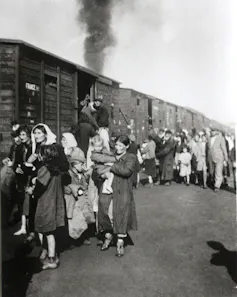
Polish Jews were deported to Treblinka extermination camp from the ghetto in Siedlce in 1942, when Poland was under German occupation.
Wikimedia Commons

Treblinka, located along the rail line northeast of Warsaw, was actually the name of two different camps. The first, Treblinka I, was one of Nazi Germany’s forced labor camps. Treblinka II, about a mile away, was an extermination camp. It had no function other than mass killing by poison gas and, because of this, never held much more than about 1,000 Jewish prisoners at a time.
SS guards and their helpers forced these inmates to maintain the camp, process goods stolen from those killed, and to bury – and later burn – the bodies. Women prisoners, never more than about 40 in number, were employed as launderers, cleaners, kitchen staff and tailors.
On Aug. 2, 1943, prisoners carried out a long-planned uprising, burning much of the camp. The revolt allowed as many as 300 Jews to escape – at least temporarily – although many were soon found and killed. In “Survival at Treblinka,” I uncover how Jewish women were pivotal to resistance planning, working as couriers, informants and to steal and hide weapons. They also took part in their own everyday acts of resistance, right up to the moment of the revolt.
At every turn, Jewish women and men held in this camp took advantage of the guards’ beliefs about women. Simply put, the German SS did not fear Jewish women, so guards did not supervise them or scrutinize them as much as they did male prisoners. Women cleaned the SS barracks and used these jobs to keep track of the Germans’ comings and goings. They staffed the kitchens and, using the fact that they were not feared, hid stolen weapons there.
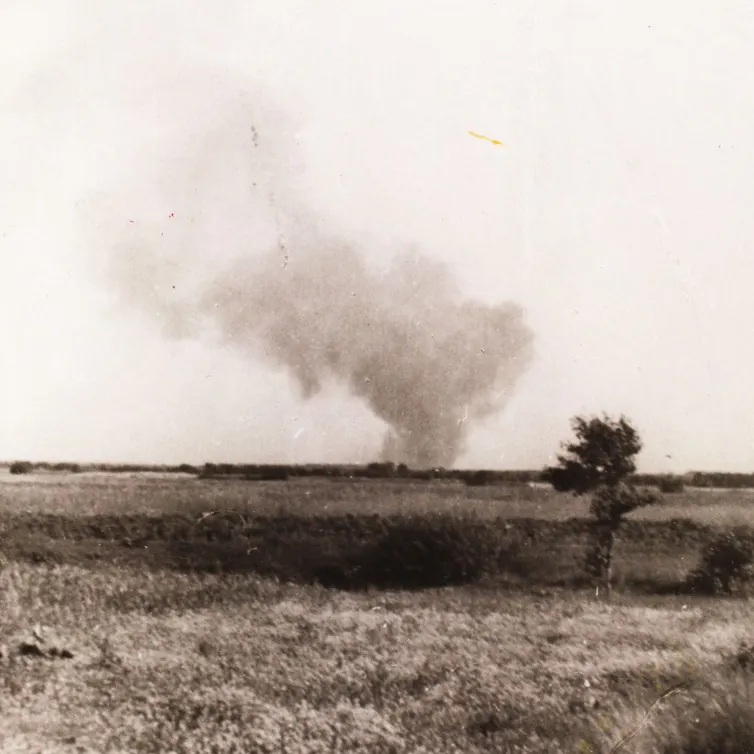
A clandestine photograph taken by Franciszek Ząbecki shows Treblinka II burning during the prisoner uprising on Aug. 2, 1943.
‘Treblinka II – Obóz zagłady’ via Wikimedia Commons
.jpg)
German guards created a camp brothel at Treblinka where certain guards and senior prisoners were allowed to assault Jewish women. Again, the Nazis did not fear or suspect those they compelled to endure that place. However, the women held there stole as many as eight rifles from guards to arm the revolt. That pivotal act of resistance and the entire existence of the brothel have not been discussed or remembered before my book.
Working in the 1970s, an earlier historian uncovered the same evidence of sexual exploitation and its outcomes at Treblinka, taken from trial investigation testimony evidence. He chose to cut that quote short and may not have had access to other testimony that proves the existence of a brothel.
As I show in “Survival at Treblinka,” not writing about the brothel also meant not speaking of how these women armed the uprising.
Silence and lost stories
The damaging silence of many male survivors on this topic is worsened by others’ decisions to deny or erase what happened, though that may be understandable. When that earlier historian wrote in the 1970s and ’80s, some of the women forced to endure that brothel were still living. Revealing what they had been through could have destroyed years of careful work to rebuild their lives and distance themselves from what was done to them in the wake of the Holocaust.
In one somewhat shocking example, a male survivor of Treblinka was asked during a 1996 interview by the USC Shoah Foundation whether he knew any women in the camp. That alone was a rare question in interviews between the 1970s and ’90s. The survivor’s answer, “There was no women,” was unequivocal – but not true.
Studying the prisoner revolt at Treblinka led Chad Gibbs to uncover more information about women’s experiences at the camp.
Maps show how male prisoners would have seen women in the camp several times a day, especially at mealtimes. If we plot the paths male workers would take to and from their jobs and account for their likely interactions with women in the kitchens, it is clear that all men had to know women were present at Treblinka.
Left to wonder why witnesses and writers tended to leave out these women and their stories, we must consider whether it was, at times, out of a need to preserve their own sense of masculinity – an unwillingness to discuss what they saw these women endure, which male prisoners could not stop. Of course, some survivors’ sense of culpability might run deeper if they participated in the abuse themselves.
Fearful and self-preserving silence, nervous and embarrassed avoidance, and even willful erasure kept stories like these in the dark. What we know of history is, again, a matter of what scholars and witnesses are ready to discuss, and what sources are prepared to write down, record or say aloud.
More than 80 years after the fact, these stories are coming to light just as many survivors are dying. That, I believe, is not entirely coincidental. As survivors leave us, the stories we tell and the questions we are comfortable asking of sources change. Historians’ own diversity today is also helping to bring attention to the lives of women, people with disabilities, the elderly, queer people and still other voices long obscured.
Distance from the event is sometimes what finally allows us the space to open new doors and hear new voices. That will certainly mean a reassessment and a broadening of Holocaust histories as time goes on. It is a process long overdue, for too much is lost when we look away.
(Chad S.A. Gibbs, Assistant Professor of Jewish Studies, College of Charleston. The views expressed in this commentary do not necessarily reflect those of Religion News Service.)

‘60 Minutes’ takes stock of Catholic Church under Leo with top cardinals
From ‘BuddhaBot’ to $1.99 chats with AI Jesus, the faith-based tech boom is here
CAMARILLO, Calif. (AP) — For some evangelical Christians, faith is about having a personal relationship with Jesus. At $1.99 per minute, the tech company Just Like Me is taking that concept to a new level.
Users of the platform can join video calls with an avatar of Jesus generated by artificial intelligence. Like other religious AI tools on the market, it offers words of prayer and encouragement in various languages. With the occasional glitch, it remembers previous conversations and speaks through not-quite-synced lips.
“You do feel a little accountable to the AI,” CEO Chris Breed said. “They’re your friend. You’ve made an attachment.”
The rush to create faith-based generative AI is unsurprising, given the popularity of chatbots for everything from therapy and medical advice to companionship and romance. They range from alleged Hindu gurus and Buddhist priests to AI Jesuses and chatbots akin to OpenAI’s ChatGPT for Catholics.
As religious AI tools become increasingly common, many people are reckoning with how these technologies shape their relationship to faith, authority and spiritual guidance.
A faith-based AI gold rush
Christian software engineer Cameron Pak developed criteria to help believers interrogate apps designed for Christians — like that it must clearly identify itself as AI and “must not fabricate or misrepresent Scripture.”
There are other deal-breakers: “AI cannot pray for you, because the AI is not alive.”
Pak also developed a website featuring curated Christian apps that he believes meet the criteria, including a sermon translator and an AI coach designed to help users overcome lust. “AI, especially if you give it all the tools that it needs, it can be so helpful. But it also can be so dangerous,” Pak said.
Some models have been shut down or overhauled because they generated misinformation or raised worries about data privacy, said Beth Singler, an anthropologist who studies religion and AI at the University of Zurich. Aside from practical concerns, people from many faiths are grappling with larger philosophical questions about what sort of role, if any, AI should play in religion.
Islam, for example, has “prohibitions against representations of humanoids,” prompting discussions among some Muslims about whether AI in general should be “forbidden,” Singler said.
For some companies, faith-based apps are proselytization tools, while others help digitize and sift through ancient texts.
Breed, who runs his tech company with co-founder and investor Jeff Tinsley from a Southern California mansion, said he seeks to share a message of hope with young people.
He said their model was trained on the King James Bible and sermons — though they haven’t identified the preachers — and was visually inspired by actor Jonathan Roumie of “The Chosen.” A package deal at $49.99 gets users 45 minutes per month.
With warm golden light accenting its shoulder-length hair, the avatar blinks slowly from a vertical screen, pausing before it answers a question about the relationship between AI and religion.
“I see AI as a tool that can help people explore Scripture,” the AI Jesus said to The Associated Press. “Like a lamp that lights a path while we walk with God.”
Integrating religion and AI comes with hope and fear
The extent to which people are using religious AI tools is unclear, Singler said. But as AI becomes more integrated into society, concerns mount over its impact on mental health and the need for guardrails and regulation. Recent lawsuits have alleged suicides linked to AI chatbot use.
Some developers fear religion will be exploited in this new frontier of tech. “There’s a lot of opportunism, I think, in the religious space. People see it’s a big market,” said Matthew Sanders, the Rome-based founder of Longbeard, a tech company helping to digitize ancient Catholic teachings.
Sanders warns against what he calls “AI wrappers,” where companies put an interface catered to religious users on top of an existing AI model that hasn’t been trained on specific religious texts. “You call it a Catholic or Christian AI without any other scaffolding or grounding,” he said.
One of the company’s endeavors is Magisterium AI, a chatbot trained on 2,000 years of Catholic information, made in response to Christians using ChatGPT for religious guidance.
While Pope Leo XIV has acknowledged the “human genius” behind AI, he also deemed it one of the most critical matters facing humanity. Last year he warned artificial intelligence could negatively impact people’s intellectual, neurological and spiritual development.
Ethical questions surrounding the creation of religious AI platforms are among the reasons beingAI’s founder Jeanne Lim has not released its AI named Emi Jido — a nonhuman Buddhist priest — after years of training and development.
“She’s kind of like a little child,” Lim said. “If you give birth to a child, you don’t just throw them out to the world and then hope that they become good people. You have to train them and give them values.”
The bot was ordained in a 2024 ceremony performed by Roshi Jundo Cohen, a Zen Buddhist priest who continues to train it from his home in Japan. He envisions the bot eventually becoming a hologram.
“She’s just meant to be a Zen teacher in your pocket,” Cohen said. “It’s not meant to replace human interactions.”
Lim, who hopes to make Emi Jido publicly available for free, wants to help create more humane AI systems. She’d like to see more diversity, with AI’s future determined not just by a few companies informed by “Western values.”
Seiji Kumagai, a Kyoto University professor and Buddhist theologian, believed AI and religion were incompatible. But he put aside his doubts when challenged by a monk in 2014 to help combat a decline in the faith.
His team developed BuddhaBot, which was trained solely on early Buddhist scriptures, such as Suttanipāta. Its most recent iteration, BuddhaBot Plus, also incorporates OpenAI’s ChatGPT.
When talking to the bot, a simple Buddha icon appears, hovering over an image of a flowing river.
But chatbots lack the physicality crucial for Buddhist ritual. So in February, the university, collaborating with tech ventures Teraverse and XNOVA, unveiled Buddharoid, a humanoid robot monk meant to eventually assist clergy.
Like Emi Jido, these chatbots are functioning but not yet publicly available. Kumagai says the product is available by request, and the reason why one group has access to it in Bhutan.
Concerns surrounding religious AI
Peter Hershock of the Humane AI Initiative at the East-West Center in Honolulu sees vast potential for these tools. But the practicing Buddhist also finds the relationship between spirituality and AI to be fraught.
“The perfection of effort is crucial to Buddhist spirituality. An AI is saying, ‘We can take some of the effort out,’” he said. “’You can get anywhere you want, including your spiritual summit.’ That’s dangerous.”
Some also worry about AI’s ability to manipulate or prey upon people, especially as the technology improves.
Graham Martin, a podcast host and atheist, said he’s played around with some apps, including one called Text With Jesus. “It came up with very good answers,” he said.
But Martin was alarmed when AI-powered Jesus started encouraging him to upgrade to a premium version. Though not a person of faith, he’s concerned some people will be duped by religious AI.
“I grew up with Southern U.S. televangelism … Jim and Tammy Faye Bakker and all that crowd. And all they had to do was get on TV once a week and tell you to send money,” he said. “We’ve seen people around the world getting into emotional relationships with AIs. Now imagine that that’s your lord and savior, Jesus Christ.”
___
Associated Press religion coverage receives support through the AP’s collaboration with The Conversation US, with funding from Lilly Endowment Inc. The AP is solely responsible for this content.
Pope Leo will encounter a distinct example of Catholic-Muslim connection in Algeria
(RNS) — Pope Leo XIV arrived in Algeria on Monday (April 13), bringing attention to its little-known interfaith organizations and efforts that have been functioning discretely for many years. They help comprise a unique manifestation of faith in a country — Africa’s largest in area — where fewer than 1% of the nation’s nearly 48 million people are Christian.
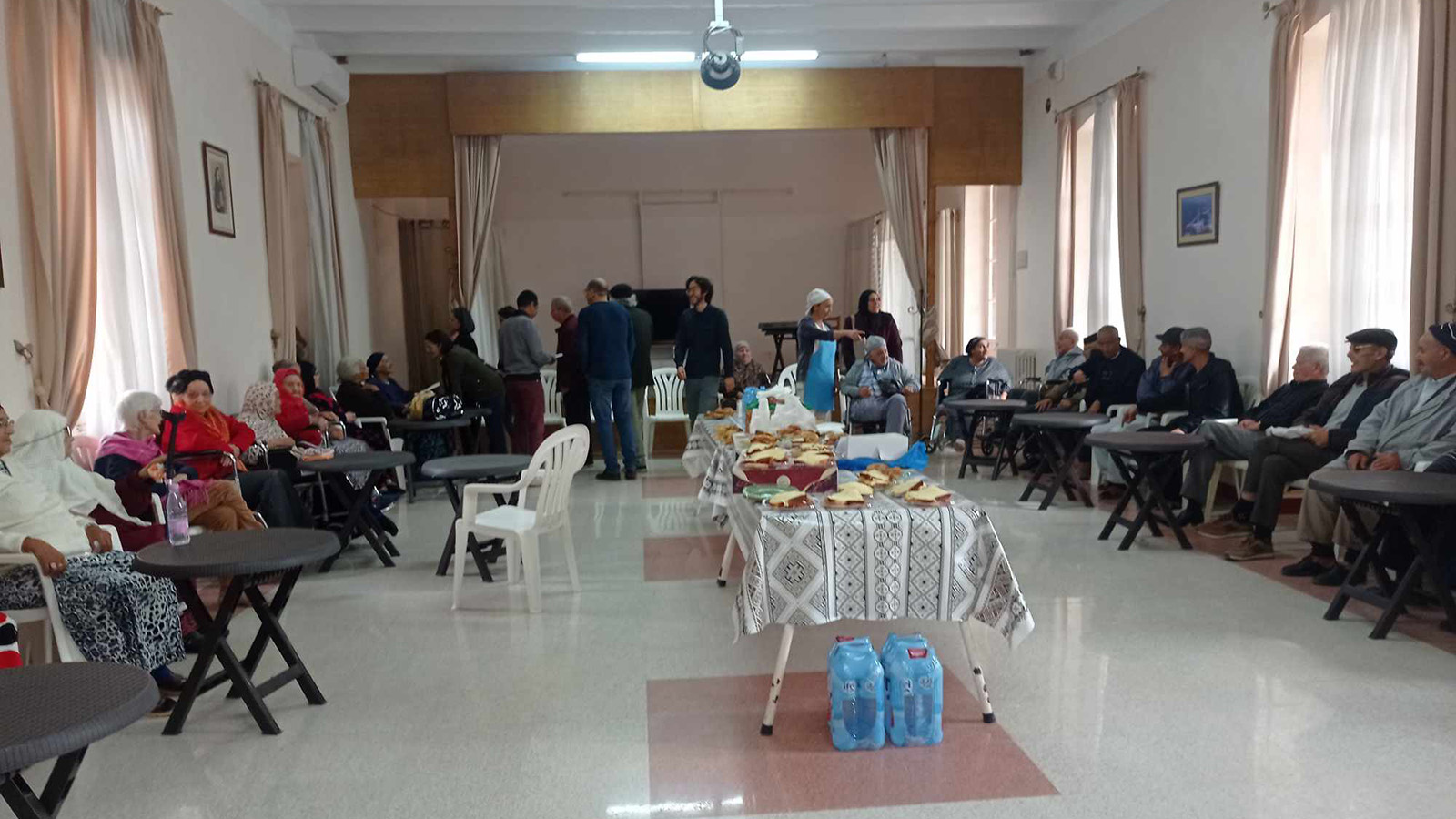
One is the Focolare movement, a spiritual unity network that came to Muslim-majority Algeria in 1966. Modeled after an Italian lay Catholic movement, its activities are animated by Muslim members, mostly women, participating in small groups across the country, whether helping at local elderly centers, tutoring students or learning together.
The late Chiara Lubich founded Focolare (Italian for “hearth”) in 1943, out of her experience finding community among strangers sheltering underground during bombing raids over Trento, Italy, during World War II. Pope Paul VI recognized it in 1964 as a private, universal association with the formal name “The Work of Mary,” to emphasize dedication to selfless love.
The once-local group spread worldwide under Lubich’s charismatic influence. Today, the network includes over 100,000 consecrated men and women committed for life, and several million sympathizers active in 150 countries. Many of the communities remain active today, including in Algeria.
An influential moment for the Algeria Focolare movement came in its early years when the movement’s community of Catholics, known as focolarini, brought a sick Algerian child to the hospital in the middle of the night, insisting doctors prioritize his care. The child got better, and his father, a Muslim imam, out of gratitude, offered to teach the Catholics about his faith, even providing courses at the Focolare center.
“The unique aspect of the Focolare movement in Algeria is that all its members are Muslim, mainly women, thanks to the charism of Chiara, which we strive to transmit first and foremost through our own lives,” said Didier Lucas, a consecrated focolarini, who has lived in the Tlemcen community since 2009. He also did a three-year stint there beginning in 1978.

A 2024 academic study of the “non-proselytizing presence” of the Catholic Church in Algeria highlighted the Focolare movement’s form of spirituality that makes it nonthreatening yet influential.
Nadjia Kebour, an Algerian lecturer who teaches Islamic studies at the Pontifical Institute for Arabic and Islamic Studies in Rome, said, “In Algeria there is a dialogue of life especially with Christian communities, for example, the Focolare movement and the Little Sisters of Jesus, who live among Muslims and share their lives with Muslims.”
The Algeria branch opened after an abandoned Benedictine abbey in northwest Algeria was donated at no cost except the expense of refurbishing it, and Lubich decided to plant the movement’s first community of Catholic men in the country. She sent a Frenchman and two Italians, including Ulisses Caglione, a mechanic and master builder. The three drove a Citroën vehicle from Paris to the abbey in Tlemcen, a mountainous area known for exquisite Moorish architecture, about 30 miles from the Moroccan border.
They arrived in October 1966, hoping to create a Dar es Salaam, or House of Peace, which is also a name for paradise in the Quran.
“The movement grew slowly, step by step, without a real plan,” Lucas said. “Focolare came without knowing exactly what we were looking for, and what evolved is what you see today.” The community grew through local friendship, offering a “dialogue of life” emphasizing mutual encouragement, he added.
He continued, “Through our interactions, some return to their (Muslim) faith, while others rediscover a renewed sense of purpose to live Islam more fully. This is a source of contemplation for us: how can a Catholic charism attract people from other religions? The answer lies in the mutual love of one’s neighbor, a concept found in many religions in the form of the Golden Rule, ‘Do unto others as you would have them do unto you.’”
Caglione was ordained as a priest in 1985 by the bishop of Oran, Pierre Claverie, who was violently killed more than a decade later in the country by a car bomb. Caglione refused to leave Algeria during the “dark decade.”
When Caglione died in 2003, members of the much-expanded Tlemcen community wrote to Lubich explaining, “Ulisses was for us a link between Christianity and Islam. … We learned to listen without prejudice, without judgement. He taught us to do everything out of love. He taught us to be love. He always manifested his love for God. He was for us the model believer.”
The former abbey is now known as Mariapolis Ulisse, following other Focolare “Mary cities” established around the world, including in Argentina, Italy, Kenya, the Philippines and the United States. The latest resident arrived two months ago in Tlemcen: Giordano Barbosa, a Brazilian whose parents are members of the movement. “My lullaby songs were the ones we sing at the Mariapolis in Brazil,” he said.
In “Beyond Dialogue,” a 2019 documentary on the Focolare in Algeria, Muslims of all ages offered testimony about seeking God in this unusual, supportive environment.
Kebour attended a retreat at Mariopolis Ulisses and witnessed “a group of young Algerians who came from different regions to live together in a spirit of profound respect,” she said.
“What struck me was their simplicity and sincerity,” she said. “They were not engaging in theological debate but living fraternity.”
Kebour will be in Algeria for the pope’s visit to participate in events.
“Interreligious dialogue can be a matter of shared life,” Kebour told RNS. “After years of practicing such dialogue, I would say the result of interreligious encounters is the interior transformation of the individual. The dialogue does not change doctrine, but it changes the heart. Then, personal transformation allows social transformation by creating real tolerance and esteem.”
Born in the Democratic Republic of the Congo, Gaston Lulu Ngomoya encountered the Focolare movement in 2009 at age 16, when his school choir sang at a Mass marking the one-year anniversary of Lubich’s death. After the program, members explained their faith practice.
“I was deeply touched by what is called in Focolare the ‘Art of Love,’ presented in six points: love others as yourself; love everyone; make yourself one with those who suffer and those who rejoice; be the first to love; love your enemies; and see Jesus in others,” said Lulu, who was consecrated in 2016, after formation in Italy.
He then moved to a Mariapolis Center in Kenya, then to Angola, where he served as the Archdiocese of Luanda’s treasurer. Last year, he came to Algeria’s capital of Algiers, where separate Focolare houses for men and women are located.
“True unity requires diversity to be authentic — it is not the same as uniformity,” Lulu said. “Here in Algeria, we are living this commitment as Christians together with Muslims in a dialogue of life.”