RICHMOND, Va. (RNS) – From 1830 to 1860, tens of thousands of enslaved people disembarked ships at Richmond’s Manchester Docks, an entry point into a bondage system that built Virginia’s wealth and shaped the city’s history. Shackled together, the enslaved people trudged along a muddy trail connecting the docks to the city’s auction house, where they were sold and bought as property.
Today, the path, known as the “slave trail,” is part of a citywide walking tour exploring Richmond’s role as a major hub of the domestic slave trade.
As about 20 Virginians marched in line, in silence, over the muddy trail on Saturday (June 13) — some clinging to one another to understand the experience of enslaved people who walked the trail in chains — a gospel singer performed the African American spiritual “Wade in the Water” alongside them.
Walking silently, Renee Munford, who is Black, said she felt her ancestors. The 65-year-old wondered what they thought as they walked, whether they were afraid, confused or both. At some point, she cried.
“Every time I looked out at the water, all I could see was people coming in on ships and disembarking, and just in a frenzy, so my heart bled for that,” she said.
The silent walk was the first part of a historical and spiritual pilgrimage through Richmond led by two local Episcopal churches. The gathering, called “Walking With the Enslaved: The Church’s Role in Slavery Pilgrimage,” seeks to cover the city’s racial history from the steps of Virginia’s state Capitol to a notorious 19th-century slave jail to Richmond’s first African church.
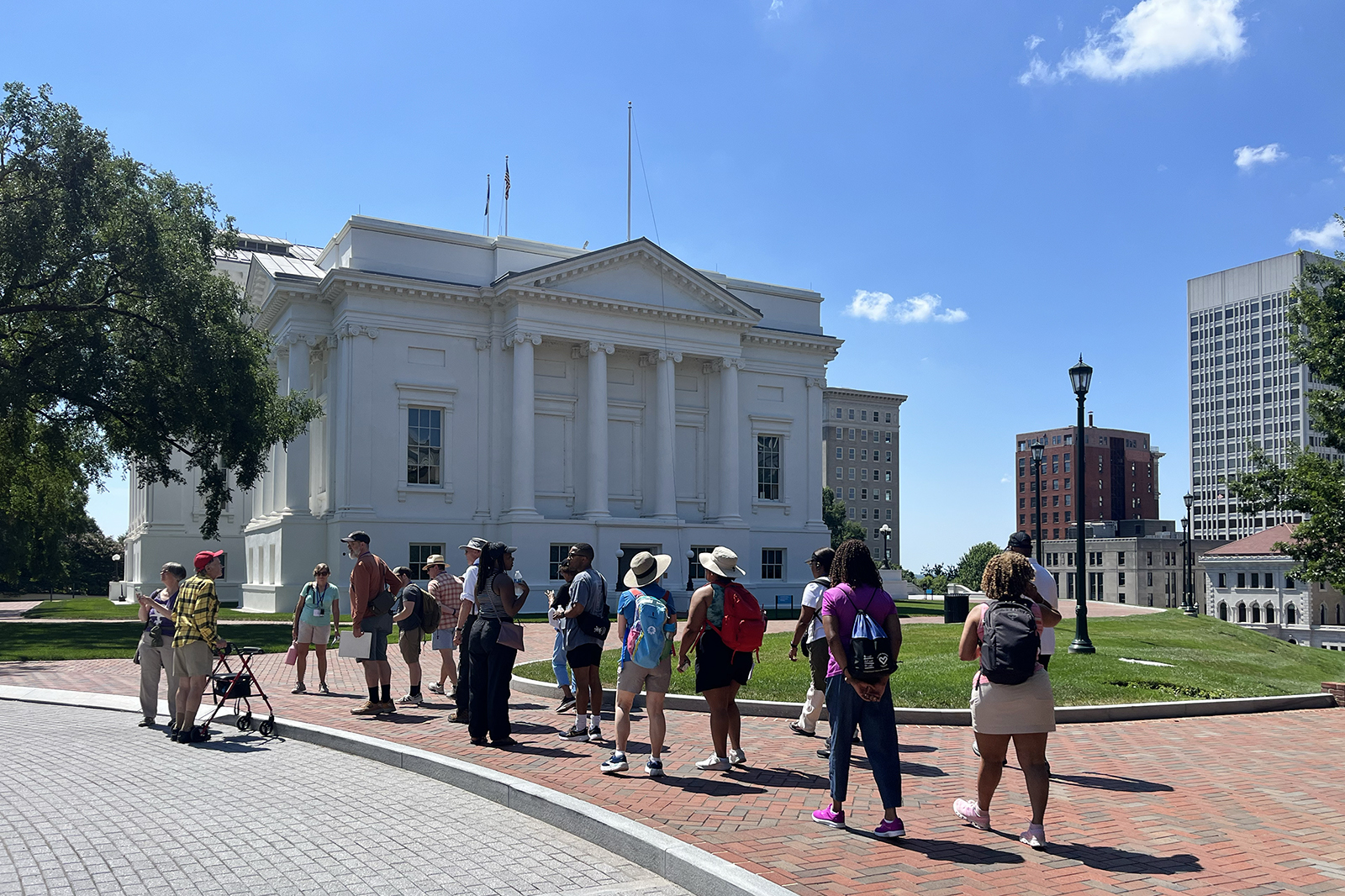
The daylong retreat grew out of a partnership between St. Paul’s Episcopal Church, Virginia’s largest Episcopal parish that was once attended by Confederate army Gen. Robert E. Lee and Confederate President Jefferson Davis, and St. Philip’s Episcopal Church, one of the South’s oldest Black Episcopal churches, founded in 1861 by enslaved and freed Richmonders. The two congregations designed the experience centered on stories of enslaved people and enslavers, prayer and African American spirituals, which they hope will make for a transformative and eye-opening encounter for all who take part.
Just as the country prepares to celebrate the 250th anniversary of the Declaration of Independence — and Juneteenth, the commemoration of when enslaved people of Galveston got news of their liberation on June 19, 1865 — these Episcopalians are trying to reckon with the role of their city and their denomination in slavery as a founding reality of the United States. The churches’ collaboration reflects both the Episcopal Church’s racial reconciliation focus, announced in 2016, by then-Presiding Bishop Michael Curry — the first African American to lead the denomination nationally — and a broader citywide effort to confront the city’s slave-trading past.
St. Paul’s and St. Philip’s, both of whose histories were shaped by Richmond’s role as a major slave-trading center and the capital of the Confederacy, are hoping to translate these efforts into personal transformation.
Before they embarked on the pilgrimage, the group gathered for an introduction session at St. Philip’s. Nikki Fernandes, one of the tour’s docents, reminded them of the day’s spiritual goal. “We hope you leave this pilgrimage with something, and that the Holy Spirit will guide what that something is,” said Fernandes, a Virginia native and a Ph.D. candidate at the University of Pittsburgh.
Walking through these historic sites is more likely to transform people and help the history solidify in their minds than something less immersive, said Jerry Gilbert, one of the pilgrimage’s co-chairs and a vestry member at St. Paul’s. “That may be what people would call the ancestors talking to you, or the place talking to you. … But I think it really happens because I’ve felt it happen,” Gilbert told RNS in an April interview.
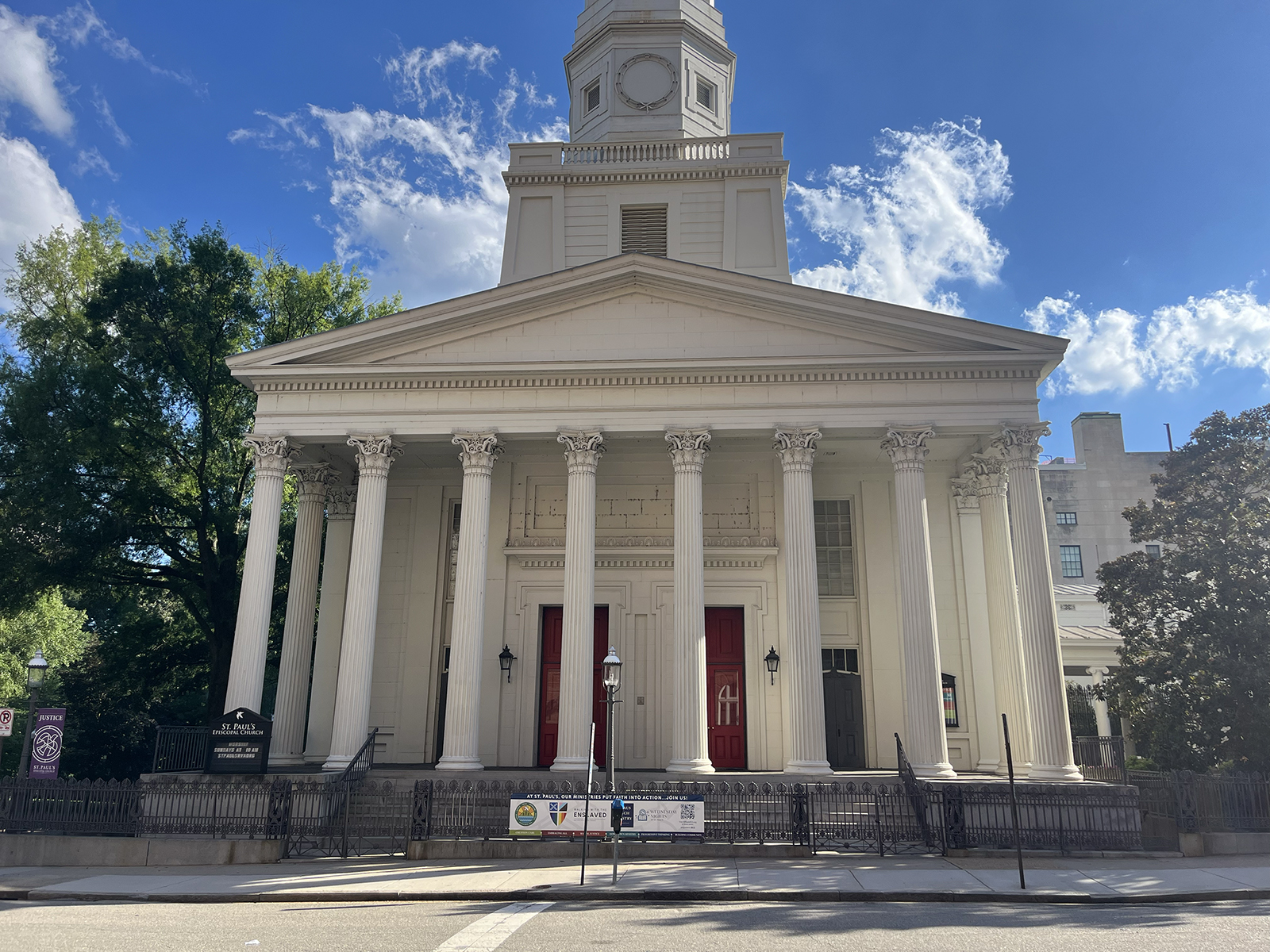
Many participants had heard about the pilgrimage through the churches. The project started at St. Paul’s and took off after the congregation reached out to St. Philip’s to collaborate. Gilbert said the church needed a “nonwhite majority” partner to improve the walks.
“We knew that sometimes white privilege is very blind to seeing all of the aspects of a situation when race is involved,” he said.
St. Paul’s, perched on Richmond Hill near the Virginia Capitol, traces its roots to Monumental Church, established in 1814 by prominent Richmonders — “nearly all” enslavers, according to the church’s website. During a tour stop on Richmond Hill, Glyn Hughes, another docent, stressed that the freedom ideals that fueled America’s founding collided with Virginia’s reliance on slave trading and its leaders’ affiliation with Episcopal and Presbyterian churches.
In front of the state Capitol, which once held church services for Presbyterians and Episcopalians but also served as the Confederate States Congress during the Civil War, Hughes invited participants to “think about how they were mingling Christian values to their ideals.”
Docent Nikki Fernandes, center, addresses a slavery pilgrimage group on Saturday, June 13, 2026, in Richmond, Va. (RNS photo/Fiona André)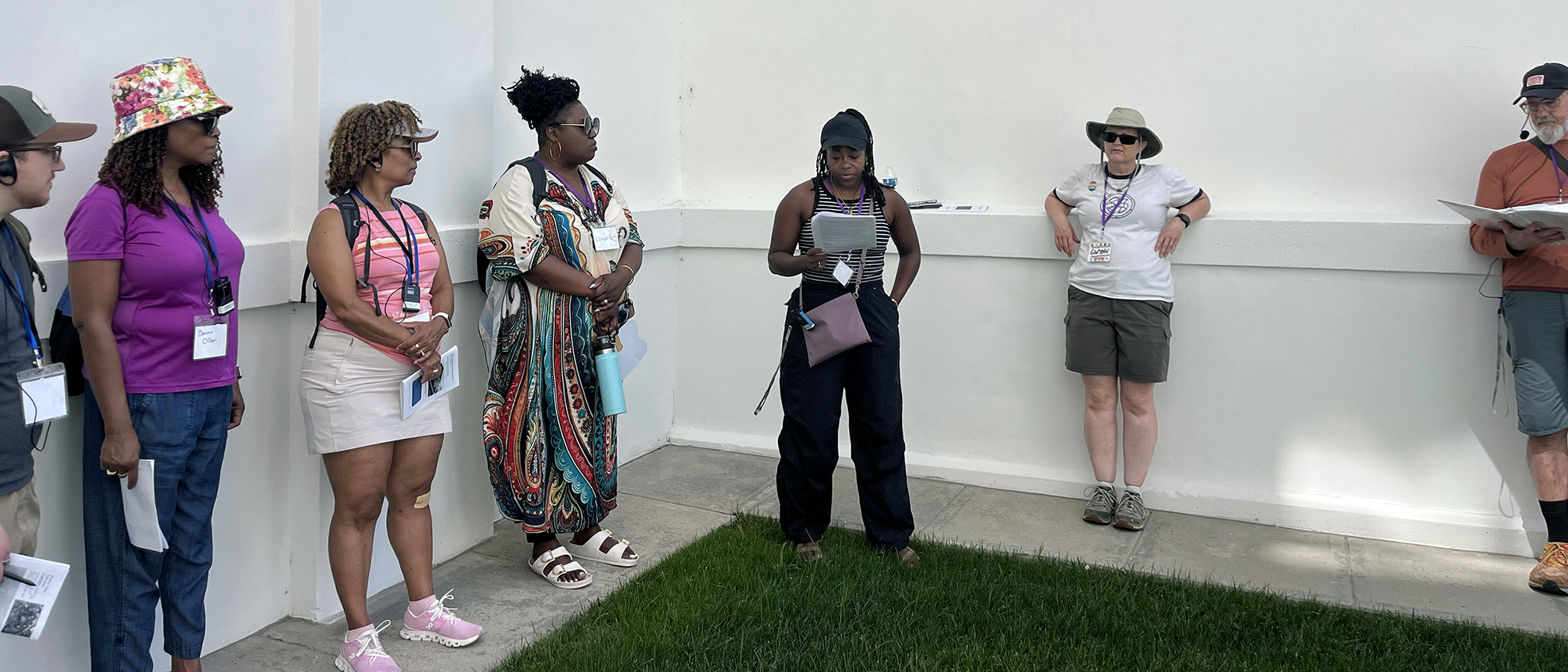
After the 2015 killing of nine Black worshippers at Mother Emanuel AME Church in Charleston, South Carolina, St. Paul’s started examining its own racist past. Five years later, the church removed Confederate symbols from the sanctuary, shedding the most visible reminders of its support for the Confederacy and cutting off its embrace of Lost Cause ideology after the Civil War.
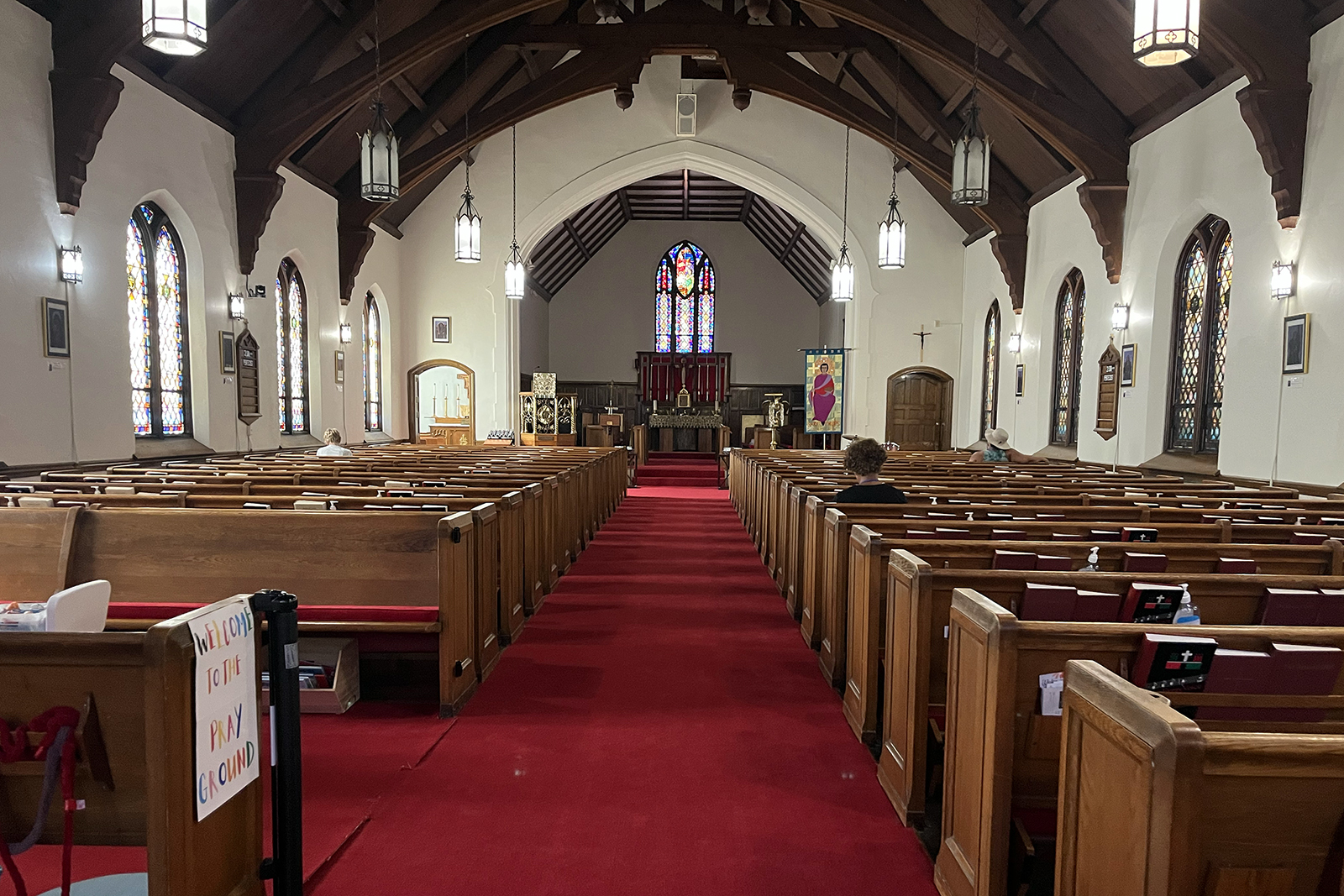
St. Philip’s, nestled in Richmond’s North Side, has served as a refuge for Black Richmonders through the Civil War, the Jim Crow era and today. Despite its prominence for the city’s Black Episcopalians, the church didn’t gain full representation at the diocesan convention until 1937.
The churches’ partnership has been “transformational,” said Crystal Green, a co-chair of the project and a member of St. Philip’s. “It’s part of a healing process that is 400 years in the making, so it’s transformed our lives, our worship styles, and it’s also built a lifetime of friendships.”
Beginning at the “slave trail” shapes participants’ experience of the pilgrimage’s nine remaining stops, organizers noted. The recovered stories of Black Richmonders also ensure participants center the perspectives of enslaved people during the pilgrimage.
At the fifth stop, the First African Baptist Church, Fernandes recounted the story of Henry “Box” Brown, a member of the congregation born into slavery on a Louisa County plantation. In 1849, Brown escaped by shipping himself to Philadelphia in a wooden box to reach freedom in the North.
The tour cultivates a sense of sacredness through prayers, silent reflections and songs. The pilgrimage’s opening prayer, which invites participants to “leave the familiar, the comforting, the known” to find a deeper sense of God, is echoed through the Bible verses associated with each stop. A preacher-style call and response ritual in front of each site also reinforces the pilgrimage’s spiritual dimension.
“God of love who traces our journeys,” Hughes said as the group approached each stop. “Enlighten the eyes of our hearts,” participants replied in unison.
The spirituals — including “Amazing Grace,” a hymn that predates the United States, and Thomas Dorsey’s 1930s classic “Take My Hand, Precious Lord” — also help set the pilgrimage’s solemn tone. For Shauntae Lilly, the gospel singer who accompanies the group, the songs are a tribute to the enslaved.
“My voice provides the voice of the journey,” said the 43-year-old singer. “ … Sometimes stories are easier felt than heard.”
Lilly, who grew up attending both Southern Baptist and Black Episcopal churches, said years of observing and listening to church choirs compensate for her lack of classical training. Like some Black participants, Lilly said she feels the presence of her ancestors during her performances.
“I feel as if the good Lord uses my voice to do that,” she said.
The pilgrimage’s last stops — the Shockoe Bottom African Burial Ground, the sunken slave jail of Shockoe Bottom and its dried-up reconciliation fountain — sit under the shadow of Interstate 95. Built in 1958, the highway severed Sixth Mount Zion Baptist Church, a 150-year-old Black Baptist congregation and the pilgrimage’s final stop, from Jackson Ward, Richmond’s historical Black neighborhood.
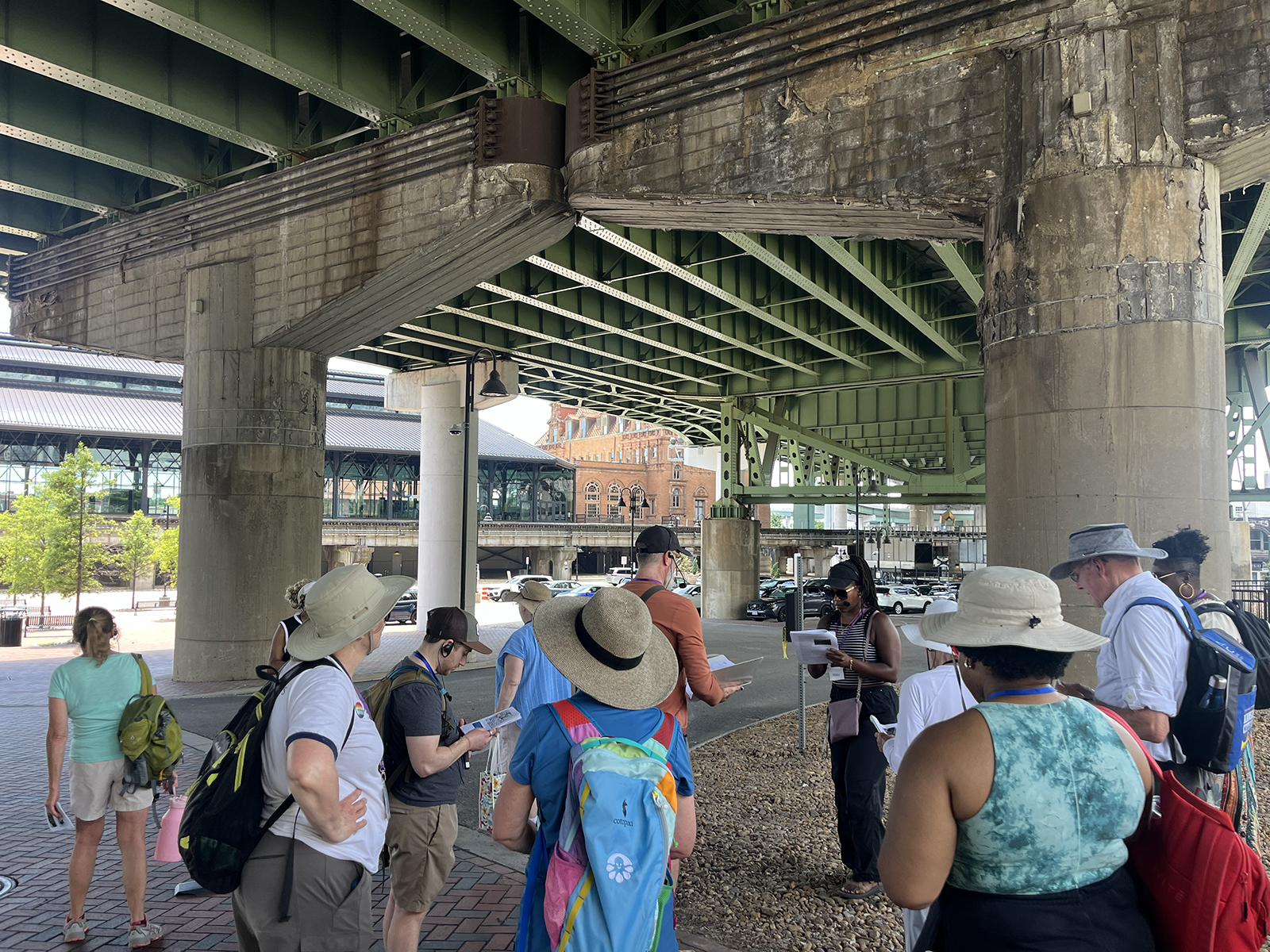
To Hughes, the interstate’s path through Jackson Ward is an example of “infrastructural violence” and a reminder of continued harm inflicted on Black Richmonders, he told participants on the bus ride back to St. Philip’s.
After lunch at St. Philip’s, participants scattered across the sanctuary and garden for a period of silent reflection. Guided by a Gospel of Matthew verse quoting the Prophet Isaiah about people who “listen, but never understand … look, but never perceive,” participants then shared their emotions, frustrations and awakenings. Equipped with a form inquiring about how they felt, what they thought and what value they carried as they completed the walk, the group embarked on an hourlong discussion on the pilgrimage.
As she sat on a bench by herself in St. Philip’s garden after the walk, Monica Melton, an educator who has lived in Richmond for 20 years, said she was thinking about how to get more involved.
Ever since the U.S. Supreme Court ruled against a Louisiana congressional map that included two Black-majority districts, thereby hollowing out a key provision of the 1965 Voting Rights Act, Melton said she has been concerned about Black voters’ political power in the South.“I was really thinking less, maybe about the experience throughout the day, but like ‘where is my voice?’ like my political voice,” she said.The personal stories of the enslaved, which she called the “most powerful piece,” also changed how she plans to approach discussions on racial history with her students.Her husband, the Rev. Brent Melton, has also been impacted by the enslaved people’s stories. When the couple, who are white, got home on Saturday, Brent Melton modified the sermon he had prepared for the next-day service to mention the pilgrimage.As he told the parishioners of Richmond’s Grace & Holy Trinity Church that the “work of the Kingdom coming near” requires building communities, Brent Melton noted how the pilgrimage created community by pushing participants to convene with strangers.“It was kind of like doing the stations of the cross, we had a simple liturgy, the story slowly unfolded, we even had music with a cantor,” he said. “Before we met in our small group, we were asked to do the most hated thing: do not sit with anyone you know. It was a God experience of movement with strangers. We were in the action of bringing God’s kingdom near.”
As she stepped into St. Philip’s that morning, Munford said, she felt weary of the experience ahead. Time invested in multiple racial reconciliation efforts that ultimately stalled had left her skeptical. “It made me kind of bitter towards the whole reconciliation thing,” she said. But seeing white Virginians willing to face this history gave her hope.
“All I could think is, you’ve got these white people that are interested enough to take out time on their Saturday and go through this process with us,” she said.
Original Source: