(RNS) — New Yorkers expecting to see Knicks celebrations and visitors in town for the World Cup were surprised Saturday (June 13) to encounter a series of colorful chariots adorned with jewel-toned balloons, surrounded by thousands of singing and chanting worshippers.
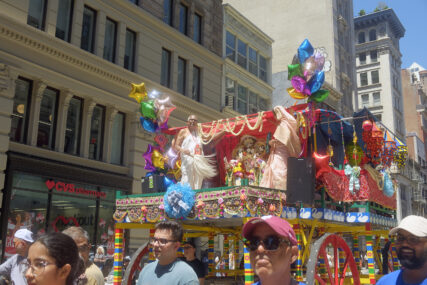
More than 25,000 devotees of the International Society of Krishna Consciousness (ISKCON) attended the parade, according to organizers. Worshippers wrapped in silk saris and patterned tunics pulled three 25-foot-high chariots displaying the statues of Krishna, his older brother Balarama and his younger sister Subhadra down Manhattan’s Fifth Avenue. The procession marked the 50-year anniversary of ISKCON’s first Ratha Yatra, or “Chariot Journey.”
With over 1 million devotees in more than 80 countries, ISKCON has historic roots in Hinduism but places itself under Gaudiya Vaishnavism, a monotheistic tradition within Hinduism dating back to 15th century India. The movement anchors itself in venerating Krishna through bhakti yoga, which features meditation, kirtan (devotional chanting) and Vedic principles and began in New York City in 1966.
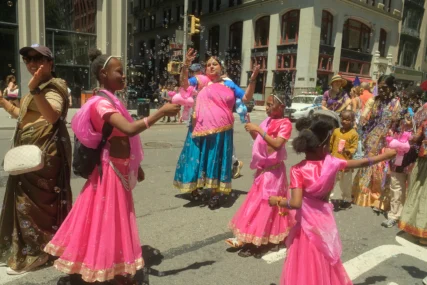
Around 10 a.m., monks readied the deities and the chariots as worshippers arrived. Devotees crowded into slivers of shade to escape the beating sun. Hundreds danced, chanting “Hare Krishna, Hare Krishna, Krishna Krishna, Hare Hare.”
By 11 a.m., the Yatra was ready to commence. Saffron-robed monks offered a blessing. Devotees picked up ropes tied to each side of the wooden chariots. As a priest blew his conch shell, they began to pull. The chariots gained momentum, turning onto Fifth Avenue enveloped in swirling colors and the rhythms of the dhol and manjira.
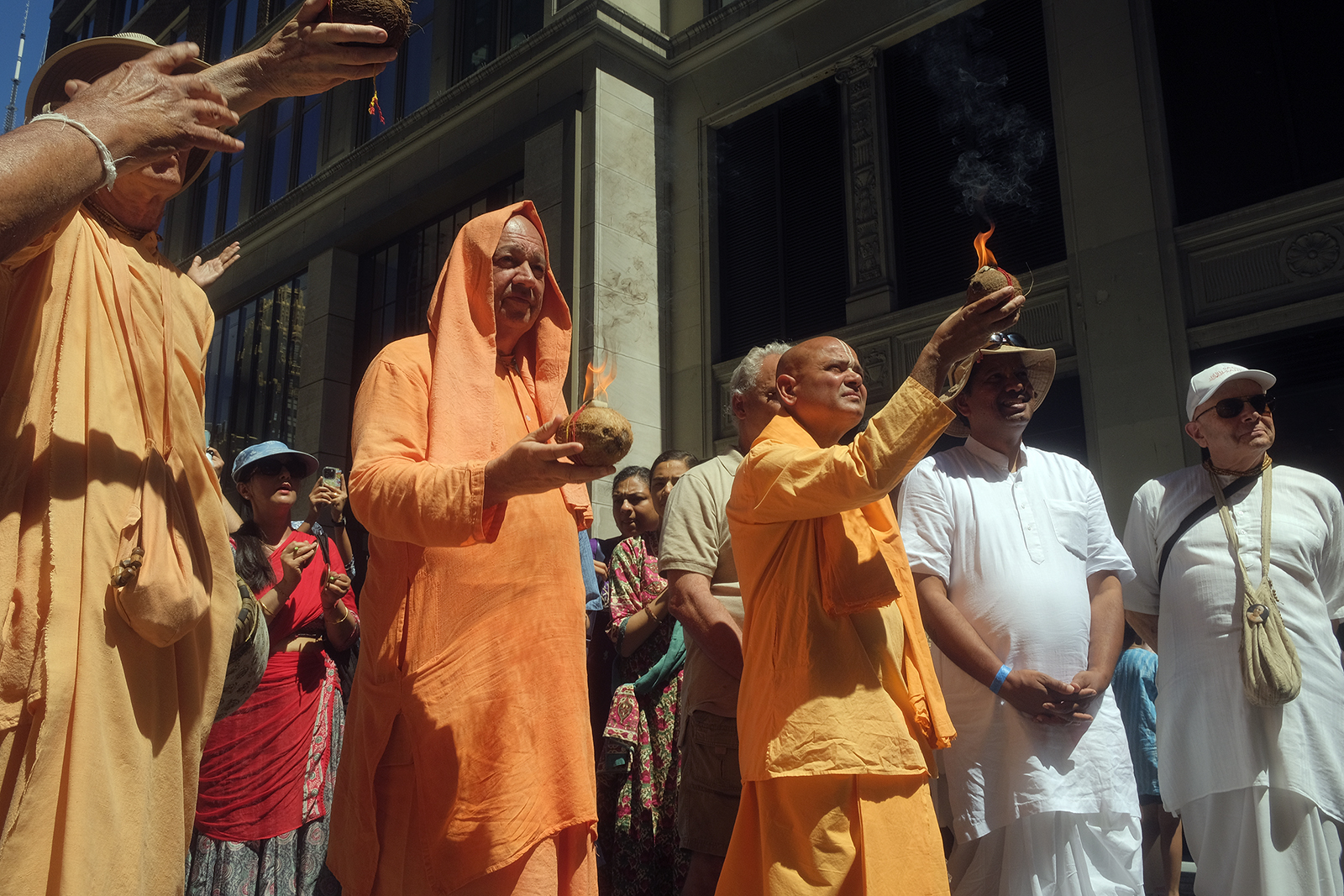
Passersby stopped and marveled. “We don’t see anything like this back home,” said Patrick Ornelas, who was visiting from Salt Lake City.
Another bystander, Brad Browning, was visiting from upstate New York to watch the Brazil v. Morocco World Cup match. A devotee handed him ISKCON pamphlets as he paused to watch the parade. “Considering I don’t know anything about Hare Krishna,” he told Religion News Service, “I’ll probably take a look.”
In addition to celebrating Krishna, ISKCON devotees see the Ratha Yatra as part of an outreach drive that welcomes new practitioners through public-facing events.
“Our aim is to reach out and see if we can get around 3% of the population of North America coming to these festivals, enjoying the company of the devotees and eating sanctified food,” said Aditya Devi Dasi, the vice president of ISKCON’s New York City branch. The ISKCON temple in Brooklyn houses around 40 full-time monks and attracts around 500 regular attendees for services. The annual Ratha Yatra is by far their largest event, regularly engaging tens of thousands.
Costing approximately $160,000 sourced from donations, the parade was the culmination of six months of preparation. For the 50th anniversary, organizers transported one of the original chariots from the first parade in 1976 from Florida to New York City.

Over 400 people volunteered at the event, according to organizers. One group spent 24 hours cooking bread, rice and curries in shifts to offer the pilgrims free “prasadam,” or consecrated food. Another group took shifts throughout the night before the Ratha Yatra to guard the chariots against vandalism.
When ISKCON organized its first parade in New York, the Hare Krishnas were still a young movement. Its founder, A. C. Bhaktivedanta Swami Prabhupada, had immigrated to the U.S. from India 10 years prior with the mission of spreading Krishna consciousness in the West. Spurred by the counterculture movement, Prabhupada garnered a small following of devotees who often left behind their jobs and families to live in an ashram.
When Prabhupada first conceived of a Ratha Yatra in Manhattan, the group struggled to find a location near enough to Fifth Avenue to construct the giant chariots. Almost at the point of giving up, they sought help from a new property owner in the neighborhood: now-President Donald Trump. Unexpectedly, Trump offered his land for the chariot assembly, making the inaugural event possible.
In the 1990s, ISKCON shifted to a new model of congregational membership, welcoming devotees from diverse backgrounds who maintain a life outside ISKCON while attending events. This model has become increasingly favored — and the annual Ratha Yatras in Manhattan, inspired by the procession attended by millions in Puri, India, aim to draw New Yorkers into Krishna worship. Many of the Krishna devotees call themselves servants of God rather than identifying as Hindu to emphasize transcending sectarian identities.

On Saturday, tourists in double-decker buses and fans in sports jerseys paused to wave to the Hare Krishna devotees. ISKCON has supported the Knicks, even going viral for chanting with fans outside Madison Square Garden during the NBA championship games.
Mahamantra, an ISKCON monk who featured in the viral clips, was selling Hare Krishna T-shirts in the style of the Knicks logo after the Ratha Yatra, sharing the same neon orange with the NBA champions.

“I’m excited for if the Knicks win, but I’m most excited to be with people dancing and chanting,” he told RNS, adding that ISKCON has seen more interest since the videos went viral.
Around four hours after the chariots departed from 41st Street, they arrived at Washington Square Park. Devotees filtered into a ring of circus-like booths. Some booths served vegetarian food. Others featured candid Q&As with Hare Krishna monks. Still others offered henna and face paint. Dozens of worshippers lined up for thick slices of cold watermelon to refresh themselves after dancing in the summer heat.
Sarvopama Das, 79, //is he 80/81 possibly?//https://chicagoreader.com/arts-culture/restaurant-tours-karma-free-fare/a Hare Krishna devotee who flew in from Chicago for the event, had volunteered to serve watermelon at the inaugural Ratha Yatra 50 years ago. Back then, he reminisced, outsiders were dumbfounded by the Hare Krishnas and their philosophies. “We thought we were cool talking about karma in the hippie days,” he said. “Now it’s in the dictionary!”

Amongst the thousands of devotees eating and relaxing in Washington Square Park were many young practitioners. Payal Mazumdar, 15, attends weekly Bhagavad Gita classes at the ISKCON temple in Brooklyn. “I have a really bad overthinking problem,” she told RNS. But through the ISKCON community and philosophies, she said, “it felt like I had a support system on my side.”
In the coming weeks, the three chariots will be transported to other cities around the United States to feature in their annual Ratha Yatras — growing ISKCON, organizers hope, with every turn of the wheel.
Original Source: