Religions Around The World

In the early morning hours, monks can be seen walking on their alms round in Kanchanaburi, Thailand
Showing humility and detachment from worldly goods, the monk walks slowly and only stops if he is called. Standing quietly, with his bowl open, the local Buddhists give him rice, or flowers, or an envelope containing money.  In return, the monks bless the local Buddhists and wish them a long and fruitful life.
Christians Celebrate Good Friday
Enacting the crucifixion of Jesus Christ in St. Mary's Church in Secunderabad, India. Only 2.3% of India's population is Christian. 
Ancient interior mosaic in the Church of the Holy Saviour in Chora
The Church of the Holy Saviour in Istanbul, Turkey is a medieval Byzantine Greek Orthodox church.
Dome of the Rock located in the Old City of Jerusalem
The site's great significance for Muslims derives from traditions connecting it to the creation of the world and to the belief that the Prophet Muhammad's Night Journey to heaven started from the rock at the center of the structure.
Holi Festival in Mathura, India
Holi is a Hindu festival that marks the end of winter. Also known as the “festival of colors”,  Holi is primarily observed in South Asia but has spread across the world in celebration of love and the changing of the seasons.
Jewish father and daughter pray at the Wailing Wall in Jerusalem, Israel.
Known in Hebrew as the Western Wall, it is one of the holiest sites in the world. The description, "place of weeping", originated from the Jewish practice of mourning the destruction of the Temple and praying for its rebuilding at the site of the Western Wall.
People praying in Mengjia Longshan Temple in Taipei, Taiwan
The temple is dedicated to both Taoism and Buddhism.
People praying in the Grand Mosque in Ulu Cami
This is the most important mosque in Bursa, Turkey and a landmark of early Ottoman architecture built in 1399.
Savior Transfiguration Cathedral of the Savior Monastery of St. Euthymius
Located in Suzdal, Russia, this is a church rite of sanctification of apples and grapes in honor of the Feast of the Transfiguration of the Lord.
Fushimi Inari Shrine is located in Kyoto, Japan
It is famous for its thousands of vermilion torii gates, which straddle a network of trails behind its main buildings. Fushimi Inari is the most important Shinto shrine dedicated to Inari, the Shinto god of rice.
Ladles at the purification fountain in the Hakone Shrine
Located in Hakone, Japan, this shrine is a Japanese Shinto shrine.  At the purification fountain, ritual washings are performed by individuals when they visit a shrine. This ritual symbolizes the inner purity necessary for a truly human and spiritual life.
Hanging Gardens of Haifa are garden terraces around the Shrine of the Báb on Mount Carmel in Haifa, Israel
They are one of the most visited tourist attractions in Israel. The Shrine of the Báb is where the remains of the Báb, founder of the Bábí Faith and forerunner of Bahá'u'lláh in the Bahá'í Faith, have been buried; it is considered to be the second holiest place on Earth for Bahá'ís.
Pilgrims praying at the Pool of the Nectar of Immortality and Golden Temple
Located in Amritsar, India, the Golden Temple is one of the most revered spiritual sites of Sikhism. It is a place of worship for men and women from all walks of life and all religions to worship God equally. Over 100,000 people visit the shrine daily.
Entrance gateway of Sik Sik Yuen Wong Tai Sin Temple Kowloon
Located in Hong Kong, China, the temple is dedicated to Wong Tai Sin, or the Great Immortal Wong. The Taoist temple is famed for the many prayers answered: "What you request is what you get" via a practice called kau cim.
Christian women worship at a church in Bois Neus, Haiti.
Haiti's population is 94.8 percent Christian, primarily Catholic. This makes them one of the most heavily Christian countries in the world.

A Native naming ceremony welcomes newly discovered spider into community of the land

PORTLAND, Ore.  (RNS and NPR) — A few years ago, Greta Binford was hiking in the Columbia River Gorge when she saw a spider that “looked different from anything that I normally see when I roll over rocks and logs in this area,” she said. 

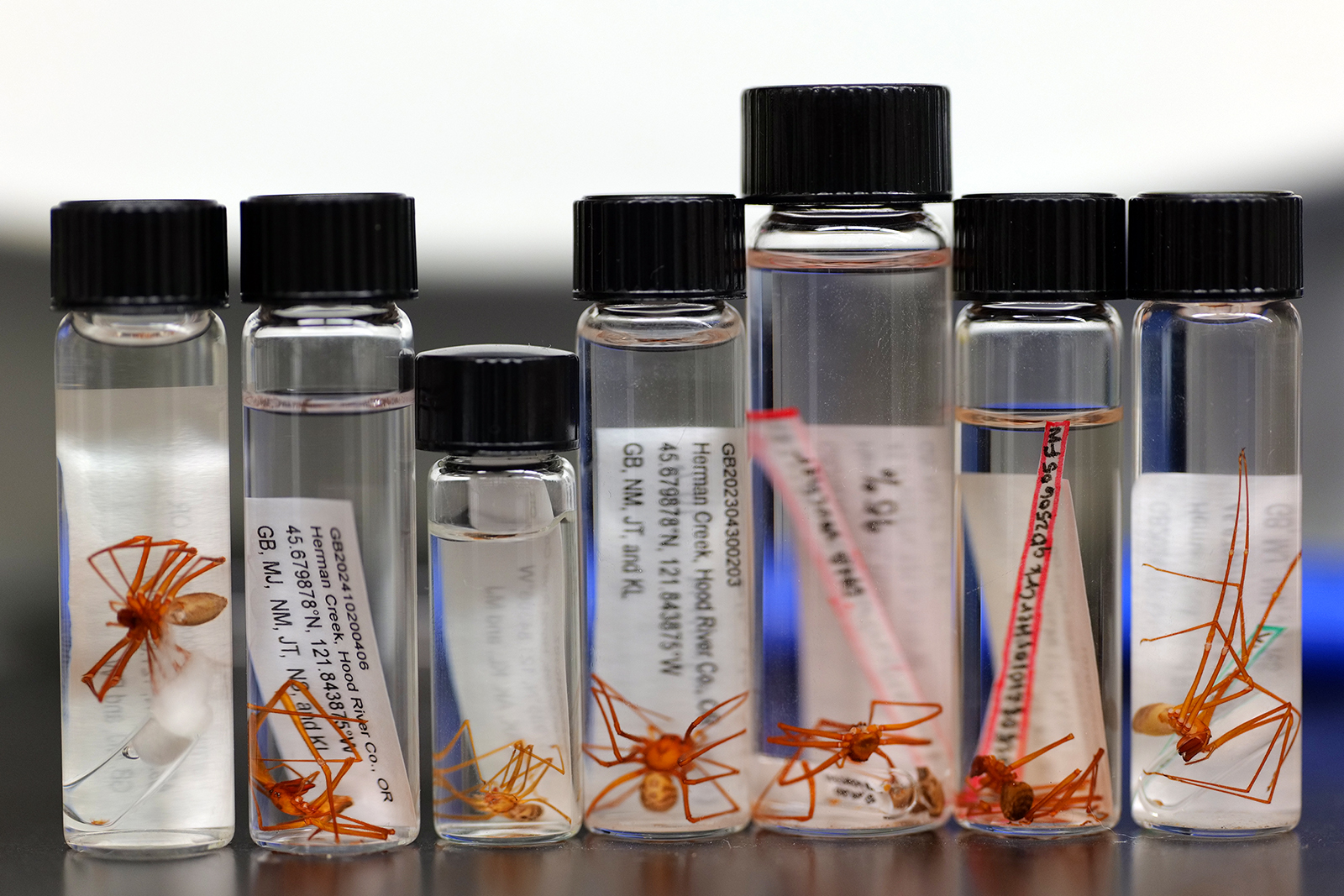
An evolutionary biologist at Lewis & Clark College in Portland, Oregon, she thought the spider looked liked a Trogloraptor — a distinctive family of spiders that have a small extra hook on the end of their feet, which make them better at pouncing on and biting other spiders. The family only contained one known species, which lives about 350 miles away.  

Over the next few years, Binford found more of these mystery spiders that her lab observed, analyzed and tested. It was, in fact, a Trogloraptor, but a new species. And when a new species is discovered, scientists get the honor of naming it, usually something that reflects the organism’s characteristics or some source of inspiration. But Binford’s lab decided to share it.

“We had an idea, really spearheaded by my student, Madeline Jones, who suggested, ‘Why don’t we reach out to the local tribes and see if they have an idea for a name?’” Binford said.


Binford’s lab reached out to the Columbia River Inter-Tribal Fish Commission, which coordinates management and fishery services for several Native tribes in the area, for help finding a name that would be significant to the tribes that traditionally lived in that area. The group connected the lab with Donella Miller, a biologist with the commission and a member of the Yakama Nation. 
“I totally nerded out,” Miller said, laughing . “I thought it was the coolest thing in the world, right? A new species and being able to be a part of the naming of that.” 

She added, “Honestly, acknowledging the First People, the Indigenous people who live in that area, and bringing them into it, it kinda seems like this is what should’ve been done all along.”  

Miller helped the lab connect with Anthony Washines, an elder who grew up speaking Sahaptin, the native language traditionally spoken in that region. And after reflecting, Washines selected the name Trogloraptor tulishpun, which means cave predator, honoring the spider’s role as a hunter.

Binford’s paper was accepted, and the spider was sent to the Smithsonian. But as Miller and Washines emailed back and forth about the name, Miller joked that because the spider was given a Native name it meant they would need to have a naming ceremony, referring to a formal bestowing of a name in Native traditions. It is seen as a way to welcome that individual and mark their place in the community. 

 ”You’re introducing yourself to the land and to our people so that you’ll be recognized,” Miller explained. 

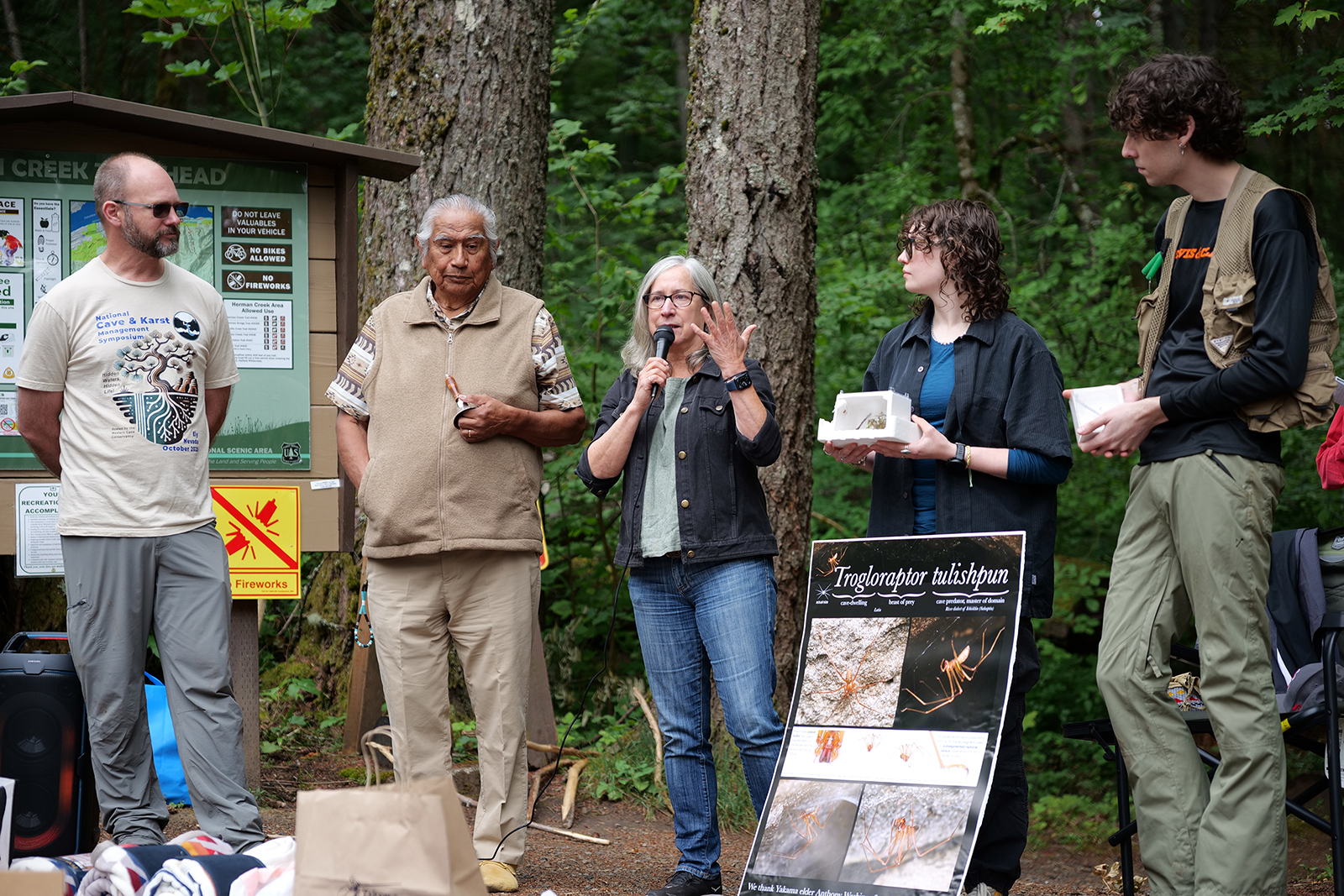
This past week, several dozen tribal members and scientists gathered under the hemlocks and fir trees near where Trogloraptor tulishpun was found for that ceremony. Washines led the ceremony honoring the scientists who found the spider, the tribes who have cared for the land and the spider itself. He led the group in a traditional naming song, a recitation of the name and a gifting to elders, scientists and all who were gathered to bear witness.

A few spiders were gathered by Binford and local cavers to receive their name, and then returned back to the nearby caves.


Washines said he knows people will see tulishpun as a small thing, but it’s significant because not every creature has its place. This little spider has been in the same place even when Washines’ people were not. 

“We were literally herded to a reservation,” he said. “Up in the high desert plateau, which was not our land. But he (the spider) stayed here, and remained. … He still took care of this land.” 

Usually the discovery of a new species is celebrated with a pizza party in a lab, maybe a nod from the college dean as an academic milestone. But for Trogloraptor tulishpun, the naming became a gathering of scientists and citizens, of human and animal, to name all those who make up the land and to honor the connections between them.
This story was produced through a collaboration between NPR and RNS. Listen to the radio version of the story.

Original Source:

https://religionnews.com/2026/06/15/a-native-naming-ceremony-welcomes-newly-discovered-spider-into-community-of-the-land/