VATICAN CITY (RNS) — When Pope Leo XIV lands in Spain on Saturday (June 6), he will find a country riven by polarization over migration and life issues, and where declining church attendance coexists with a new, striking interest in faith among young people.
In short, the pope will land in a European laboratory for many tensions shaping the West: a promising stage to deliver his message of unity, human dignity and peace.
Already in 2010, Pope Benedict XVI described Spain as a central place for the “encounter, not conflict,” between faith and secular modernity. Leo struck a similar note in a Feb. 9 letter to 1,600 Spanish priests, saying Spain faces “advanced processes of secularization” and “a growing polarization in public discourse,” but also a “new restlessness” and spiritual searching among young people.
Spain, once the home of Catholic missionaries throughout the centuries, is now itself a mission territory where an increasingly small Catholic minority seeks the encouragement of the pontiff. “I think the pope’s visit will be a splendid moment to encourage this whole missionary path of the church in Spain,” said Archbishop Luis Argüello of Valladolid, who heads the Spanish conference of bishops.
“For Spanish Catholics, it is like a great call — allow me the expression — to get our act together,” he added.
Pope Francis avoided traditional Catholic and political centers of power in Europe, often opting for the peripheries. Twelve years later, European countries are eager to host a pope again. Madrid is filling the streets with flowers in the white and yellow colors of the Holy See, and over 1.8 million people have already signed up to attend the papal events.
During his stops in Madrid, Barcelona and the Canary Islands, Leo has a chance to broadcast his message from a favorable pulpit — where his words can reach both Europe and Latin America.
An appeal to politics amid mounting polarization
Like in many Western countries, Spanish society is deeply divided. “There is no dialogue,” said José Restán, editorial director of the Catholic radio COPE. “It is a very harsh, very polarized, very aggressive political confrontation that in a certain way has reached the deepest layers of society, normal people.”
The visit has already become a political competition for proximity to Leo. Prime Minister Pedro Sánchez met the pope at the Vatican on May 27, highlighting their shared positions on migration, peace and artificial intelligence. Five days later, Isabel Díaz Ayuso, the conservative president of the Madrid region and one of Sánchez’s fiercest rivals, also met privately with Leo and later held a press conference.
While Sánchez’s government has worked with church organizations on issues such as migration, it has also clashed with the bishops over abortion, euthanasia and the role of Catholic institutions in education and healthcare. Spain approved euthanasia during the COVID-19 pandemic and Sánchez has pushed to enshrine abortion access in the constitution, following in French President Emmanuel Macron’s footsteps.
“On issues such as migration, war and other questions, it may seem that there is a coincidence between some of the statements made by this government and those made by the church,” Argüello said, while adding that there are “red lines.”
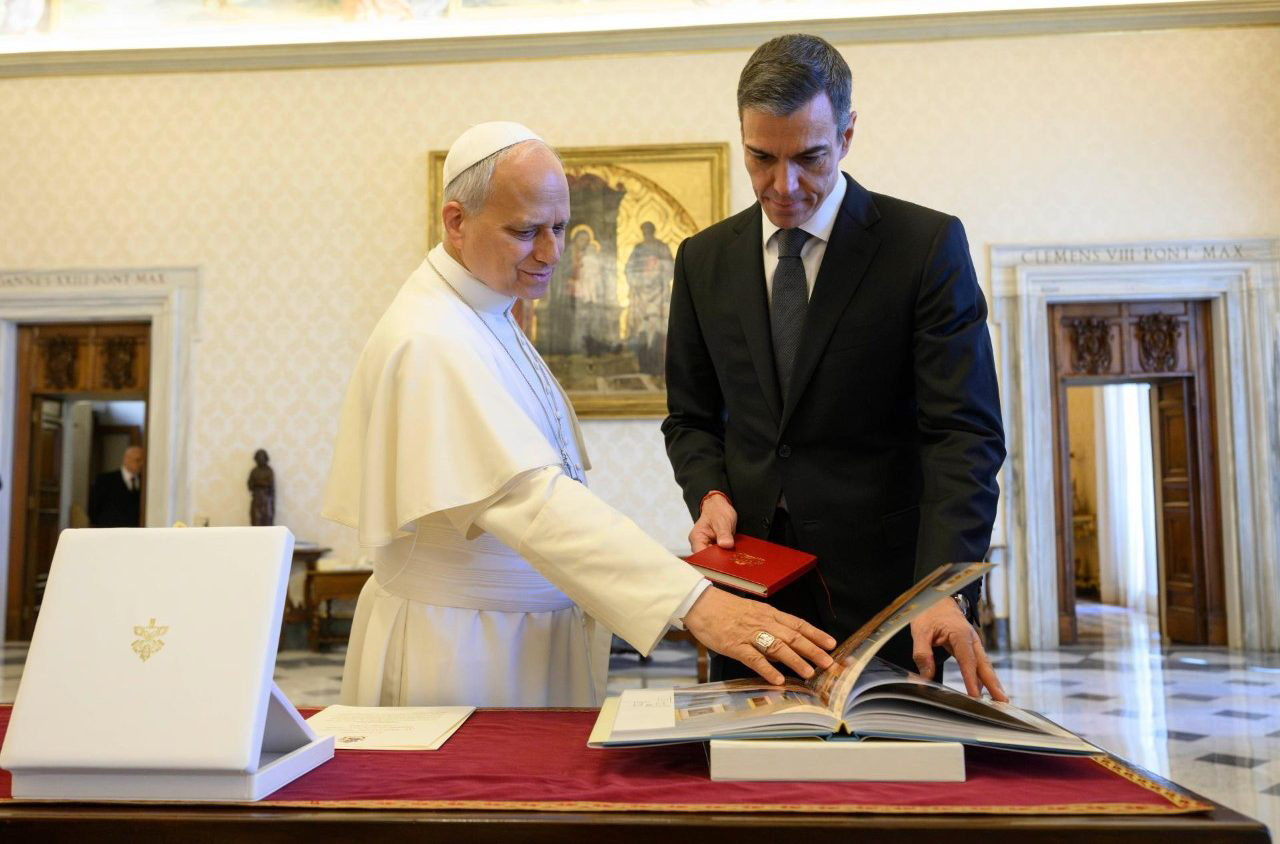
The papal visit also occurs as Sánchez’s Socialist Party is under mounting pressure from corruption investigations that have dominated Spanish headlines.
Leo will be the first pope to deliver a speech at the Spanish parliament, Las Cortes, on Monday in Madrid. It will be a chance for him to call for “disarmament” not only in war but also in political rhetoric and speak on behalf of the church’s view on bioethics.
As for the rest of the papal visit, it will be a test to see how well the pope disentangles himself from political interest. “The greatest mistake any government could make,” said the former mayor of Madrid Alberto Ruiz-Gallardón, “would be to seek political advantage from Pope Leo’s visit to our country.”
Migration and the peripheries
Migration is fueling polarization not just in Spain but in many parts of the Western world. Roughly 19% of the 49.1 million inhabitants of Spain were born outside the country, according to Spain’s National Statistics Institute, with the majority hailing from Morocco, Colombia and Venezuela.
“The migration issue is a very sensitive issue in Spain,” said the Rev. Fernando Redondo, a former missionary who now heads the migration office of the Spanish bishops’ conference. “We’re worried here, because the European pact on immigration, the policy at the European level, is restrictive. It’s not to build bridges but to erect walls,” he added.
But it’s migrants, especially from Latin America, who are filling the pews and animating the churches in Spain, Redondo said, adding that the majority of baptisms and weddings are for immigrants.
Leo will likely address migration during several stops of his trip, but especially at the Canary Islands, a key point in the Atlantic route, where he will meet organizations assisting migrants and migrants themselves in Gran Canaria and at the Las Raíces Center in Tenerife.
“The pope is going to stand in the same spot where migrants arriving by boat from Senegal and elsewhere arrive almost helpless, almost breathless, and many die on the way,” Restán said.
In “Magnifica Humanitas,” Leo’s first encyclical, the pope described the treatment of migrants and refugees as “a litmus test for social justice today.” He will likely articulate his take on the church’s stance on migration again in the Canary Islands, where his message has a chance to ripple across the Atlantic.
Following in Pope Francis’ footsteps, Leo will ensure that the peripheries remain at the center of his papal visit. On his first day, immediately after the formal greetings with Spain’s royal family, Leo will visit the CEDIA, a center for homeless people in Madrid.
Elmer León Calderón, a 60-year-old Peruvian migrant living at CEDIA, said he came to Spain nearly four years ago but was forced to live on the streets after being scammed. He said the papal visit to the center is a “privilege” and a “blessing.”
“Maybe God brought me from so far away here for that purpose,” he added.

Secularization, popular piety and the Gen Z ‘revival’
While many Spaniards still identify as Catholics, only about 18% are practicing, according to a 2025 study by the American University of Madrid. “Spain is a very secular country, and fundamentally anticlerical,” said Federico de Montalvo Jääskeläinen, constitutional law professor at Comillas/ICADE, during a conference at the LUMSA university in Rome.
But culturally, the country still engages in major religious events of popular piety, and that’s exactly where Leo will be going to inject new zeal among the faithful. On Sunday, he will guide the Corpus Christi procession through the streets of Madrid, which has grown in popularity in recent years, according to the Madrid Archdiocese.
Sara de la Torre, spokesperson for the archdiocese, said it will be “a historic moment.”
The pope will also give a golden rose to the beloved statue of Our Lady of Almudena in Madrid, and he will visit the historic sanctuary of Montserrat, which draws over 2.5 million pilgrims every year to venerate the Black Madonna, referred to as La Moreneta.
Leo will also speak to the youth in Spain, which like in other parts of Europe and some areas in the United States is displaying a renewed interest in religiosity. There has been a spike in curiosity toward the Catholic faith among Generation Z in Spain, according to a survey on 10,000 young people by GAD3, a market research and consultancy firm in Spain.
“It’s not God who is in fashion. What is new in this moment, in this visit of the pope, is that God is no longer a taboo anymore,” said Narciso Michavila Núñez, president and founder of GAD3, at the LUMSA event.
Leo will hold a prayer vigil and Eucharistic adoration with an expected 200,000 young people at Plaza de Lima in Madrid on Saturday. Thirty young people from different walks of life will have a chance to ask the pope questions, and organizers suggest there might be a surprise appearance by Puerto Rican singer Bad Bunny through video link as he performs in the nearby Metropolitano stadium.
A church that engages with the culture
Speaking to journalists on Wednesday, Vatican spokesperson Matteo Bruni identified “dialogue and culture as bridges to overcome polarization” as a key theme of the papal visit to Spain. Pope Leo will meet with representatives from the worlds of culture, sports, business and education on Sunday at the Movistar Arena, where he will also hear a testimony written and performed by famed actor Antonio Banderas.
“It will be a meeting in which Madrid’s civil society can explain to the pope how people are living, what the cultural movements are, what the concerns are,” said de la Torre.
The pope will celebrate Mass at the famed Sagrada Familia basilica in Barcelona on Wednesday, the centenary of the death of its architect Antoni Gaudì. There, Leo will inaugurate the Tower of Jesus, a center point of the city’s skyline.
“Having this tower rising there, in the center, [is] a reminder: Christianity is not a medieval issue; it is a contemporary issue,” Restán said.
Original Source: