Religions Around The World

In the early morning hours, monks can be seen walking on their alms round in Kanchanaburi, Thailand
Showing humility and detachment from worldly goods, the monk walks slowly and only stops if he is called. Standing quietly, with his bowl open, the local Buddhists give him rice, or flowers, or an envelope containing money.  In return, the monks bless the local Buddhists and wish them a long and fruitful life.
Christians Celebrate Good Friday
Enacting the crucifixion of Jesus Christ in St. Mary's Church in Secunderabad, India. Only 2.3% of India's population is Christian. 
Ancient interior mosaic in the Church of the Holy Saviour in Chora
The Church of the Holy Saviour in Istanbul, Turkey is a medieval Byzantine Greek Orthodox church.
Dome of the Rock located in the Old City of Jerusalem
The site's great significance for Muslims derives from traditions connecting it to the creation of the world and to the belief that the Prophet Muhammad's Night Journey to heaven started from the rock at the center of the structure.
Holi Festival in Mathura, India
Holi is a Hindu festival that marks the end of winter. Also known as the “festival of colors”,  Holi is primarily observed in South Asia but has spread across the world in celebration of love and the changing of the seasons.
Jewish father and daughter pray at the Wailing Wall in Jerusalem, Israel.
Known in Hebrew as the Western Wall, it is one of the holiest sites in the world. The description, "place of weeping", originated from the Jewish practice of mourning the destruction of the Temple and praying for its rebuilding at the site of the Western Wall.
People praying in Mengjia Longshan Temple in Taipei, Taiwan
The temple is dedicated to both Taoism and Buddhism.
People praying in the Grand Mosque in Ulu Cami
This is the most important mosque in Bursa, Turkey and a landmark of early Ottoman architecture built in 1399.
Savior Transfiguration Cathedral of the Savior Monastery of St. Euthymius
Located in Suzdal, Russia, this is a church rite of sanctification of apples and grapes in honor of the Feast of the Transfiguration of the Lord.
Fushimi Inari Shrine is located in Kyoto, Japan
It is famous for its thousands of vermilion torii gates, which straddle a network of trails behind its main buildings. Fushimi Inari is the most important Shinto shrine dedicated to Inari, the Shinto god of rice.
Ladles at the purification fountain in the Hakone Shrine
Located in Hakone, Japan, this shrine is a Japanese Shinto shrine.  At the purification fountain, ritual washings are performed by individuals when they visit a shrine. This ritual symbolizes the inner purity necessary for a truly human and spiritual life.
Hanging Gardens of Haifa are garden terraces around the Shrine of the Báb on Mount Carmel in Haifa, Israel
They are one of the most visited tourist attractions in Israel. The Shrine of the Báb is where the remains of the Báb, founder of the Bábí Faith and forerunner of Bahá'u'lláh in the Bahá'í Faith, have been buried; it is considered to be the second holiest place on Earth for Bahá'ís.
Pilgrims praying at the Pool of the Nectar of Immortality and Golden Temple
Located in Amritsar, India, the Golden Temple is one of the most revered spiritual sites of Sikhism. It is a place of worship for men and women from all walks of life and all religions to worship God equally. Over 100,000 people visit the shrine daily.
Entrance gateway of Sik Sik Yuen Wong Tai Sin Temple Kowloon
Located in Hong Kong, China, the temple is dedicated to Wong Tai Sin, or the Great Immortal Wong. The Taoist temple is famed for the many prayers answered: "What you request is what you get" via a practice called kau cim.
Christian women worship at a church in Bois Neus, Haiti.
Haiti's population is 94.8 percent Christian, primarily Catholic. This makes them one of the most heavily Christian countries in the world.

A Catholic solution to gender bias in AI

(RNS) — The widespread analyses of Pope Leo XIV’s encyclical, “Magnifica Humanitas,” overlook one thing: Artificial intelligence is inherently male. 

Most people think of AI as a tool to summarize information through what are called large language models. The problem: LLMs are trained by men, and most of the data and information available has been created by men. Most of the programmers teaching AI to “think” are men. So, AI decision-making and prediction behaviors are essentially male.

No wonder the pope has called for “disarmament” of AI. Men go to war.

The world is a mess. Can AI help?

Maybe yes. Maybe no.

These are Pope Leo’s answers in “Magnifica Humanitas,” which he released on Monday (May 25) along with three cardinals, two female professors and Christopher Olah, co-founder of the AI giant Anthropic.


Olah specializes in reverse engineering neural networks at Anthropic. That means he looks inside the machine, as it were, trying to understand how it learns, how it “thinks,” how it makes decisions. But almost everything he studies comes from the male point of view.

The male viewpoint dominates AI answers, AI algorithms, AI predictions and AI decisions from start to finish.

Would “gender-neutral” be any better?

No.

If the trainers aim for complete removal of gender, if gender drops from the equation, and everything entered into AI machines is nonbinary, AI’s responses and decisions are still likely male-oriented, since the general default in language is male.
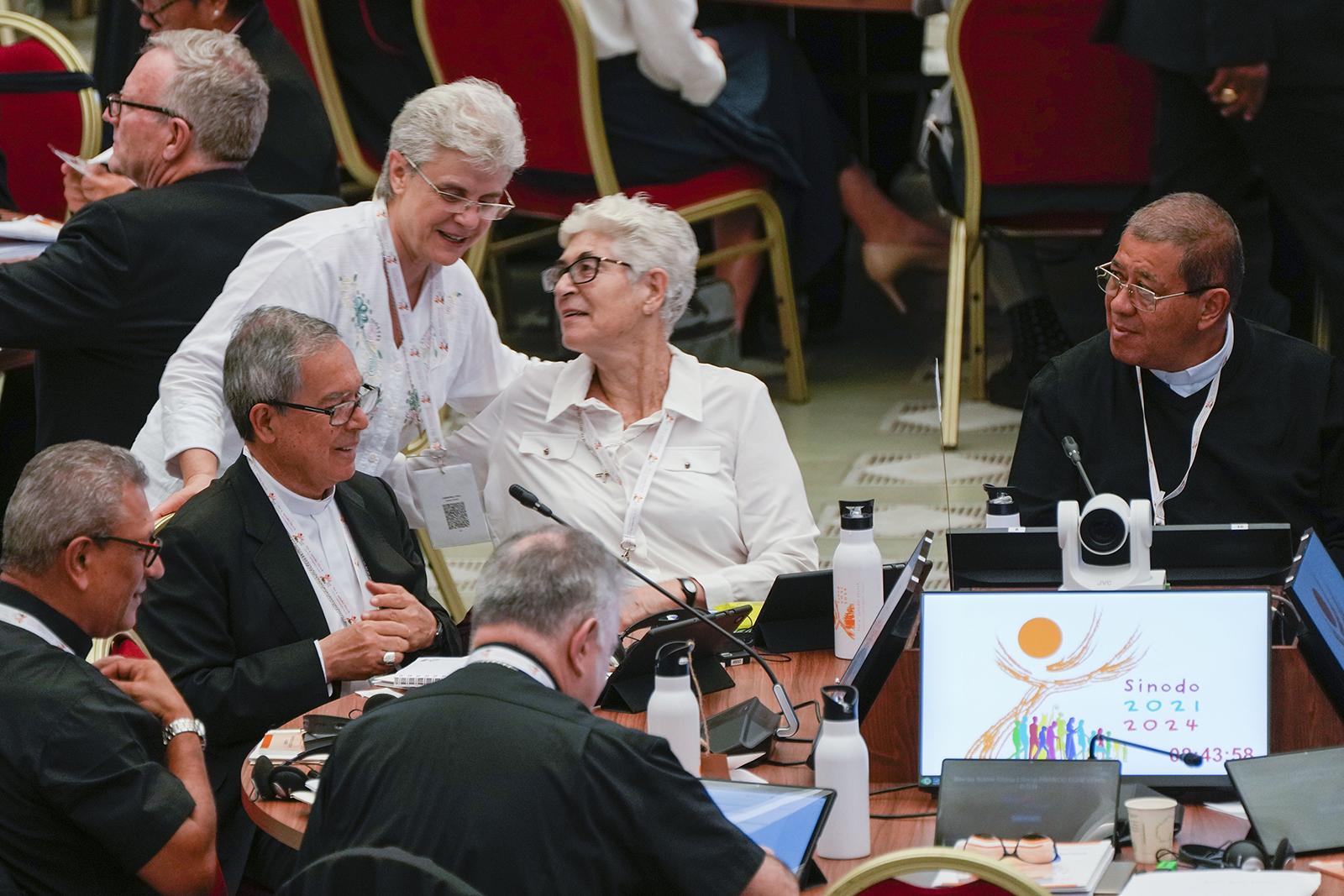
So, is there a solution? Where can it be found?

Suggestion: synodality and synodal reciprocity. “Reciprocity” is a word threaded throughout the final document of the years-long (and continuing) Synod on Synodality, begun by Pope Francis in 2021. Reciprocity requires the views of males and of females to be positively, if not equally, considered. It is a matter of epistemology — of how we know and understand. Humans are gendered, embodied beings and possess different outlooks. Reciprocity attempts to merge the outlooks. The concept of “reciprocity” denies the epistemological error that sees the male and female as existing and defined only in opposition to each other. It also argues that the combination of viewpoints is more likely to arrive at a balanced answer to whatever question arises.

Can synodality survive in the Catholic Church, and can AI be useful, when both the church and AI default to a male point of view? If the search is for truth, only reciprocity can produce balanced, some would argue correct, questions and answers.


As the American poet E.E. Cummings once wrote, “Always the more beautiful answer, who asks the more beautiful question.”

Pope Leo is asking the right questions. He wrote, “when AI systems present themselves as neutral and objective, they end up reflecting and reinforcing the stereotypes or ideological bias of their designers and developers.” (#102)

One can only hope that the views of women will be added to the equation.


Original Source:

https://religionnews.com/2026/05/29/a-catholic-solution-to-gender-bias-in-ai/