This story is part of RNS’ Love Thy Neighbor series. You can read all the stories here.
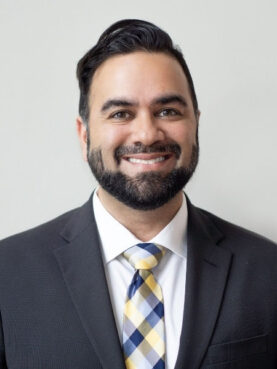
(RNS) — In the months after Oct. 7, 2023, Shariq Ghani, the 44-year-old Muslim executive director of the Houston-based civic multifaith nonprofit Bridges, began hosting regular, emergency meetings with Jewish and Muslim community partners in the city.
Interfaith relations in Texas — like the rest of the country — were tense. As the war in Gaza progressed, reported incidents of anti-Muslim and anti-Jewish hate crimes, discrimination and harassment skyrocketed across the state and the U.S.
While such polarization over politics, culture and religion isn’t a new issue facing interfaith collaboration, Ghani said he’s seen it exacerbated since the 2016 elections, and again after the Oct. 7 Hamas attacks on Israel, and the ensuing Gaza and Iran wars. He wanted Bridges — founded by Muslim Texans 16 years ago amid rising prejudice after 9/11 — to work with its partners to find ways of maintaining dialogue when old models were failing and fewer people were reaching across political, religious and cultural barriers, he told RNS. Formerly called the Minaret Foundation, it had led “common ground” efforts like advocacy for child welfare, food security and religious freedom.
While these efforts are still a priority, Ghani said he found the group needed to pivot to talking directly about the “divisive topics, the elephants in the room,” in order for the partners to keep working together constructively.
A first case study came in December 2025, when Bridges brought together Jews and Muslims to talk about the Israeli-Palestinian conflict. It was Bridges’ Muslim-Jewish Christmas gathering, or what Ghani called “an event for people with nothing else to do that day.” Traditionally centered on fellowship, they changed course to foster hard dialogue on the conflict.
Several months and discussions later, Bridges’ approach to tackling hard topics straightforwardly seems to be working — despite discomfort. After the conversations, participants said they were surprised by what they found out and their ability to work together afterward.
For that first Christmas discussion, dialogue participants were placed in small groups to discuss how their faith, lived experiences and understanding of history shaped their views. They also considered how xenophobia toward Palestinians and Israelis alike affects communities globally — including in Houston, one of America’s most religiously diverse cities, where an estimated 120,000 Muslims and 65,000 Jews live alongside sizable Hindu, Sikh and Buddhist communities.
The format emphasized peer-to-peer conversation — no panels, no stage, no moderator. Participants were given equal time to speak, while clergy attended only as observers. Two volunteers first modeled a discussion before the broader group began conversations.
“People really talked to each other. They were very direct, no sugarcoating,” Ghani said. “It was uncomfortable at times, but nobody stormed out. They listened, they shook hands, they hugged, they cried.”
Bridges staff told RNS they thought the new model was successful because it brought together people of goodwill in a structured way. It did not marginalize diverging viewpoints and instead encouraged honesty and vulnerability.
Some participants, who asked to be kept anonymous, said they were surprised because “some of the strongest critics of Israeli policy were Jewish” and “many Muslims spoke out so strongly against Hamas” and Palestinian leadership. Simple revelations like this, they said, broke down stereotypes among participants. Others said they were moved when participants from each community shared family histories that broke down misconceptions.

Aqib Irshad, a Pakistani American software engineer and board member at Clear Lake Islamic Center in Houston, initially feared that discussions would devolve into conflict, but he instead found people “laughing, talking, making jokes, eating together.” He said each potluck he attended allowed him to learn something new as he could also share his perspective with members of other faiths.
Yvette Pintar, another participant and a board member at the Jewish Community Center of Houston, discussed her family’s close ties with a Palestinian Christian family. Their relationship, she said, reinforced the importance of “showing up for difficult conversations” and working together to promote peace.
“We really need to continue to have more of this kind of hard dialogue, people willing to put themselves out there, talking about perceptions of people in the other group, about how our own group is misunderstood,” Pintar said.
In the months to follow, Bridges staff continued experimenting with the direct dialogue model, hosting programs about other “elephants in the room,” as they called it, in the Texas political landscape — specifically, immigration and adolescent gender identity. These dialogues this spring brought in hundreds of participants, some affiliated with Houston houses of worship, for potluck meals.

In a midterm election year, Julianne Ho, a policy analyst at Bridges, told RNS that “there’s a lot of buzz around the role of faith in the Texas political landscape,” making it the right time to begin these conversations.
Ho pointed out that while some Christian candidates in the state use their religion to promote progressive causes, others use Christian rhetoric to run campaigns hostile to diversity. “Faith is essential to the identity claim in Texas,” Ghani interjected. “But what really concerns us right now in this current environment is a weaponization of faith.”
Recent opposition to a proposed Muslim values–aligned housing development near Plano, Texas, has drawn national attention. Also in the last year, Texas Gov. Greg Abbott moved to designate the Council on American-Islamic Relations a terrorist organization due to alleged connections with the Muslim Brotherhood and Hamas, which CAIR has denied and called “defamatory.” And recently, Muslim parents sued Texas leaders for excluding them from a private school voucher program.
Ho said anti-Catholic and anti-Hindu rhetoric, primarily targeting immigrants from Latin America and South Asia, has also risen. Antisemitism also looms large in Texas as synagogues and Jewish communal organizations have seen vandalism and violent threats across the state. And campus battles continue, leaving many Jewish and Muslim students feeling vulnerable.
The Rev. Justin Elder, Bridges’ Christian outreach coordinator and pastor at the Houston-based House Church Collective, said immigration enforcement and migrant rights had become painfully polarizing issues in his evangelical community. He said one of his favorite parts of the potlucks was realizing he agreed with Jews or Muslims on some points rather than his fellow Christians.
“If you live in your echo chamber or your algorithm, it’s very easy for someone to be manipulated and it’s very easy to demonize an entire community of people without knowing a single member of their community,” he said.
He said this kind of interfaith engagement has challenged assumptions both about his community and within it. Many evangelicals are migrants or refugees themselves, and many in evangelical churches have spoken out against immigration policy enforcement in the state, he said. This surprised some people in the dialogue session, as white evangelicals have tended to support Republicans and a majority voted for Donald Trump in 2024.
One participant, Alan Brochstein, said that while he appreciated the conversations to help build “peace and justice,” he added that “it tends to be the same people who generally come to these spaces over and over, who already have a willingness to engage in this dialogue.
“It would be nice if it were possible to reach people who aren’t so open,” he said.
At the same time, Ghani said tense and painful moments emerged, causing real anguish for some participants.
“We’ve had events where the rooms got uncomfortable,” he said. “People have said things that hurt others, like ‘the Holocaust didn’t happen’ or ‘All of you are Hamas,’ and that’s where we’ve had to do serious repair work afterward.”
However, he said he believed those situations weren’t failures, but rather evidence of the model working “because hard conversations are meant to create conflict.”
“How we guide that conflict is going to be important,” he said. “We have to really work through it, and they can actually do that when they’re deeply in thought and they want to have a relationship and they want to engage in a meaningful way.”
Jim Uschkrat, a 73-year-old Lutheran participant and retired energy executive, said he’d come to respect many different points of view over the years, thanks in part to Bridges’ facilitation of dialogue. “We can be a model for the rest of the country,” he said.

Elsewhere, Muslim civic leaders voiced similar desires to engage in dialogue across divides.
Zainab Khan, president and founder of the Chicago-based Muslim American Leadership Alliance, said her organization has faced criticism from some in the Muslim community for its willingness to work with synagogues and Jewish groups, as well as for platforming of LGBTQ Muslims. However, she said she believes working with such communities is essential to advancing the needs of the diverse Muslim community in America.
Anila Ali, president of the California-based American Muslim & Multifaith Women’s Empowerment Council, also said such relationships gave her the strength to navigate the most challenging moments of interfaith leadership — after 9/11, and again after Oct. 7.
“As Muslims faced hate after 9/11, rabbis called us to say they stood with us, and Jewish friends told us, ‘We will stand outside your mosque during prayer, we will form a circle around you if anyone comes to harm you,’” she told RNS. “They stood up for us. I did not forget. So, after Oct. 7, I knew I had to speak out against the hatred of our Jewish brothers and sisters.”
Back in Houston, Bridges plans to continue its experimental dialogue as midterm season progresses.
“Faith can either divide or bring people together,” Ghani said. “For us, it builds bridges. And if in Texas, we can get it right, then we’re a light for the 49 other states.”
The RNS Love Thy Neighbor series is made possible by support from Faith in Public Life, Garrett-Evangelical Theological Seminary, the Center for Congregations, The Fetzer Institute and readers like you. Support this work with a gift today.
Original Source: