(The Conversation) — Defense Secretary Pete Hegseth’s conservative evangelical religious beliefs drew attention even before his confirmation hearings in January 2025. He is a member of the Communion of Reformed Evangelical Churches – CREC – whose beliefs have been influenced by a 20th-century movement called Christian Reconstructionism.
Many CREC leaders call for the implementation of biblical law and a theocratic state structured on Christian patriarchy. Theocratic states are ruled according to religious laws, which in the case of the CREC means a conservative evangelical understanding of Christianity.
The CREC website claims to have over 160 churches and parishes spread across North America, Europe, Asia and South America.
Hegseth’s use of religious language and prayers has raised questions about his religious beliefs in relation to his role as secretary of defense. At a prayer service on March 25, 2026, during the current war in Iran, Hegseth said, “Let every round find its mark against the enemies of righteousness and our great nation.” He went on to add: “Give them wisdom in every decision, endurance for the trial ahead, unbreakable unity, and overwhelming violence of action against those who deserve no mercy.”
As a scholar of the Christian right, I have studied the CREC. To understand Hegseth’s rhetoric, it is helpful to understand what the CREC is and its controversial leadership.
What is the CREC?
The CREC church is a network of churches across the globe. It is associated with the congregation of Doug Wilson, the pastor who founded Christ Church in Moscow, Idaho. Christ Church is the flagship church of the CREC and operates as a denominational headquarters. Wilson grew up in the town, where his father was an evangelical minister.
Wilson co-founded the CREC in 1993 and is the public figure most associated with the network of churches. Christ Church operates as the hub for Logos Schools, Canon Press and New Saint Andrews College, all located in Moscow.
Logos is a set of private schools and homeschooling curriculum; Canon Press is a publishing house and media company; and New Saint Andrews College is a university. All of these were founded by Wilson and associated with Christ Church. All espouse the view that Christians are at odds with – or at war with – secular society.
While he is not Hegseth’s pastor, Wilson is the most influential voice in the CREC, and the two men have spoken approvingly of one another.
Hegseth invited Wilson to give a prayer service at the Pentagon in February 2026. Wilson told the assembled military members, “If you bear the name of Jesus Christ, there is no armor greater than that. Not only so, but all the devil’s R&D teams have not come up with armor-piercing anything.” In other words, Wilson tied the success and safety of military members and their missions to a belief in Jesus Christ and the military’s enemies as agents of the devil.

Pastor Doug Wilson leads others at a protest in Moscow, Idaho.
Geoff Crimmins/The Moscow-Pullman Daily News, CC BY-SA
As Wilson steadily grew Christ Church in Moscow, Idaho, he and its members sought to spread their message by making Moscow a conservative town and establishing churches beyond it. Of his hometown, Wilson plainly states, “Our desire is to make Moscow a Christian town.”
The CREC doctrine is opposed to religious pluralism or political points of view that diverge from its theology. On its website, the CREC says it is “committed to maintaining its Reformed faith, avoiding the pitfalls of cultural relevance and political compromise that destroys our doctrinal integrity.”
CREC churches adhere to a highly patriarchal and conservative interpretation of Scripture. Wilson has said that in a sexual relationship, “A woman receives, surrenders, accepts.”
Church-state separation
In a broader political sense, CREC theology includes the belief that the establishment clause of the Constitution does not require a separation of church and state. The most common reading of the establishment clause is that freedom of religion prohibits the installation of a state religion or religious tests to hold state office.
According to scholar of religion Julie Ingersoll, in this religious community there is “no distinction between religious issues and political ones.”
The CREC broadly asserts that the government and anyone serving in it should be Christian. For Wilson, this means Christians and only Christians are qualified to hold political office in the United States.
‘Church planting’
Scholar of religion Matthew Taylor explained in an interview with the Nashville Tennessean, “They believe the church is supposed to be militant in the world, is supposed to be reforming the world, and in some ways conquering the world.”
While the CREC may not have the name recognition of some large evangelical denominations or the visibility of some megachurches, it boasts churches across the United States and internationally.
Like some other evangelical denominations, the CREC uses “church planting” to grow its network. Planted churches do not require a centralized governing body to ordain their founding. Instead, those interested in starting a CREC congregation contact the CREC. The CREC then provides materials and literature for people to use in their church.
CREC controversies
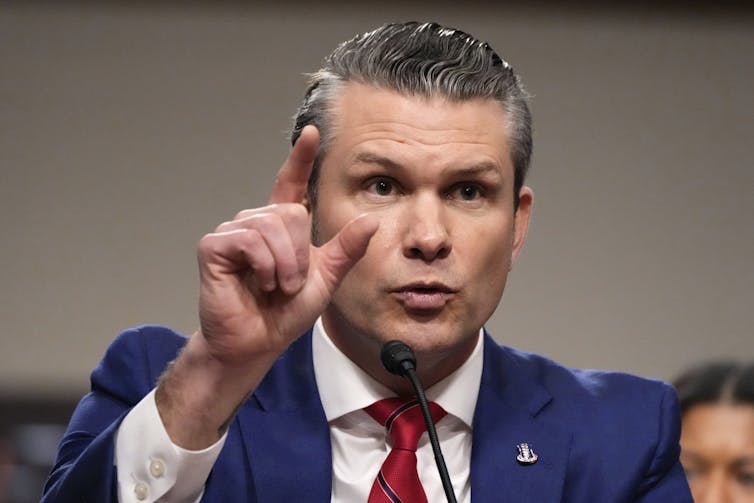
Pete Hegseth at his confirmation hearing in Washington, D.C., on Jan. 14, 2025.
AP Photo/Alex Brandon
As the church network has grown, it has drawn attention and scrutiny. In 1996, Wilson published a book positively depicting slavery and claiming slavery cultivated “affection among the races.”
Accusations of sexual abuse and the church’s handling of it have also brought national news coverage. Vice media’s Sarah Stankorb interviewed many women who talked about a culture, especially in marriage, where sexual abuse and assault was common. That reporting led to a podcast that details the accounts of survivors. In interviews, Wilson has denied any wrongdoing and said that claims of sexual abuse would be directed to the proper authorities.
Hegseth’s actions in May and June of 2025 as secretary of defense concerning gender identity and banning trans people from serving in the military, in addition to stripping gay activist and politician Harvey Milk’s name from a Navy ship, brought more attention to the CREC.
Hegseth’s religious rhetoric
As the Trump administration engages in military conflicts around the globe, Hegseth often uses religious language to justify them.
In a March 5, 2026, speech to South American and Central American leaders, Hegseth justified intervention in Venezuela, the blockade of Cuba and the attacks on boats across the region by invoking a shared Christian identity.
Hegseth said, “We share the same interests, and, because of this, we face an essential test – whether our nations will be and remain Western nations with distinct characteristics, Christian nations under God, proud of our shared heritage with strong borders and prosperous people, ruled not by violence and chaos but by law, order, and common sense.”
Hegseth’s comments about Iran since bombing began on Feb. 28 have also invoked religion. Some of these invocations align with Hegseth’s recurring references to the Crusades in the Middle Ages – a centuries-long holy war between Christians and Muslims. Hegseth has a tattoo that says “Deus Vult” – “God wills it” – the rallying cry of Crusaders, another with the Arabic word for infidel, and the Jerusalem cross, a prominent Christian nationalist symbol. He also published a book titled “American Crusade.”
In framing the use of overwhelming force in Iran, Hegseth said, “We’re fighting religious fanatics who seek a nuclear capability in order for some religious Armageddon.”
As long as Hegseth remains the secretary of defense, his affiliation with the CREC and religious language will likely provide insight into how these conflicts are managed at home and abroad.
This is an updated version of a piece first published on June 20, 2025.
(Samuel Perry, Associate Professor of Rhetoric, Baylor University. The views expressed in this commentary do not necessarily reflect those of Religion News Service.)

Original Source: