WASHINGTON (RNS) — On Wednesday (April 8), Vice President JD Vance stood in front of Air Force Two in Budapest and was confronted with the latest chapter in an emerging, global drama: rising tensions between the U.S. military and religious leaders.
Standing on the tarmac in Hungary, where the vice president spoke at an electoral rally for that country’s president, Viktor Orbán, Vance was asked by a reporter about a Free Press article that had been rapidly spreading online. The report, which cites unnamed Vatican officials, alleges military leaders invited then-Apostolic Nuncio to the U.S. Cardinal Christophe Pierre to the Pentagon for a meeting in January. The cleric was, according to The Free Press, reportedly dressed down by officials, who insisted the Catholic Church take the U.S. government’s side in military matters.
In response, Vance initially said he did not know who Pierre was, before reversing course after being reminded of the cleric’s former role as nuncio. The vice president then explained he had not seen the report, and wanted to speak with Pierre — who resigned his nuncio post in March — and administration officials to discern “what actually happened” before commenting further.
Religion News Service has been unable to independently confirm many of the details of the story, including the claim that a military official invoked the Avignon Papacy during the Pentagon meeting — a bleak era of church history when the 14th-century French monarchy exerted significant power over the papacy. But in a statement sent to RNS on Wednesday afternoon, a Department of Defense official confirmed the meeting occurred, while disputing The Free Press’ assessment.
“The Free Press’s characterization of the meeting is highly exaggerated and distorted,” the statement read. “The meeting between Pentagon and Vatican officials was a respectful and reasonable discussion. We have nothing but the highest regard and welcome continued dialogue with the Holy See.”
The controversy surrounding the meeting is likely to further inflame religious pushback to an unusual wave of spiritual saber-rattling by President Donald Trump’s administration — particularly surrounding the U.S. government’s military actions in Iran, which the president himself has suggested are the will of God. Combined with his other incendiary remarks about the war, the increase in faith-filled militaristic rhetoric is pitting Trump and his administration against a growing list of faith leaders, ranging from local clergy to the pope.
Faith leaders have reacted with frustration to the administration’s penchant for invoking the divine when discussing the Iran war, which was on full display earlier Wednesday when Secretary of Defense Pete Hegseth led a press briefing at the Pentagon on the five-week-long war with Iran. After insisting Tuesday evening’s fragile ceasefire deal between the U.S. and Iran was evidence of a broader military victory, the secretary intimated the pause in fighting was the result of divine intervention.
“Our troops, our American warriors deserve the credit for this day, but God deserves all the glory,” Hegseth said. “Tens of thousands of sorties, refuelings and strikes carried out under the protection of divine providence. A massive effort with miraculous protection.”
By Wednesday afternoon, reports had emerged of the U.S.-Iran ceasefire already under stress, with both sides threatening to resume attacks.
Trump, a nondenominational Christian, has also made references to faith when discussing the war in Iran. When asked by a Washington Post reporter on Monday during a press briefing whether he believes God is on the side of the U.S. in the war, the president responded, “I do, because God is good.”

He then added: “And God wants to see people taken care of.”
Trump’s certainty contrasted with remarks offered the next day by Vance, a Catholic, who was more cautious when asked the same question by the Post reporter.
“I think my attitude toward military conflict has always been to pray that we are on God’s side,” Vance said.
The administration’s emerging war theology has encountered fierce pushback from religious critics, especially when the president took to social media on Tuesday morning and threatened to eradicate Iran’s “entire civilization” if its government did not agree to his demands by that evening. He concluded the post with the phrase “God Bless the Great People of Iran!”
Pope Leo XIV called Trump’s civilizational threat “truly unacceptable” before calling on citizens of “all the countries involved” to contact their representatives and call for peace. The striking remarks came after weeks of Leo’s repeated criticism of war in general, and implied critiques of the U.S. in particular.
In his Easter message, the pontiff declared “let those who have weapons lay them down!” and called for a prayer vigil for peace on Saturday to be held in St. Peter’s Basilica. Similarly, on Palm Sunday, Leo said during Mass in St. Peter’s Square that God “does not listen to the prayers of those who wage war.” Leo celebrated Tuesday’s reports of a ceasefire in the conflict.

The White House told RNS in a statement on Wednesday that Trump’s foreign policy actions “have made the world safer, more stable, and more prosperous,” adding that the president received the support of Catholic voters in 2024 and that the “President’s administration has a positive relationship with the Vatican, which was strengthened when Vice President Vance attended the Pope Leo XIV’s inaugural mass last year.”
“The President has done more than any of his predecessors to save lives and resolve global conflicts, and following the completion of his military objectives in Iran, he is hopeful that the agreement under discussion can lead to a lasting peace in the Middle East,” according to the statement from White House Principal Deputy Press Secretary Anna Kelly.
Trump has also seen religious pushback for a separate Truth Social post on Easter Sunday, which featured threats to infrastructure in Iran — a Muslim-majority country — before concluding “Praise be to Allah.” The Council on American-Islamic Relations condemned the remarks, accusing the president of mocking Islam.
Comments from other administration officials and their allies have also sparked outcry. Much of the religious rhetoric has come from Hegseth, who converted later in his life to a small Reformed evangelical tradition associated with Doug Wilson, a controversial Idaho pastor and self-described Christian nationalist. It’s a community that has long mixed religious language with violent and warlike terminology. When Wilson’s church launched a new worship service in Washington, D.C., last year, the preacher of the inaugural Sunday sermon — which was delivered with Hegseth in the pews — kicked off his remarks with the declaration: “Worship is warfare.”
Hegseth, for his part, has opted for the reverse, infusing his military rhetoric with religious appeals. At a worship service last month at the Pentagon — a recurring monthly event organized by Hegseth himself — the secretary read a prayer, which he said was originally offered by an unnamed military chaplain to troops shortly before they captured then-Venezuelan President Nicolás Maduro.
“Let every round find its mark against the enemies of righteousness and our great nation,” Hegseth prayed. “Give them wisdom in every decision, endurance for the trial ahead, unbreakable unity, and overwhelming violence of action against those who deserve no mercy.”

The fusion of faith and war has been celebrated by at least some of Trump’s religious allies. That includes Franklin Graham, who led a prayer at a White House Easter gathering earlier this month in which he compared Trump to the biblical figure Esther, who saved her fellow Jews in ancient Persia — which is now Iran.
“You raised up Esther to save the Jewish people,” Graham said. “The Iranians, the wicked regime of this government wants to kill every Jew and destroy them with an atomic fire. But you have raised up President Trump. You’ve raised him up for such a time as this. And Father, we pray that you’ll give him victory.”
Religious frustration with such rhetoric was evident outside the White House in early April, when a group of clergy gathered for a rally opposing the war. The group, which included Christian and Jewish clergy as well as the local bishop with the Evangelical Lutheran Church in America, was led by the Rev. William Barber, a prominent anti-poverty activist and Disciples of Christ pastor who teaches at Yale Divinity School.
“It is shameful that religious nationalists like Franklin Graham and a host of others are calling Trump and his co-conspirators in Congress, and his Cabinet members, ‘God-sent leaders,’” Barber said at the gathering. “I’m so glad that Scripture corrects that. For it says, ‘Blessed are the peacemakers, for they shall be called the sons of God.’”
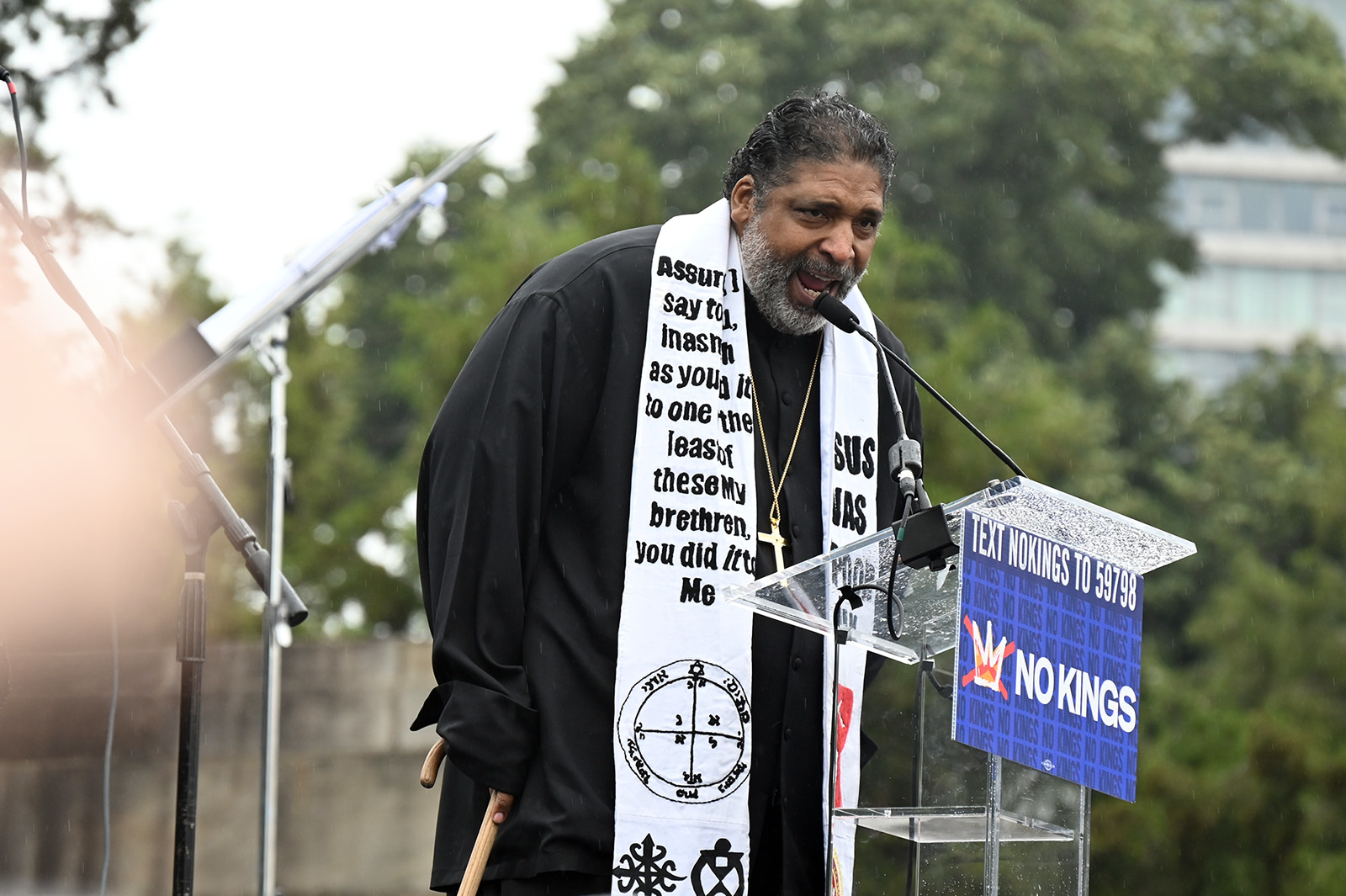
Barber was even more strident in a separate interview with RNS later that day.
“There is no scriptural basis, no witness of Jesus or the prophets that would line up from what Hegseth said, what Franklin Graham said, and what Trump is saying,” he said.
Barber said he intends to voice criticism of the administration’s religious justification for the war — as well as the war itself — as often as possible. The demonstration has become a weekly faith-led “Moral Monday” protest against outside the White House, which organizers say will continue until the war ends.
Original Source: