(The Conversation) — Several Shiite communities in South Asia recently refrained from celebrating Eid as they mourned the death of Iran’s supreme leader, Ayatollah Ali Khamenei. From Nigeria to Kashmir – well beyond the Gulf region – the assassination has stirred deep concerns among Shiite Muslims.
Shiite Islam is the official, and majority, religion of Iran. Shiite minorities in other countries tend to view Iranian leaders as protectors and have sometimes risked personal safety to protest the war.
As the violence expands around Tehran, Shiites are not only grieving the death of their leaders but also fear the loss of holy cities and shrines that anchor their collective memory.
Many of the cities targeted in the war today are home to these types of shrines, including Qom, Isfahan and Mashhad. In Isfahan, the 17th-century Jame Abbasi Mosque, also known as Shah Mosque, sustained damage during one of the airstrikes. After the ayatollah’s death, Shiites gathered at Imam Reza Shrine in Mashhad to mourn his loss. In a signal recognized by all Shiites, Iran raised the black flag at the shrine’s dome to mark the community’s shared grief.
Qom, located about 80 miles south of Tehran, has attracted much media attention because of the large-scale military attacks against it. Various social media platforms are showing destroyed buildings and plumes of smoke filling the skyline.
After Khamenei’s death, the city was targeted because the Assembly of Experts gathered there to elect his successor. Israel attacked Qom’s Shokouhiyeh Industrial Zone, known for its drone production companies.
With the news blackout in Iran and Gulf states, it’s impossible to know the impact of military operations on holy sites like Qom. Regardless of the level of material damage, Shiites are deploring the physical and spiritual assaults against their sacred landscape.
That’s because in Shiite Islam, grief is not only personal but collective. As a scholar of medieval Islam and Shiite piety, I have seen how this grief is expressed through rituals, pilgrimage and devotion to saints.
Redemptive suffering
Shared sorrow is a key part of Iran’s Twelver Shiite identity, which venerates the Prophet Muhammad’s family through daughter Fatima and cousin and son-in-law, Ali.
Fatima and Ali’s lineage is called the Imamate, with each individual imam recognized as a sinless spiritual leader. Each imam is responsible for providing guidance as the “proof of God” on earth.
Ali’s leadership and the imams’ leadership wasn’t recognized by all Muslims, however. Some of Muhammad’s companions and early leaders of the Umayyad dynasty, which ruled from 661-750 C.E., rejected their authority and punished their followers.
According to Shiite tradition, in 680 C.E. supporters of Ali’s family living in Kufa – in modern-day Iraq – appealed to Husayn, the prophet’s grandson, for assistance. They had refused to pledge their allegiance to the Umayyad Caliph Yazid because they viewed him as illegitimate and oppressive.
Husayn gathered a small group of friends and family, including wives, children and siblings, and headed to Kufa. Their party was intercepted outside the city, on the plains of Karbala, by Yazid’s forces led by Umar ibn Sa’d.
Cut off from water and vastly outnumbered, Husayn’s camp suffered for 10 days in the desert, and the Kufans never rallied to their defense. Desperate from thirst, Husayn rode out of the camp with his infant son to appeal for water, but an enemy archer shot an arrow through the child’s neck.
Tradition says that on the 10th of Muharram, Husayn and his companions met Yazid’s military on the battlefield and were massacred. Many of the men were beheaded and women captured; Umar ibn Sa’d marched the spiked heads and shackled women through various towns on the way back to Caliph Yazid in Damascus to deter further protest.
Husayn’s Kufan supporters acknowledged their failure to aid the imam and pledged to publicly atone. In 685 C.E. about 4,000 penitents revolted against Umayyads in Syria; the majority died.
Shiites worldwide still commemorate Husayn’s death at Karbala as a sacrifice for the community’s collective redemption.
Shiites frame their own suffering – from facing injustice to martyrdom – as symbolically participating in Husayn’s sacrifice. Public ceremonies include “taziyeh” plays performed during Muharram that recreate Husayn’s martyrdom and the public recitation of poetry dedicated to his family.
A sacred landscape
America and Israel associate holy sites such as Qom with underground bunkers, uranium plants and military headquarters. But for Shiites they are centers of pilgrimage, where the faithful seek connection with God, the imams and their sacred history.
Qom has universities and stunning sacred architecture that date back to the Safavids, a dynasty that ruled Iran from 1501 through 1736. Its seminary is the foremost clerical institution in the world, training students from Lebanon, Iraq and Afghanistan in a wide range of topics, including Shiite jurisprudence, Quranic interpretation and Arabic literature. Women also attend the seminary but with segregated classrooms and some course restrictions.
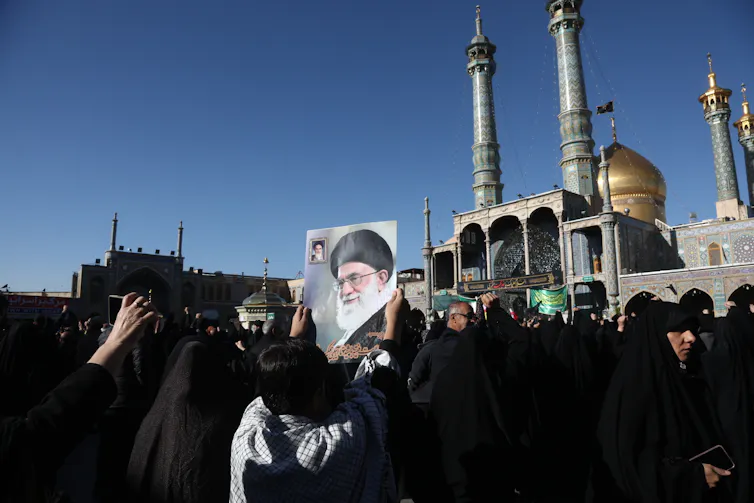
Iranians mourn the death of Khamenei in a U.S. attack during a demonstration at the Hazrat Masumeh shrine in the city of Qom, Iran, on March 1, 2026.
Stringer/Anadolu via Getty Images
Qom’s primary sacred site, the shrine of Fatima bint Musa, who died in 816 C.E., is one of the most important sacred sites for Shii Muslims worldwide and attracts millions of pilgrims each year.
Popularly known as Fatima Masuma, she is the daughter of seventh imam Musa al-Kazim and sister to the eighth imam, Ali al-Rida.
Iranian Shiites – known as Twelvers – believe there are 12 imams in the Prophet Muhammad’s family lineage with exalted spiritual status, and that the 12th imam never died but went into “hiding.” Shiites know the 12th imam as al-Mahdi, or the messiah: they believe he will return at the world’s end times to restore God’s justice and peace.
According to Fatima’s hagiographies, or popular sacred stories, she remained unmarried and devoted herself to scholarship. She’s known as a trustworthy transmitter of hadith – sayings from the prophet and his family – and she studied the Quran and jurisprudence. She’s especially revered in Shiite Islam because of her kinship with the imams.
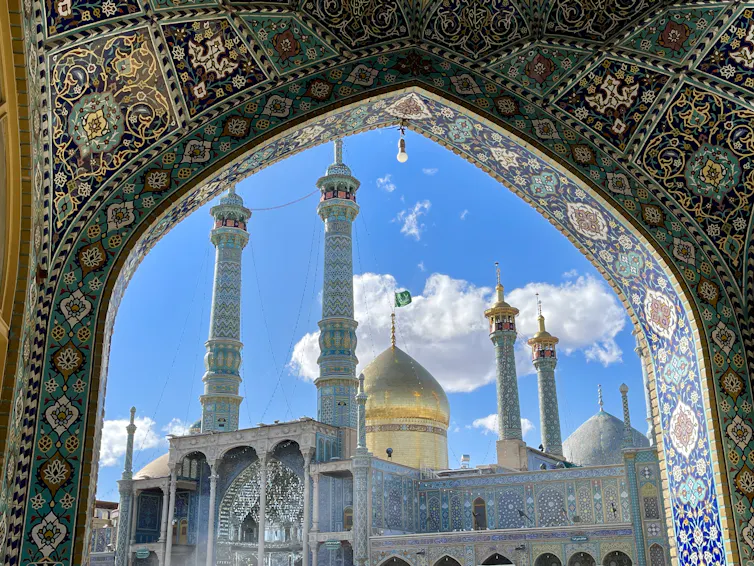
The shrine of Fatima Masumeh in Qom, Iran.
Mansoreh Motamedi/Moment via Getty images
Tradition notes that when Fatima’s father, Musa al-Kazim, was unable to meet visitors with spiritual questions, he directed them to consult his daughter.
During her lifetime, the Abbasid dynasty rose to power in Baghdad and quickly sought to curtail the imamate’s popularity because many Muslims viewed Ali’s family as the only legitimate rulers.
Saintly intercession
Just on the outskirts of Qom is a village called Jamkaran, home to another important pilgrimage site. According to tradition, the 12th imam, or Imam al-Mahdi, appeared to a devotee in the 10th century and requested a shrine be constructed.
From 1995 to 2005 the Iranian government greatly expanded the mosque complex and city infrastructure to support the millions of pilgrims who visit annually.
Shiites believe al-Mahdi is mysteriously present at the site and listens to their concerns. In a popular ritual of prayer and piety, visitors write personal requests on bits of paper and drop them down the “Well of Requests.”
Shiites share political pain and injustice not only with each other but also with the imams, bound in collective grief and prayers for redemption. These traditions help explain the powerful reactions seen across Shiite communities following attacks on sacred sites and the killing of Grand Ayatollah Khamenei.
(Mary Thurlkill, Professor of Religion, University of Mississippi. The views expressed in this commentary do not necessarily reflect those of Religion News Service.)

Original Source: