(RNS) — As Passover approaches, the Jewish people revisit the true moment of liberation, when the Israelites traversed the parted waters of the Red Sea: “The waters were split, and the Israelites went into the sea on dry ground, the waters forming a wall for them on their right and on their left” (Exodus 14:21-22).
Many Jews feel like, today, we are walking between similar walls — except the waters pressing in on us are not from a sea, but from antisemitism that emanates from both extremes of the political spectrum.
The wall on the left is epitomized by California Rep. Ro Khanna, a rising star on the Democratic Party’s progressive wing. He is not only stridently anti-Israel, he publicly aligns himself with antisemitic figures. In a recent social media post on X, Khanna said he supports Graham Platner, a candidate for Maine’s Democratic senatorial nomination who sports a tattoo that resembles the Nazi SS “death’s head,” and the far-left antisemitic streamer Hasan Piker who holds Israel responsible for Hamas’ savage Oct. 7, 2023, massacre.
On the right, there’s podcaster Tucker Carlson claiming, preposterously, that the Jewish movement, Chabad, has at least in part instigated the U.S.-Israeli war with Iran because it is obsessed with building the Third Temple on the Temple Mount. He warns us ominously that “Christians have a way of dying disproportionately in these wars, which tells you something about their real motive.” Carlson does not explicitly identify the “their.” He doesn’t have to.
Lest anyone consider Carlson to be an aberration, there’s always the erstwhile senior counterterrorism official, Joe Kent, who rooted his resignation from the Trump administration in the antisemitic conspiracy theory that the U.S. started the Iran war “due to pressure from Israel and its powerful American lobby.”
These walls demonstrate the horseshoe effect, a political theory that the views and strategies of the far-left and far-right are closer to one another than the political center. It is disheartening and worrisome.
On the right, there is a direct line from the late automobile manufacturer Henry Ford — who disseminated his antisemitic views in his weekly newspaper, the Dearborn Independent, and his International Jew pamphlets — to Father Charles Coughlin to Pat Buchanan to Carlson.
In 1920, Ford told the New York World, “The international financiers are behind all war. They are what is called the International Jew – German Jews, French Jews, English Jews, American Jews. I believe that in all these countries except our own the Jewish financier is supreme. … Here the Jew is a threat.”
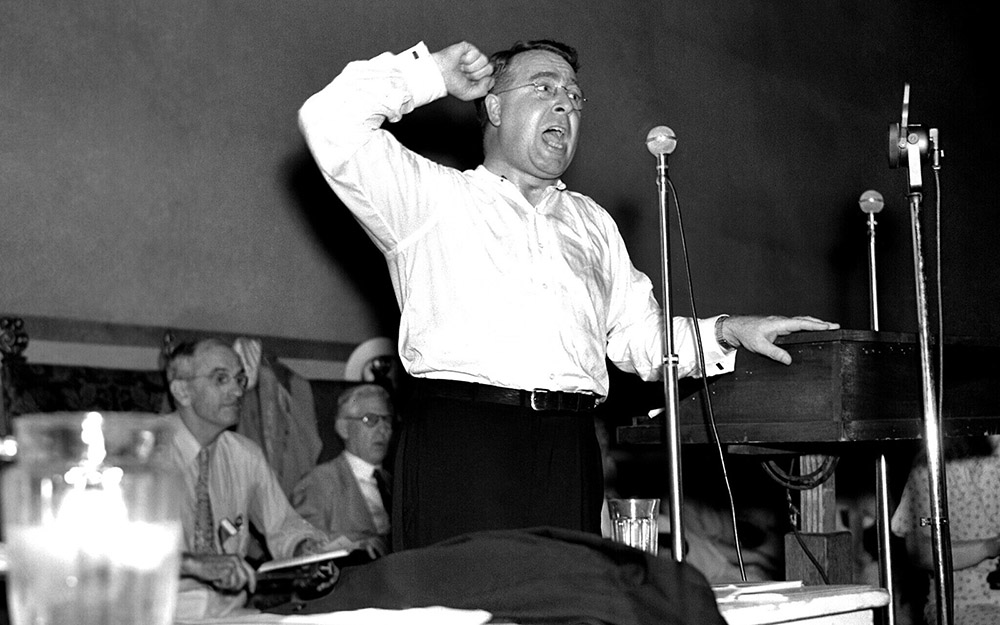
Coughlin was a hate-spewing Catholic priest whose radio programs had an audience of about 30 to 40 million listeners — roughly a quarter to third of the U.S. population at the time. In January 1939, he asked his listeners: “Must the entire world go to war for 600,000 Jews in Germany who are neither American, nor French, nor English citizens, but citizens of Germany?”
Jump to 1990. Buchanan, a political commentator and presidential candidate, warned that “the Israeli Defense Ministry and its amen corner in the United States” was pushing toward war in the Middle East, and that the Americans who would die in such a war were “kids with names like McAllister, Murphy, Gonzalez and Leroy Brown.” (And not, say, Shapiro. We got it.)
Fast-forward to today. In a widely circulated social media post, conservative political commentator Candace Owens wrote: “No group of people should have the power to censor speech the way Jewish elites do.”

None of this is new. It’s simply right-wing Jew hatred 2.0 — or, perhaps, 3.0. It’s like an app that constantly updates itself. None of us should be shocked.
On the left?
In 1843, Karl Marx’s essay, “On the Jewish Question” asked, “What is the worldly religion of the Jew? Huckstering. What is his worldly God? Money.”
The Soviet Union essentially created all modern rhetoric that portrays Israel as a colonial and racist project. The United Nations Resolution 3379 of 1975, which declared that “Zionism is a form of racism and racial discrimination,” came with a heavy side of Russian dressing. The resolution was repealed in 1991, but its language remains — on college quads, in faculty lounges and in political discussions.
Buffalo Springfield once sang: “There’s something happening here. What it is ain’t exactly clear.” Except, it is.
When the only country in the world that is deemed illegitimate is Israel; when haters portray Zionism as racist, colonialist and genocidal rather than the Jewish imperative to escape from persecution; when people deny Jewish self-determination in their ancestral homeland, but applaud every other national movement — the “something” that’s happening is absolutely clear. It’s antisemitism.
That anti-Zionism and antisemitism have crept into the Democratic Party — so much so that many centrist Jews who used to consider themselves proud Democrats are declaring themselves in political galut (exile).
So here we are: walls on the right, walls on the left. But the Exodus story also offers guidance for how to walk through that narrow corridor.
First, we must tell the story. Open the Haggadah of our times and name the plague of antisemitism in plain language. When the bitter herbs of antisemitic tropes appear, whether in conspiracy theories, political rhetoric or social media memes, call them out unapologetically for what they are.
Second, emulate Moses. Stand up to the ideological 21st-century pharaohs who de-legitimate Israel’s very right to exist.
Third, find allies. Sen. Ted Cruz, R-Texas, recently praised Sen. John Fetterman, D-Penn., for showing “extraordinary courage calling out antisemitism in his own party.” Cruz, meanwhile, is doing the same on his side of the fence, as when he denounced Carlson as “the single most dangerous demagogue in the country.”
And so, we return to the scene at the sea. The Israelites crossed through a narrow corridor. But it was enough.
The Hasidic master Rabbi Nachman of Bratslav once said: “The whole world is a very narrow bridge — and the essential thing is not to be afraid.”
Jews have been walking across narrow bridges for thousands of years. And somehow — against every historical probability — we keep making it to the other side.
(Menachem Z. Rosensaft is adjunct professor of law at Cornell Law School, lecturer-in-law at Columbia Law School and general counsel emeritus of the World Jewish Congress. He is the author, most recently, of “Burning Psalms: Confronting Adonai after Auschwitz.” The views expressed in this commentary do not necessarily reflect those of Religion News Service.)
Original Source:
https://religionnews.com/2026/03/20/antisemitism-from-all-sides/