(RNS) — John M. Perkins, an influential Baptist author, Bible teacher and longtime racial reconciliation advocate, died Friday (March 13). He was 95.
Perkins died surrounded by his wife and family, they announced on social media Friday. On March 4, his daughters, Priscilla and Elizabeth Perkins, co-presidents of the John and Vera Mae Perkins Foundation based in Jackson, said he was under hospice care.
A civil rights veteran and co-founder of the Christian Community Development Association, Perkins was dedicated to a collaborative approach to ministry, including through a weekly Zoom Bible study that carried his name but has featured more than 200 people, some of whom took turns leading it.
“I’m learning from them because they are doing really good research,” said Perkins, then 92, of his co-leaders, who have included Shane Claiborne, co-founder of Red Letter Christians, and megachurch co-founder Rick Warren, as well as civil rights attorney Bryan Stevenson. “We want our Bible class to be a model of what the influential pastor or the influential leader can do back in their own hometown.”
His family had posted on social media accounts the summer of 2024 that Perkins had been hospitalized. The postings, including one on Facebook, also featured a message from Perkins: “Thank you for our life together, for being my friend, and for joining with me in this mutual ministry of discipleship.”
The Rev. Barbara Williams-Skinner, co-founder of the Skinner Leadership Institute who knew Perkins for decades, said he helped her learn develop multiracial networks after meeting him through her late husband, Tom Skinner, who Perkins befriended when Skinner developed a ministry in Harlem, New York.
“John Perkins is probably one of the true unsung heroes in America — not in Black America, not in the church community, but in America,” she said in a 2023 interview. “He’s really done more to break down racial barriers and walls than almost any other person we know. We hear of Dr. King, we hear of others like John Lewis, but he lived the gospel of loving your neighbor as yourself. He lived the gospel of the Good Samaritan.”
RELATED: 8 over 80: At 92, John Perkins still mobilizes Christian communities
In recent years, Perkins had been on a bit of a farewell tour, realizing that in his 90s, he might have limited time to share his wisdom with younger generations who have embraced the 3 R’s — relocation, redistribution, reconciliation — through which he sought to address systemic racism with social action.

In 2021, shortly after surgery for colon cancer, Perkins traveled from Mississippi to Missouri to attend the meeting of the CCCA he had helped organized decades before. It was worth the journey from Mississippi to Missouri, he said, to see his friends and to continue to motivate them while he could.
“Really to pass on, in my own way, this mission that we have arrived at together,” he said in a phone interview. “I just came to encourage and to say goodbye.”
Perkins’ life was accentuated by loss and violence, as he overcome the deaths of loved ones and his own hatred of white people, specifically police who took his brother’s life and, years later, nearly took his. Once one of the few Black leaders in predominantly white evangelical circles, Perkins credits particular white people for introducing him to the Christian faith, caring for his wounds and comforting him when he was mourning.
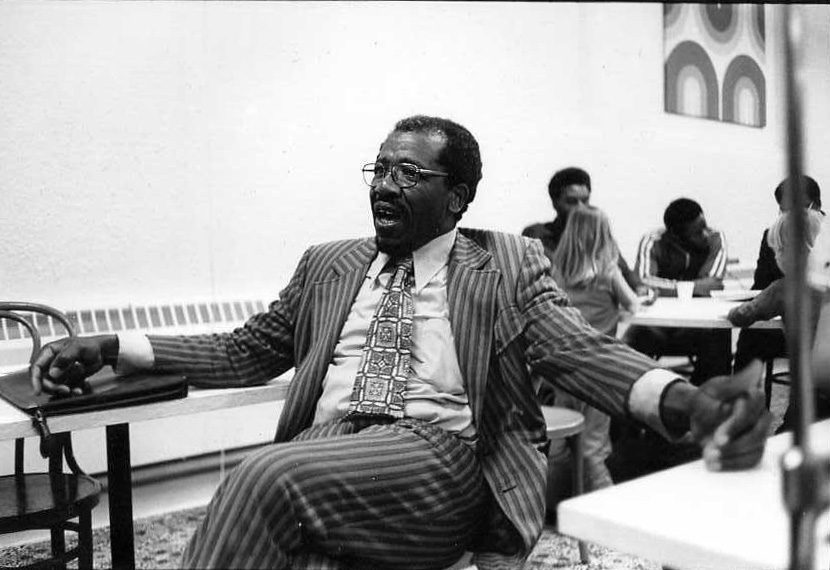
His mother died of starvation in 1930, the same year he was born in Mississippi. While a teenager, his brother was killed by a police chief after the young man grabbed the blackjack the officer had used to strike him.
Fleeing to California in the 1940s after his brother’s death, Perkins started a union of foundry workers in that state a decade later. He later was drafted and served three years in Okinawa, Japan, after the start of the Korean War. Returning to the United States, he became a Christian and was ordained a Baptist minister.
In 1960, he returned to his native state and started a ministry in Mendenhall, providing youth programs, day care, cooperative farming and health care.
An activist who registered Black voters and boycotted white retailers, Perkins visited college students who had been arrested after a 1970 protest. He was tortured and “beaten almost to death,” he said in his book, “Count it All Joy: The Ridiculous Paradox of Suffering.”
“He was beaten for just attempting to be a human in Mississippi,” added Williams-Skinner. “But instead of being bitter, he became a better human and taught us to be better humans.”
After Perkins recovered, he continued to support college students, and, in 1976, published “Let Justice Roll Down,” which codified his “3 Rs.” It was placed, in 2006, at No. 14 on Christianity Today’s list of the top 50 books that had shaped evangelicals over the previous five decades.
Christianity Today Editor-in-Chief Marvin Olasky referenced the book in a tribute to Perkins published by the magazine March 4, the day Perkins’ daughters announced their father was under hospice care.
“His most-read book, ‘Let Justice Roll Down,’ came out 50 years ago, so now some have forgotten him — but this great leader deserves remembering both for his own achievements and the way his life demonstrates God’s mercy,” Olasky wrote.
“Justice is an economic issue,” Perkins told Religion News Service in 2021. “It’s the management and stewardship of God’s resources on the Earth.”
Ron Sider, former president of Evangelicals for Social Action (now Christians for Social Action) who died in 2022, told RNS that Perkins had “phenomenal” influence, cultivating — possibly more than “any single American” — holistic ministries meeting both physical and spiritual needs of people in rural and urban settings.
His efforts on racial reconciliation, Sider said, also contributed to a more diverse “evangelical center,” to the point that the National Association of Evangelicals — on whose board Perkins served in the 1980s — chose an African American board chair, an Asian American president and a woman vice chair in 2019.

Perkins encouraged “collective prosperity,” where wealth is distributed equitably, and living in neighborhoods close to the poor, something he had done in the West and in the South.
“I’d say a lot of white suburban folks like me were deeply challenged by his call to justice and to the three Rs of his ministry,” said Jo Kadlecek, who was inspired by “Let Justice Roll Down” and later co-authored a book with Perkins after he sought her out.
“‘You know, Jesus didn’t commute from heaven,’ he’d say frequently,” she said in 2021, referring to urban ministers’ belief that Christians who help poor and underserved communities should consider residing near them.
In the 1980s, Perkins returned to California and his family founded the Harambee Christian Family Center in a high-crime area of Pasadena, offering teen and after-school programs and providing urban missions training to visiting church work groups.
“You win the trust of parents, you win the trust of community leaders, because you’re proving, day by day, that you want to develop children and young people,” said Rudy Carrasco, who served as the center’s executive director, told RNS in 2021. “I learned that from John Perkins.”
In the 1990s, after returning to Jackson, Perkins founded the Spencer Perkins Center, named for his son who died in 1998, to continue his longtime focus on affordable housing, evangelism and helping poor children and families.
During the last two decades, Perkins has been honored by institutions of higher learning, including Calvin University, which hosts a fellows program named for him, and historically Black Jackson State University, which named a scholarship after Perkins and his wife of seven decades, Vera Mae.
In 2023, his family honored Perkins and his wife with a gala dinner for their 63 years dedicated to reconciliation, Christian development and justice.
“They say ‘a prophet is not recognized in his own home,’” Priscilla Perkins said in a report from Jackson Advocate News Service. “That can be said of my father, but we will fight on for justice for the voiceless and make our community a place where children can thrive.”
When he was feted in 2022 as a Black Christian “elder” at a Museum of the Bible gala, Perkins continued to preach about the need for love.
“The only way we can go forward now is with ‘love one another,’” he said at the Washington, D.C. ceremony, quoting the New Testament Book of 1 John, as he spoke about elevating the church as a whole over congregations attended by Black or white people. “‘He that loves knoweth God. He that loveth not knoweth not God.’”
This is a developing story and will be updated.
RELATED: John Perkins: On race and the church, authentic friendship, considering heaven
Original Source:
https://religionnews.com/2026/03/13/john-perkins-prepared-obituary/