JERUSALEM (RNS) — Living in the Muslim Quarter of the Old City of Jerusalem, Mohammed Mahmoud enjoys a privilege other Muslims around the world can only dream about: the ability to pray at the Al-Aqsa Mosque every day.
For the first two weeks of Ramadan, Mahmoud, who works in a bakery across the street from the Muslim Quarter, did just that. But worshippers’ access to Israel’s holy sites came to a sudden halt last week after the U.S. and Israel coordinated a joint attack against Iran, and Iran retaliated by launching ballistic missiles at Israel, U.S. military assets and almost a dozen other countries.
While Home Front Command, the Israel Defense Forces’ civil protection arm, has now deemed it safe to permit workplaces, stores, restaurants and virtually all of the country’s mosques, churches and synagogues to reopen — provided that no more than 50 people congregate and there is a nearby bomb shelter — the Al-Aqsa Mosque compound on the Temple Mount/al-Haram al-Sharif, the Western Wall and its plaza and the Church of the Holy Sepulchre remain shuttered to worshippers due to the state’s fears of a mass-casualty event.
Since the war began Feb. 28, more than 1,600 people in Israel have been rushed to the hospital and at least 11 killed due to war-related injuries or trauma, according to Israel’s Ministry of Health.
On a typical weekday, a Home Front Command spokesperson said several thousand people congregate at the Western Wall and the Temple Mount/al-Haram al-Sharif. On holidays, that number can soar to the tens of thousands. And in the event of an incoming missile alert, there is a danger of stampedes even if the alert turns out to be a false alarm.
But that’s of little comfort to Holy Land Muslims who want immediate access to Al-Aqsa during the remainder of Ramadan, which will end around March 18. Many believe the decision to maintain the closure when almost everything else is open, and at a time when religious Jewish extremists are demanding more access to the Temple Mount, is being driven by political motives.

A week after the start of the war (March 7), the international General Secretariat of the Organisation of Islamic Cooperation condemned the closure, calling it “a blatant violation” of the sanctity of holy places, the right to freedom of worship and “a provocation to the feelings of Muslims around the world.” The secretariat warned that continuing the closure and the system that enabled it “would fuel the cycle of violence and destabilize the region.”
The Temple Mount/al-Haram al-Sharif — the holiest site in Judaism and the third holiest site in Islam — has long been a flashpoint of Muslim-Jewish tension.
“I think the closure of Al-Aqsa is a political issue, not a safety issue,” Mahmoud said as he served clients from heaping trays of sweets, to be consumed at the end of the day’s Ramadan fast. “We watched as Jews celebrated Purim in Mahane Yehuda (Market) while we are banned from Al Aqsa,” referring to the hundreds of young Jews in Jerusalem who defied military orders not to congregate outdoors during last week’s holiday.
Mustafa Abu Sway, a Palestinian Islamic scholar and deputy head of the Islamic Waqf, the Islamic council that manages Muslim holy sites, told RNS that Al-Aqsa’s continued closure is “an extreme measure that violates the historical status quo,” which grants administrative control of the mosque compound to the Waqf but security control to Israel. The system permits non-Muslims to visit the Temple Mount/al-Haram al-Sharif during certain hours, but not to openly pray there.
The number of Orthodox Jews who visit during these hours has grown since Prime Minister Benjamin Netanyahu’s nationalist government came to power, and a small number of them now pray out loud, some by prostrating themselves on the ground.
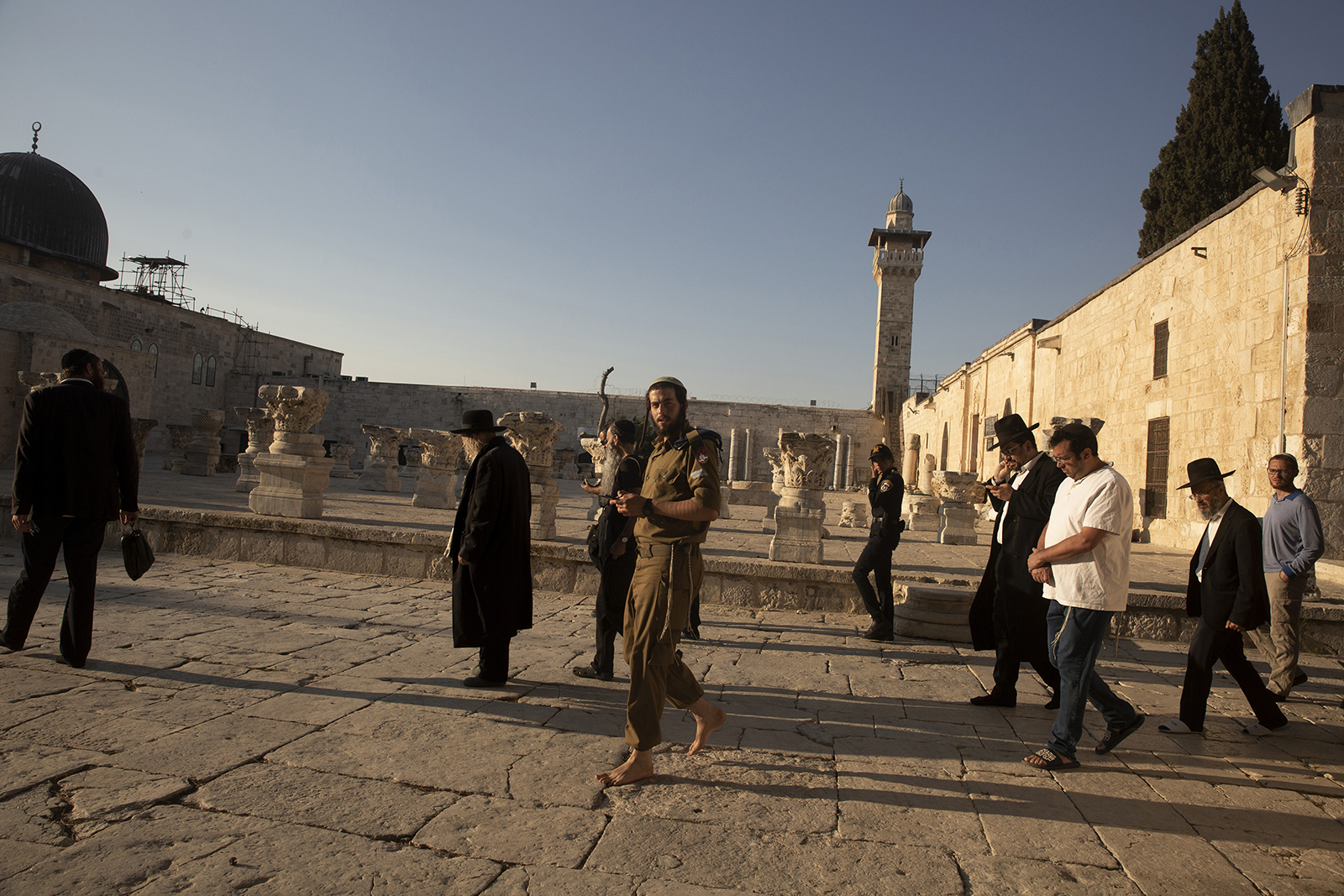
“The historical status quo has been systematically broken and altered, especially since Itamar Ben-Gvir became Israel’s minister of (national security),” Abu Sway said. “The political motivation behind the severity of the closure cannot be ruled out altogether.”
If the issue is the safety of worshippers, he said, the mosque has “massive” subterranean halls that can host thousands of people. Its Al-Marwani subterranean hall alone can host 10,000 worshippers, according to Abu Sway. And from a purely religious perspective, banning all but clergy to pray at the mosque during Ramadan “disrupts the spiritual life of the Muslim community,” Abu Sway said.
Mahmoud envisions a compromise that would open Al-Aqsa, but only to local residents.
“If the authorities allowed just people from the Old City, or people around the Old City, there would be enough shelter underground,” he said, as the muezzin’s call to prayer was broadcast all over the Muslim neighborhoods of East Jerusalem via loudspeakers. “Now is the time to pray for peace.”
Original Source: