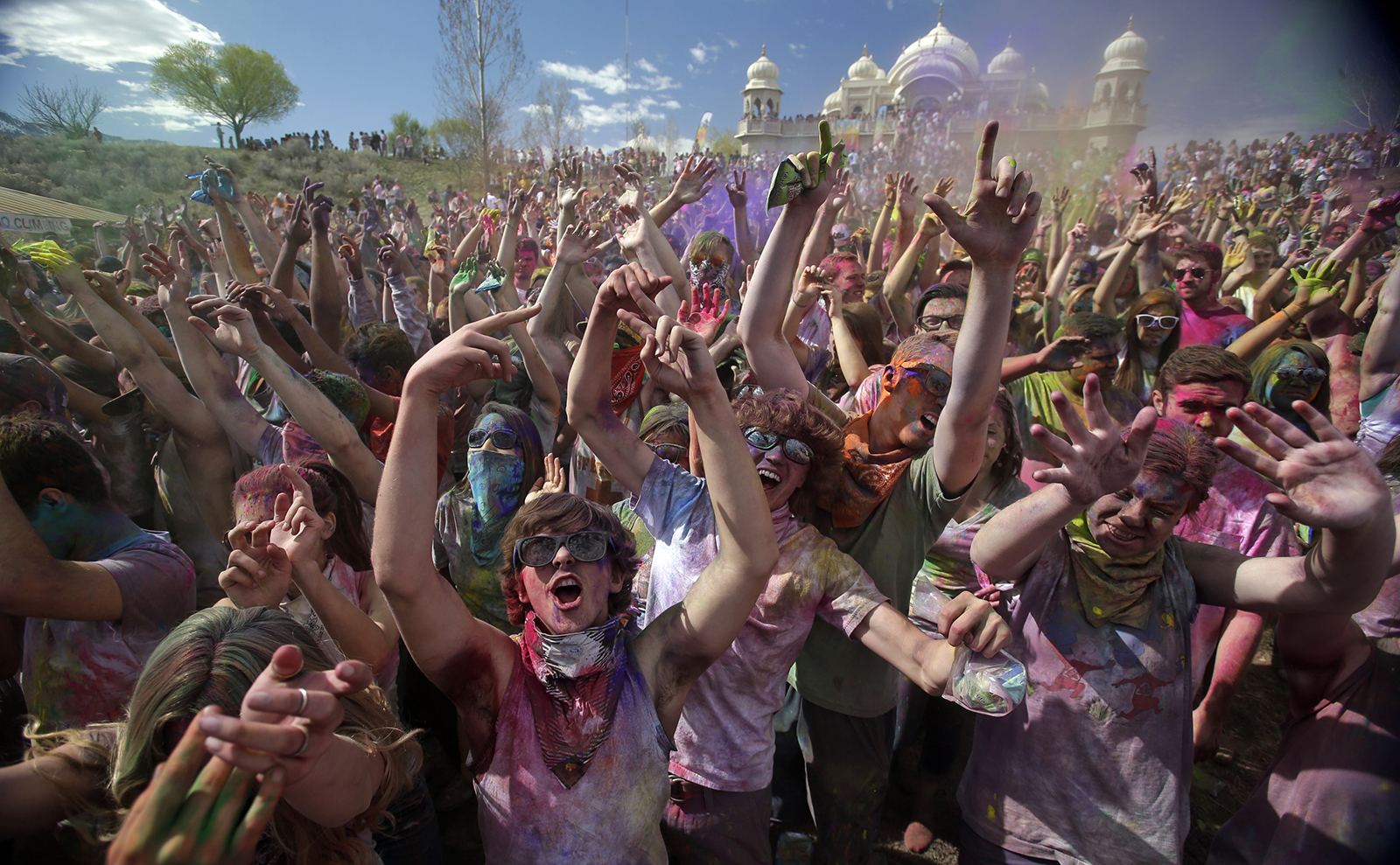
(RNS) — Wednesday (March 4) is Holi, the prominent Hindu holiday recognized for its colorful celebrations. Across South Asia and its diaspora, revelers gather in large groups to throw colored powder at one another, dance to Bollywood hits and wash the pigment away with water guns and balloons.
For many, Holi simply marks a farewell of winter and the arrival of spring’s abundant blooms. The day falls on the last full moon, or purnima, in the Hindu lunar month of Phalguna. In modern times, public color runs, large music festivals with DJs and children’s Holi parties invite people of all backgrounds to join in on the fun. But behind the exuberant color play, the holiday’s ancient origins are contested, with various mythologies offering different explanations.
In 17th-century India, Holi was a festival that celebrated agriculture, good spring harvests and fertile land. Some historians have suggested that music, rather than color, was central to the initial Holi celebrations.
Yet colors play a significant role in Holi, representing various emotions and elements of nature. Red symbolizes love and fertility, yellow signifies prosperity and new beginnings, blue is associated with the divine Krishna, and green embodies the rejuvenation of life and the onset of spring. Many of the colored powders used to celebrate are made with natural ingredients, such as dried marigold, hibiscus flowers and henna leaves.
In classical Hindu framing, one of the most widely recalled Holi narratives comes from the Hindu scripture Bhagavata Purana. In the story, the demon king, Hiranyakashipu, demanded that his subjects worship him as supreme. His son, Prahlad, however, was devoted to the Hindu Lord Vishnu. Enraged, the king plotted to kill Prahlad with the help of his sister, Holika, who possessed a gift that made her immune to fire. Holika sat with Prahlad in a blazing pyre to kill him, but Prahlad’s devotion to Vishnu protected him and Holika was consumed by the flames.

The ritual of Holika Dahan, observed on the eve of Holi, or Chhoti Holi (little Holi), commemorates this mythological story. Bonfires are lit to represent the destruction of arrogance and evil and the triumph of devotion. People dance around the fire, and some burn an effigy of Holika. They might also throw wood, leaves, grains or chickpeas into the flames as a symbolic gesture of letting go of negativity and welcoming the new season with positivity.
In another story from the Braj region of India, where the Hindu deities Radha and Krishna grew up, the festival is celebrated as Rang Panchami, commemorating their divine love for each other. According to devotional lore, the dark-blue-skinned Krishna despairs about whether the fair-skinned Radha will like him because of his skin color. His mother teasingly suggests that he color Radha’s face in any color she wishes. From this playful act grew a ritual of color-throwing. The story is also behind Phagwah, the Holi celebration in Indo-Caribbean Hindu communities.
And in parts of South India, Holi is sometimes linked to the god of love, Kama, and Lord Shiva. After the death of his consort, Sati, the god Shiva withdrew into deep meditation. The gods, seeking to restore cosmic balance, had Kama shoot arrows at Shiva. Angered at the interruption, Shiva opened his third eye and burned Kama to ashes. This upsets both Kama’s wife, Rati, and Shiva’s own wife, Parvati. Rati performs her own meditative asceticism for 40 days, after which Shiva understands, forgives out of compassion and restores the god of love. This return of the god of love is celebrated as Holi.
Across the United States, Holi parties on college campuses, in bars and on boats will be held throughout the month. The largest American celebration of Holi is said to be held in Spanish Fork, Utah. The celebration has become interfaith, holding more of a cultural than ritualistic significance. Sweet delicacies such as gujiya, a dumpling-like pastry, are eaten to symbolize abundance. The traditional Indian milk drink thandai, infused with sugar, spices, nuts and saffron, and the yogurt drink lassi, usually flavored with fruits, spices or herbs, are also popular. And in some traditions, a cannabis-infused milk drink called Bhang is enjoyed.
In all interpretations, Holi is seen as a festive day to end conflicts, forgive the past and start a new season. Many Hindus see the day as an opportunity to connect with family and make new friends, often through smearing color and shouting the Hindi greeting “Holi Hai!” (“It’s Holi!”)
Original Source:
https://religionnews.com/2026/03/04/the-many-stories-of-holi-hinduisms-festival-of-colors/