(The Conversation) — On the 800th anniversary of the death of St. Francis of Assisi, founder of the Franciscan order, his body will be displayed for the first time ever in February 2026, at the Basilica of San Francesco. Millions of visitors are expected to converge in the small Tuscan town of Assisi to honor the 13th-century saint.
Francis, who died on Oct. 4, 1226, espoused care for the poor and reverence for the natural world. Those values were reflected centuries later in the actions of Pope Francis. The late pope chose his papal name in honor of the medieval saint’s embrace of the poor and his teachings on the moral responsibility of caring for all creatures on Earth.
As a scholar of medieval religious history, I’m aware that several dramatic episodes near the end of Francis’s life played a decisive role in shaping his legacy as the founder of the Franciscan order. These events also explain why his radical messages around poverty and the environment still resonate today.
Born rich, yet sought a life of poverty
Born into a merchant family in the Umbrian town of Assisi, in present-day Italy, around 1181, Francis famously renounced his family’s wealth. One narrative recounts how he shed his garments in the public square, much to the embarrassment of his father. Early biographers described him as “Il Poverello,” or “The Little Poor One.”
In 1209, he founded the mendicant Franciscan order, a religious group devoted to works of charity.
What historians and theologians know about Francis comes primarily from his own writings and hagiographic texts. Hagiography is a form of religious biography that celebrates the virtuous lives of saints, often recounting miracles attributed to them, both in their lifetime and after their death. Devotees often visit their tombs to seek a miraculous intervention. Some of the hagiographies of Francis were written shortly after his death in 1226.
Thomas of Celano, a Franciscan friar who knew Francis personally, wrote “The Life of Francis,” published just two years after his passing. This hagiography played a central role in his rapid canonization. It provided a detailed account of Francis’ life, and Pope Gregory IX relied on its evidence that Francis’ deeds merited sainthood.
Thirteenth-century theologian and philosopher St. Bonaventure wrote the “Life of St. Francis,” now regarded as the most comprehensive account of Francis’ life. This second religious biography captures not just the key events of Francis’ life, but it also articulates his enduring legacy as the founder of the Franciscans. There are currently about 650,000 Franciscans worldwide. Members of the Franciscan order are active in over 100 countries worldwide, focusing on issues of poverty, mission and education.
Both narratives describe key moments from Francis’ early years: After taking a vow of poverty, Francis begged for alms and also worked in leper colonies near Assisi. During this period, he founded the Franciscan order.
In 1210, he traveled to Rome and received papal approval for the order from Pope Innocent III.
In 1219, Francis traveled to Egypt to meet with Sultan al-Malik al-Kamil during the Fifth Crusade. He initially attempted to convert al-Kamil to Christianity through his preaching. According to Christian texts, the meeting ultimately led to safer conditions for prisoners of war during the Crusades.
Miracles and legends
The end of Francis’ life was believed to be marked by spiritual encounters that many Catholics interpret as signs of his holiness.
Recounted in great detail in the 13th-century hagiographies, these stories explain why he later became closely associated with animals and protection of the natural world. These encounters have also been replicated numerous times in artistic renderings of Francis.
As an itinerant preacher, Francis regularly traveled throughout Italy to spread the Gospel. But on one occasion, Francis paused to preach to a flock of birds. According to legend, they listened in rapt attention.
Thomas of Celano notes that from that day on, Francis’ sermons were not just intended for people but for “all birds, all animals, all reptiles, and also insensible creatures, to praise and love the creator.”
The idea that animals became transfixed by Francis’ preaching was reiterated in other devotional texts. In the 14th-century account “The Little Flowers of St. Francis,” there is another legendary story that Francis’ preaching reportedly stopped a wolf from terrorizing the Tuscan town of Gubbio.
Francis spoke to the wolf and extended his arm. According to the legend, the wolf then stretched out his paw as if to shake his hand. Such stories became central to shaping Francis’ identity as the patron saint of animals and, later, of the natural world.
In 1224, a severe illness left Francis nearly blind. Unable to write, he dictated the “Canticle of the Sun,” or “Canticle of the Creatures,” often considered the first major work in Italian vernacular literature.
Despite his failing eyesight, this devotional text reflects poetically on the beauty of God’s creations, referring to animals as “brothers and sisters.” It praises how the Earth “sustains us and governs and … produces various fruits with colored flowers and herbs.”
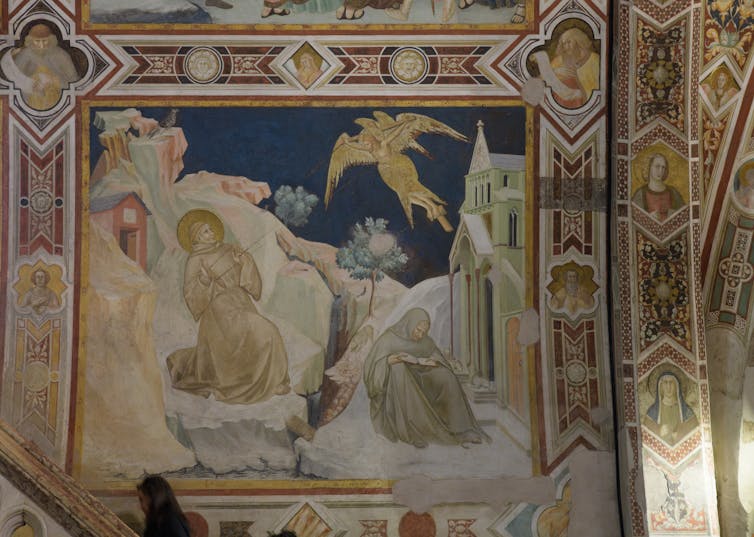
A fresco by Pietro Lorenzetti shows St. Francis receiving the stigmata. Basilica of San Francesco, Assisi, Italy.
dmitriymoroz/iStock/Getty Images Plus
Notably, Francis became the first person believed to receive the stigmata – wounds believed to mirror those of Christ’s crucifixion. Eyewitness accounts of Sept. 17, 1224, later recorded by Thomas of Celano, noted:
“A little before his death, our brother and father (Francis) appeared as if crucified, bearing in his body the five wounds which are truly the stigmata of Christ. In fact, his hands and feet had something like perforations made by the nails, front and back, that retained scars and showed the blackness of the nails. And to his side, he seemed to be pierced and blood often flowed out.”
Italian Renaissance artist Giotto di Bondone depicted these scenes in an elaborate fresco cycle in the Basilica of Santa Croce in Florence. These wounds furthered the idea of Francis as Christ-like: a motif explored often in devotional writing.
Influence on the modern-day papacy
Though Francis of Assisi was already recognized as a formative historical figure, he received renewed global attention on March 13, 2013, when then-Cardinal Jorge Mario Bergoglio broke with the church tradition of taking a name in honor of a papal predecessor. He took the name Francis.
The choice was deliberate, given that Francis of Assisi’s mission was tied to living a life of poverty and caring for others. Soon after his election to the papacy, Francis expounded on his reasoning of his papal name, affirming that his namesake was “the man of poverty, the man of peace, the man who loves and protects creation.”
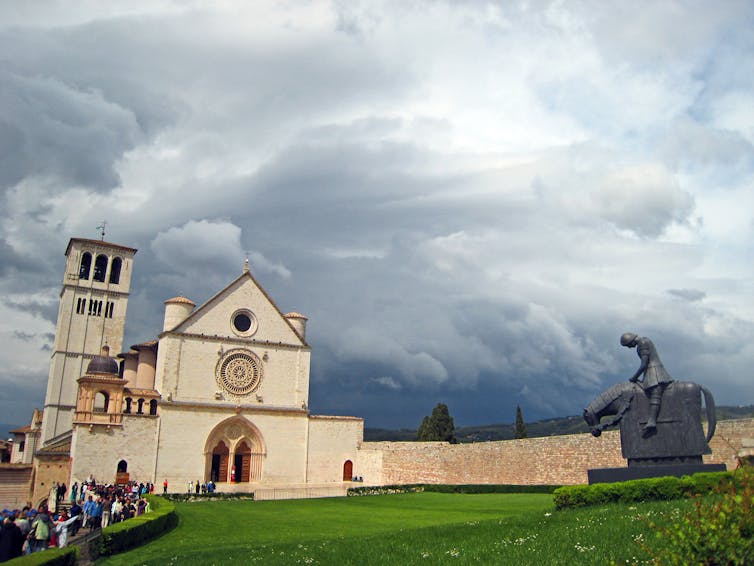
Basilica di San Francesco in Assisi.
Rosmarie Wirz/Moment Open/Getty Images
The “Canticle of the Sun” later shaped the pope’s signature 2015 encyclical, “Laudato Si’” – “Care for Our Common Home.” The first papal encyclical devoted to the environment, the document called for global dialogue and action to protect the planet. In it, Pope Francis wrote that Francis of Assisi “shows us just how inseparable the bond is between concern for nature, justice for the poor, commitment to society, and interior peace.” Since the death of the pope, “Laudato Si” has been hailed as one of the lasting contributions of the first Jesuit and Latin American-born pope.
As pilgrims travel to Assisi during this special Jubilee year of St. Francis, the church has emphasized it is not just about seeing the remains of the medieval visionary but to remember this “model of holiness of life and a constant witness of peace.”
Although this medieval saint, most commonly known through frescoes and fragmented texts, may seem like a distant historical figure, Francis’ teachings on care for the poor and responsibility toward the environment offer a lasting message to the 21st century.
(Vanessa Corcoran, Adjunct Professor of History, Georgetown University. The views expressed in this commentary do not necessarily reflect those of Religion News Service.)

Original Source: