(RNS) — I was an Air Force journalist during the first Gulf War. I remember what military life looked like before the military acknowledged that pagan service members existed and had legitimate religious needs.
Back then, the consequences showed up in very practical ways: A pagan recruit in basic training had no services to attend, deployed service members had little hope of finding spiritual support and families of the fallen fought for years simply to have their religious symbols placed on their loved one’s headstones.
This is why the Department of Defense’s recent decision to eliminate more than 180 religious affiliation codes has me deeply concerned. People who haven’t served may not understand what the big deal is about removing the religious codes and just lumping them all in as “other.”
Codes are everything in the military. Your job specialty has a code. Your medical status has a code. Equipment has codes. Training has codes. The military is perhaps the most structured bureaucracy in America. If it doesn’t have a code, it doesn’t exist.
The Pentagon states these religious codes help chaplains understand the religious makeup of their units. If pagans, druids, heathens and dozens of other minority faith groups are now grouped together as “other,” how does that help chaplains understand who they are serving?
We’re not talking about a handful of service members. Estimates suggest roughly 15,000 pagans, heathens and druids serve in the military today, according to data from the Air Force and Marines, a population similar in size to Jewish, Muslim or Buddhist service members. Under the new policy, those service members are now grouped into a generic “other” category and are effectively invisible.
I remember what it looked like when the military couldn’t see us.
When I went through Air Force basic training in 1989, pagan wasn’t a recognized option. There were no services or spaces for pagans to meet or worship. There was no spiritual counseling available because there was no code. No code means no counting. No counting means no planning. No planning means no resources.
Basic training is one of the most stressful experiences many young people ever go through. The days are long, the pressure is constant, you’re away from family and friends, every aspect of your life is controlled by someone else and you cannot leave.
On Sundays, recruits were allowed to attend religious services. They came back refreshed after spending time with clergy and people who shared their beliefs and values. Pagans, as well as other minority religions, didn’t have that option.
After the code for pagan was added in 2017, the military could identify them as a distinct community. Pagan lay leaders were appointed to help organize services and activities. Groups could request space in base chapels and other facilities. Commanders and chaplains had a way to see that a pagan population existed and plan accordingly. Volunteer pagan clergy were allowed on base to conduct services and provide fellowship and spiritual support for trainees. That’s what a code accomplishes in the military.
Having recognition didn’t just affect chaplain support. It had ripple effects throughout the military.
Take the outdoor worship circle at the Air Force Academy. It exists because the academy recognized pagan cadets as a distinct religious community with distinct religious needs. That recognition gave pagan cadets a dedicated worship space, the ability to host retreats and a seat on the Cadet Interfaith Council. None of that was accidental — it was the downstream consequence of being counted.
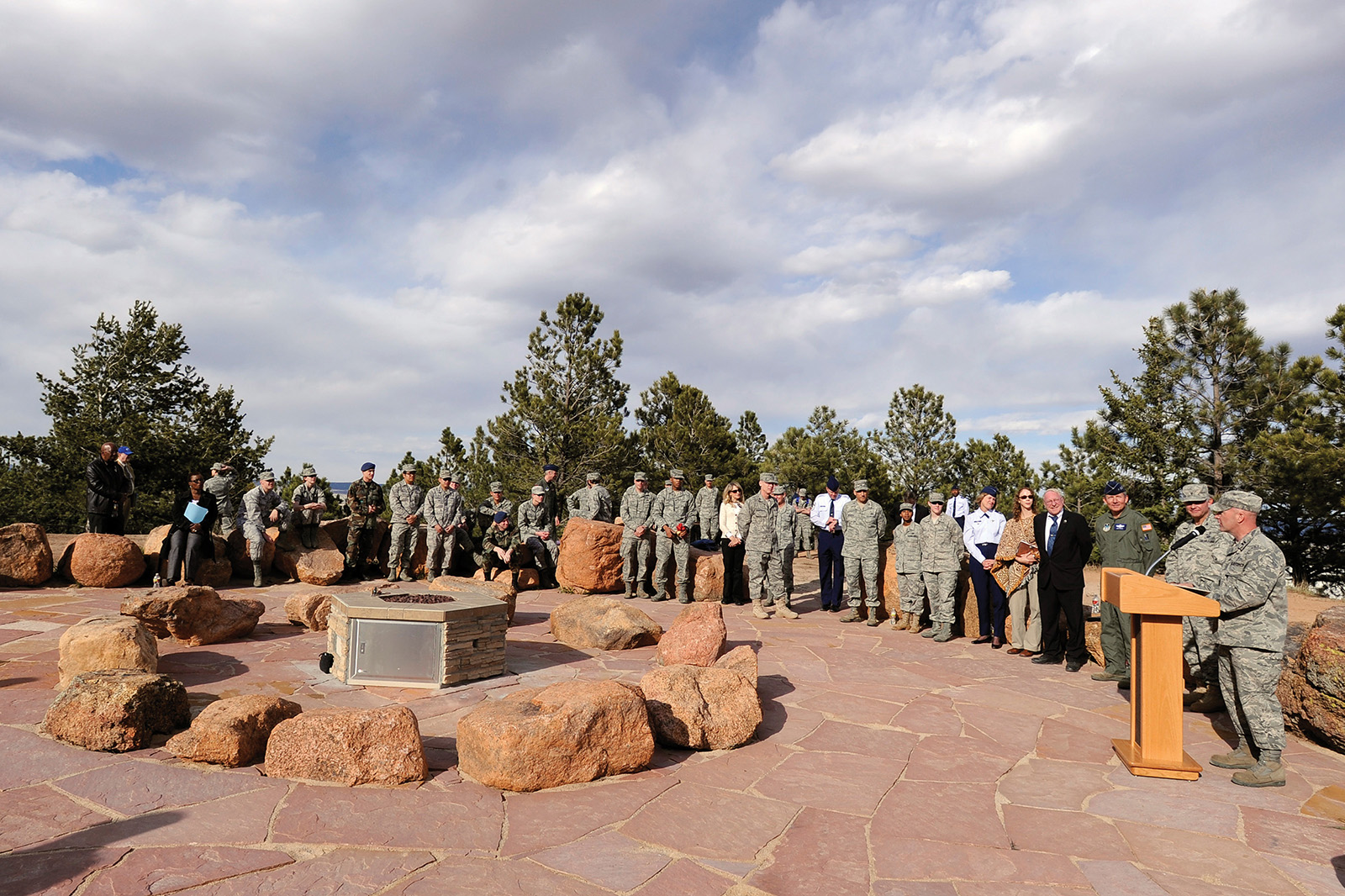
While no one is suggesting the circle will be bulldozed, what happens going forward? Will pagans still be able to apply for use of the space? Will they, and other minority faiths that have lost their code, lose their seat on the council? How do military leaders determine demand for minority-faith facilities if the communities using them are no longer separately tracked?
The impact of recognition wasn’t limited to basic training, deployment or military life. It also mattered after a service member’s death.
After my service ended, as a religion reporter for The Wild Hunt, a publication covering paganism, I covered the decades-long effort to secure pagan symbols on military headstones. This was known as the Pentacle Quest.
In 2007, the Department of Veterans Affairs finally approved the pentacle as a symbol for military headstones. This decision stemmed from decades of activism combined with a lawsuit just to grant fallen pagan service members the same dignity and recognition afforded to everyone else.
Currently, if a family requests a pentacle for a fallen service member, the Department of Veterans Affairs checks the soldier’s official military personnel file for their religious code. If the religious code matches the family request, the headstone is approved automatically.
Under the new policy, a pagan military member’s official record will list them as having “no religion” or “other.” When their family requests a pagan headstone, if the VA’s records check fails to find the matching code, the families will have to prove the veteran’s “sincerely held belief” through some other way not yet defined because the military itself stopped generating the primary proof of that faith.
The Pentacle Quest wasn’t about getting a code in a database. It was about everything that flowed from that label. The military spent decades learning how to identify and support minority-faith service members.
What happens, in a system built on codes, when your code disappears?
(Cara Schulz is a former U.S. Air Force military broadcaster and reporter for The Wild Hunt who lives in Burnsville, Minnesota. She currently is an author and serves on Burnsville City Council. The opinions expressed in this commentary do not necessarily reflect those of Religion News Service.)
Original Source: