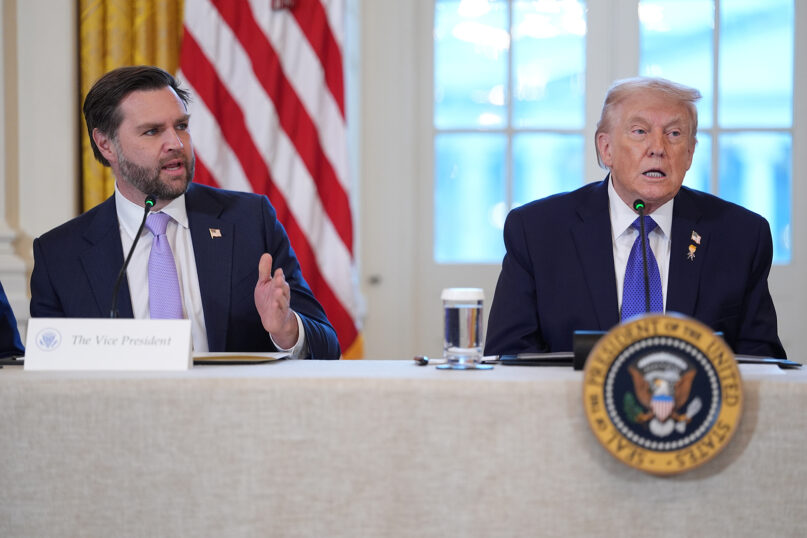
(RNS) — One week after Archbishop Paul Coakley of Oklahoma City, president of the U.S. Conference of Catholic Bishops, posed for a smiling photo standing next to a seated President Donald Trump in the Oval Office, three U.S. cardinals leading archdioceses released a statement criticizing Trump’s foreign policy.
These two contrasting scenes could appear to paint a USCCB at odds over how to approach Trump — who has this month escalated an aggressive foreign policy in capturing Venezuelan President Nicolás Maduro and demanding the U.S. acquire Greenland, and has defended increasingly violent domestic immigration enforcement at home. But some experts and bishops told RNS that dialogue and public criticism can be complementary strategies.
The bishops’ conference has not disclosed the contents of the meeting between Trump and Coakley, an ecclesiastical adviser to the conservative Napa Institute, whose co-founder called the Trump administration “the most Christian” he’d ever seen. Two days after the meeting, the administration proposed a change to a visa requirement that forced foreign priests and other religious workers to exit the U.S. for a year between R-1 visas, a change long sought by the conference.
“We are tremendously grateful for the Administration’s work to address certain challenges facing foreign-born religious workers, their employers, and the American communities they serve,” Coakley and migration chair Bishop Brendan Cahill of Victoria, Texas, wrote.
Then, five days later, the only three cardinals currently leading U.S. dioceses released a statement that quoted Pope Leo XIV and renounced military action as “a normal instrument of national policy.” Cardinals Blase Cupich of Chicago, Joseph Tobin of Newark, New Jersey, and Robert McElroy of Washington, D.C., often seen as part of the wing of the bishops’ conference most focused on social justice, wrote together that “the events in Venezuela, Ukraine and Greenland have raised basic questions about the use of military force and the meaning of peace.”
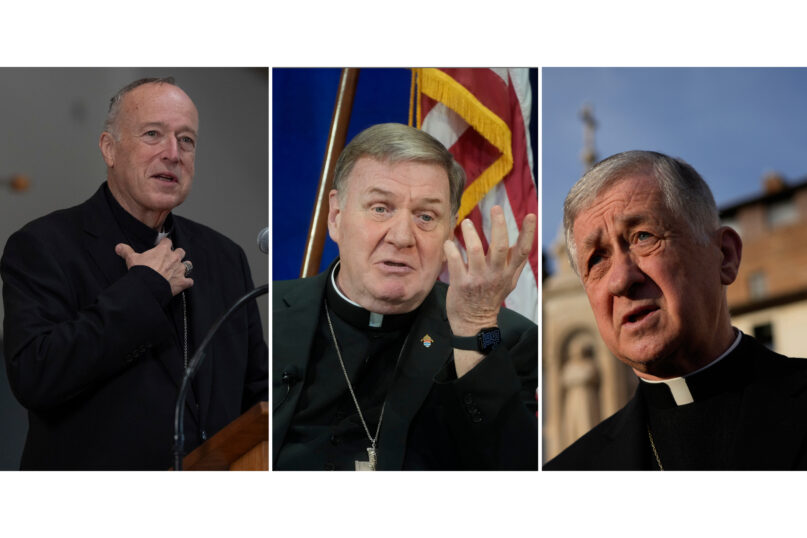
Chieko Noguchi, a spokesperson for the conference, said the USCCB was consulted on the cardinals’ statement, which did not name Trump, and that “Archbishop Coakley supports the emphasis placed by the cardinals on Pope Leo’s teaching in these times.”
There is evidence the cardinals had consulted with the Vatican before releasing their statement, including buzz within Rome the day before and the Vatican’s news service immediately releasing an article about the news.
Massimo Faggioli, an ecclesiology professor at Trinity College Dublin and Vatican expert, told RNS the cardinals’ timing of their statement after the rule change announcement was notable.
“ The Trump administration is making sure that the church knows” they have leverage over the church through those visas, Faggioli said. “There’s a fear that if the Catholic Church becomes too outspoken on some issues, there could be retaliation.”
Faggioli also said criticizing U.S. foreign policy places cardinals in a “very uncomfortable” position.
Historically, Catholics were accused of not being real Americans “to have a double loyalty, to be more loyal to the Vatican than to the president,” said Faggioli. “ In a country as patriotic as America,” Faggioli called the cardinals’ statement “courageous.”
Tobin and McElroy had previously bucked the USCCB to take a more critical stance against the 2025 federal budget proposal for its cuts to social services and funding increase for deportations. On the same day that the conference released a letter asking for changes to the bill, Tobin and McElroy joined an interfaith coalition letter that asked senators not to sign the bill.
But Archbishop Timothy Broglio, who was president of the conference when those letters were issued and is often seen as a conservative, has now begun to publicly criticize the Trump administration’s military action. As conference president, Broglio, the leader of the Archdiocese for the Military Services, USA, shied away from that criticism, but he has since weighed in to call the “intentional killing of noncombatants” illegal and immoral.
On Sunday (Jan. 18), he told the BBC he could not see any circumstances where attacking Denmark would meet the requirements for a just war and that it “would be morally acceptable” for troops to disobey an immoral order.
Christopher White, a senior fellow for Georgetown University’s Initiative on Catholic Social Thought and Public Life, said, “Archbishop Broglio’s bold statement offers moral clarity and demonstrates that the Catholic Church isn’t going to give the administration cover as it pursues an unjust and immoral foreign policy.” The range of prelates expressing concerns indicates how widespread those sentiments are in the church, he said.
Lexington, Kentucky, Bishop John Stowe, who is the bishop president of Pax Christi USA, a Catholic peace group, told RNS he is “grateful” to the cardinals for “amplifying the voice of Pope Leo and challenging the direction of the Trump administration.”
“We need to have more courageous expressions of resistance and words of caution towards this administration, especially as the abuse of human rights, conducted by [Immigration and Customs Enforcement] continues,” Stowe wrote.
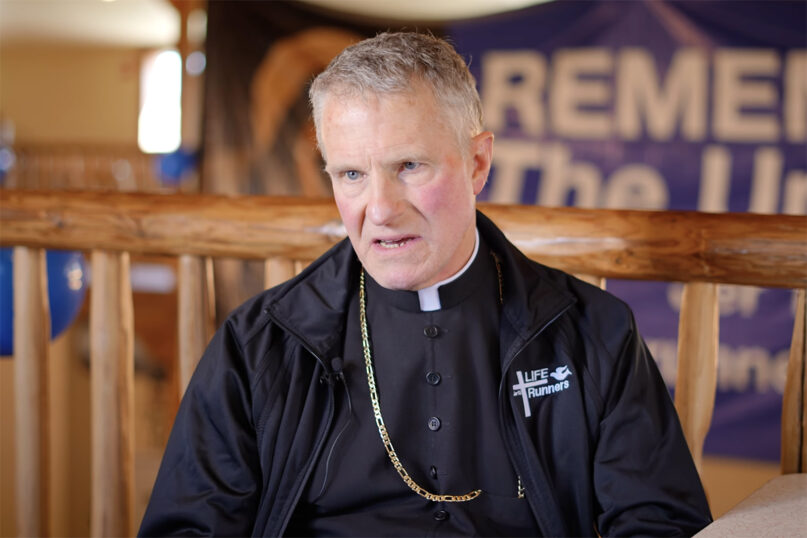
Bishop Joseph Tyson, of Yakima, Washington, told RNS the bishops have three key areas of divergence with the administration — foreign policy, immigration and abortion, where he characterized the Trump administration as “supporting chemical abortion” and backing away from the Hyde Amendment.
Anti-abortion advocates have criticized the Trump administration for approving a new generic version of mifepristone, a drug largely used for abortions that is also used to treat high blood sugar, and have been critical as well for comments in which Trump urged Republicans to be flexible on the policy banning federal funding for abortion.
Tyson has repeatedly highlighted Pope John Paul II’s teaching that deportation is “intrinsically evil,” a rhetorical strategy that has not been adopted by other bishops. But he and San Jose Bishop Oscar Cantú, another forceful voice against mass deportations, each praised Coakley’s meeting with the Trump administration.

“I’m glad Archbishop Coakley was able to meet with President Trump and express some of the concerns of the bishops on several issues, such as immigration enforcement, religious visas for priests and religious, etc.,” Cantú told RNS.
Cantú explained that bishops speak from principles of social teaching that are based on Scripture and centuries-long tradition. “While many in the church may be divided politically, the Catholic Church remains a significant voice in the American public square,” he said.
Tyson said the religious worker visa change is “enormously impactful” for his diocese, where like much of the Catholic Church, foreign-born priests are providing pastoral care.
He recalled having to tell the parishioners at one church that their pastor, the Rev. César Izquierdo, would have to leave the country for a year and they’d have rotating priests instead of a pastor. “That was really shocking to people,” he said.
“There are different roles,” Tyson told RNS of the USCCB engaging Trump in dialogue and of individual bishops criticizing his administration. “ Hopefully we complement each other, and these are carefully layered out.”
But still some theologians criticized Coakley’s decision to meet with Trump without speaking out more forcefully.
Steven Millies, a professor of public theology at Catholic Theological Union, told RNS he questioned the purpose of the conference if it could not speak strongly in moments like this.
“We’re living in extraordinary times, and the bishops of the United States can’t find a way to speak to them together. I think that should really raise an existential question for the conference,” he said.
Though he said the Catholic bishops are continuing the positions they’ve taken for decades, Daniel Williams, an associate professor of history at Ashland University, cautioned that historically, the bishops have had limited influence on presidents’ foreign policy.
For example, Williams said the bishops’ 1983 pastoral letter opposing nuclear buildup “seemed to have no effect” on the Reagan administration and did not prevent Reagan from winning a majority of Catholic voters when he was reelected. Nor did the bishops’ 2002 statement against preemptive military force in Iraq prevent George W. Bush from going to war later.
“ If we go back to some of these key moments of debates over a war or a foreign policy change, I can’t think of a single example where I would say the statement of Catholic bishops changed the course of an administration,” said Williams.
He said, “ If it had any effect, it was probably only in concert with a lot of other pressure that was pushing in the same direction.”
Original Source: