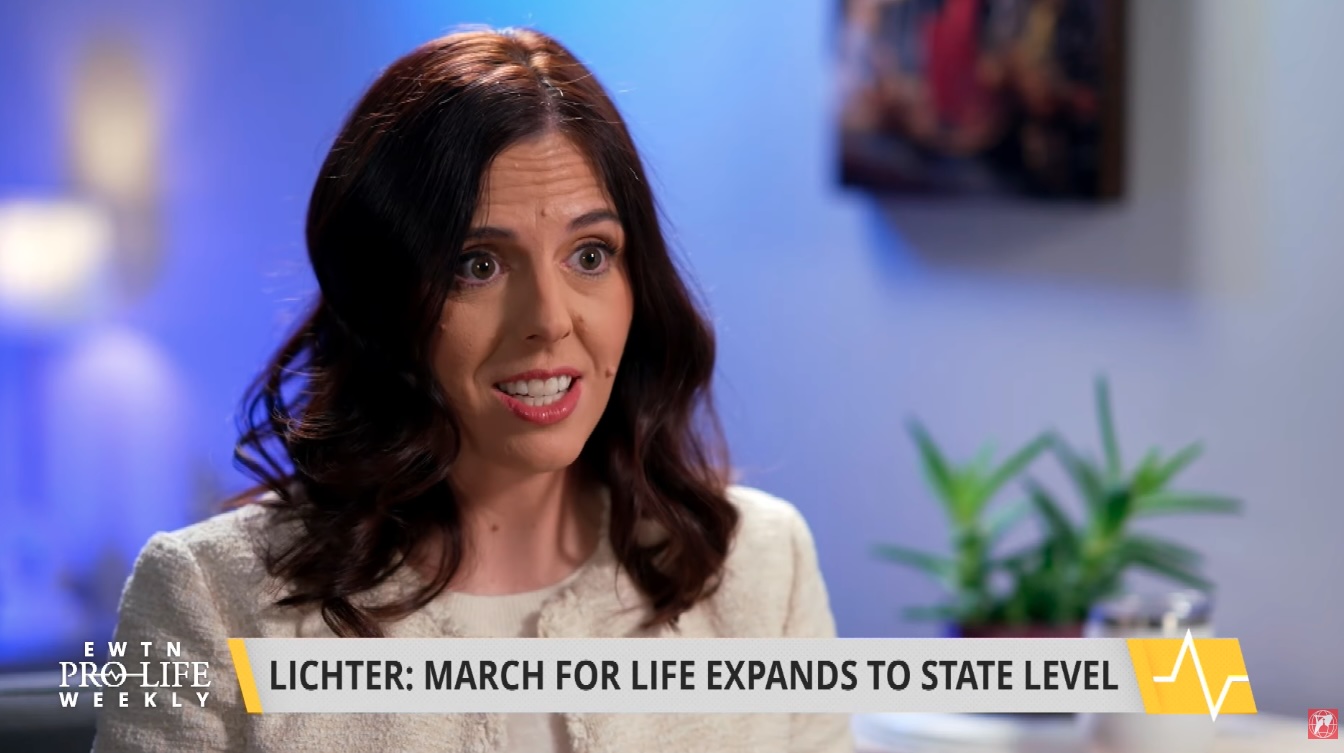
 Jennie Bradley Lichter, president of the March for Life Education and Defense Fund, speaks with host Abi Galvan during an interview on “EWTN Pro-Life Weekly” on Jan. 21, 2026. | Credit: “EWTN Pro-Life Weekly”/Screenshot
Jan 22, 2026 / 13:30 pm (CNA).
In her first year leading the March for Life, the organization’s president is reminding the pro-life movement that they “still have a lot of work to do” in the current political climate, three and a half years after the U.S. Supreme Court overturned Roe v. Wade.
“Taking down the Roe regime of abortion-on-demand across the country was incredibly important,” Jennie Bradley Lichter, who became president of the March for Life Education and Defense Fund in February 2025, told “EWTN Pro-Life Weekly.”
“But there are still way too many abortions happening in this country,” she said. “So that’s the No. 1 reason why we’re still marching.”
Tens of thousands of pro-life activists are expected to gather in Washington, D.C., for the 53rd March for Life on Friday, Jan. 23. The march, which drew out about 150,000 people last year, has been held annually since Jan. 22, 1974, one year after Roe v. Wade was decided.
The speakers will include Lichter, U.S. Vice President JD Vance, House Speaker Mike Johnson, and Rep. Chris Smith, among others. President Donald Trump provided a prerecorded message to the marchers, which will be played during the pre-march rally.
Lichter said in the interview that the annual march “accomplishes three really important things for the movement that cannot be accomplished any other way.”
The first, she said, is “forming young people for pro-life mission,” noting that many attendees are “teenagers and with college students and people in their 20s.” Second, she said, it is “also a really important moment of refreshment and being reenergized, and a lot of people have shared that with me this year.”
Third, Lichter said, is “the public witness impact of having this many people gathered in the heart of our nation’s capital.”
“When you stand at the March for Life, you have the Capitol dome behind the stage, and then the Washington Monument behind the marchers,” she said. “You are right in the heart of the most powerful and important city in the world, and the city shuts down every year on the day of the March for Life.”
“The Lord gives us a chance to show the nation what we’re made of, year after year,” she added. “It’s so powerful.”
Political climate
As pro-life advocates gather in Washington, D.C., 30 states and the nation’s capital still permit abortion up to the 22nd week or later, with nine states allowing elective abortion through nine months until the moment of birth.
In 13 states, nearly all abortions are illegal and in four states, most abortions are illegal after six weeks’ gestation. Two states prohibit abortion after 12 weeks, and one prohibits abortion after 18 weeks.
At the federal level, Lichter expressed some concern stemming from the Trump administration, which was mostly focused on his comment that asked Republicans to be “flexible” on the Hyde Amendment during negotiations about extending health care subsidies related to the Affordable Care Act.
The Hyde Amendment, which prohibits federal tax money from being spent on abortion, has been included in spending bills since 1976, shortly after Roe v. Wade was decided.
“The response to the comment about being flexible on Hyde was swift and strong from everyone,” Lichter said, referring to criticism of the comments that came from the pro-life movement.
“The truth is, we’re not going to be flexible on Hyde,” she said. “We can’t be flexible with an issue that implicates human life — the preeminent issue — abortion.”
“The Hyde Amendment is Pro-Life 101,” Lichter said. “It’s a baseline policy that has been in place for 50 years and that every pro-life politician knows is just at the very heart of what it means to be a pro-life lawmaker. So of course, we’re not going to be flexible on Hyde.”
Lichter noted that some people think abortion “might be a losing issue in the midterms” for Republicans in November, but she believes “that’s completely wrong” and “misreads the electorate.”
“There’s no data, no examples to support the idea that pro-life politicians have been losing elections since [the Supreme Court overturned Roe v. Wade],” she said.
“They just haven’t been,” she said. “And there’s a lot of counter examples, of course, of really strong pro-life politicians who have put life at the center of their work, who have continued to win reelection.”
The March for Life rally will be held on the National Mall from 11 a.m. until about 1 p.m., after which attendees will march past the U.S. Capitol and conclude in front of the U.S. Supreme Court building.
Original Source:
https://www.catholicnewsagency.com/news/269259/lichter-interview-pro-life-weekly