JERUSALEM (RNS) — Leaders of the historic or apostolic churches in the Holy Land issued a blunt joint statement accusing Christian Zionists of espousing “damaging ideologies” that “mislead the public, sow confusion, and harm the unity of our flock.”
The Saturday (Jan. 17) statement from the Patriarchs and Heads of Churches in the Holy Land suggests an ongoing rift between the historic Christian churches representing the small Palestinian Christian community in the region and the mostly U.S. evangelicals who have been unwavering in their support for Israel.
The church leaders said in the statement that “they alone” — not Christian Zionists — represent Christian churches and their followers in the Holy Land.
Israel’s current government is opposed to a Palestinian state and has shown ever greater repression toward Palestinians in Gaza and the West Bank. While the overwhelming majority of Palestinians are Muslims, many Christians living in Israel also identify as Palestinians and have claimed the land since the time of Jesus. They comprise less than 1% of the population in the West Bank and Gaza, and about 2% of Israelis.
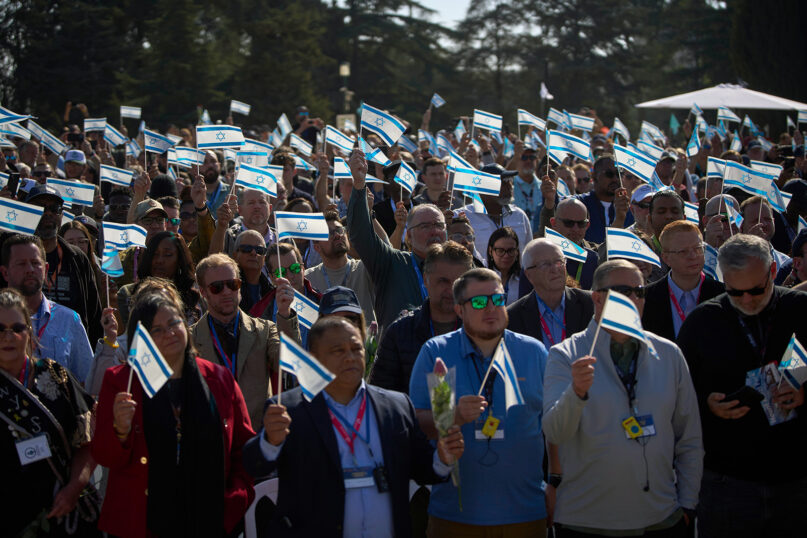
The letter comes less than two months after 1,000 evangelical and Christian Zionist pastors and influencers spent a week in Israel on a solidarity mission trip organized by the pro-Israel Friends of Zion organization and Israel’s Ministry of Foreign Affairs. Participants met with Israeli officials, prayed at holy sites and visited locations associated with the Oct. 7, 2023, Hamas massacre. The statement appears to allude to the trip without citing it, saying such “undertakings have found favor among certain political actors in Israel and beyond who seek to push a political agenda which may harm the Christian presence in the Holy Land and the wider Middle East.”
RELATED: Can evangelical faith in Israel survive MAGA and the Gaza war? Israel is betting millions on it
The officials expressed “concern that these individuals have been welcomed at official levels both locally and internationally.” Such actions “constitute interference in the internal life of the churches and disregard the pastoral responsibility vested in the Patriarchs and Heads of Churches in Jerusalem,” they said.
Christian Zionists, however, have been ascendant in Israel and U.S. policy. Mike Huckabee, U.S. ambassador to Israel, is one. “I love my brothers and sisters in Christ from traditional, liturgical churches and respect their views, but I do not feel any sect of the Christian faith should claim exclusivity in speaking for Christians worldwide,” he told RNS.
Mike Evans, the founder of Friends of Zion, the group that arranged the U.S. evangelical delegation, rejected the Patriarchs’ statement, saying that Christian Zionists base their view on the Bible, which they believe forms the basis for the Jewish people’s claim to the land of Israel.
“If you are a Christian Zionist, you believe the Bible, and you believe the Bible promises,” Evans said.
Christians who don’t believe that Israel was promised to the Jews adhere to a false theology he called “replacement theology,” which claims the church has replaced God’s chosen people. That theology, he said, was antisemitic.

Evans also rejected Palestinian demands for recognition in the lands Israel controls. “There was no Palestinian culture or language,” he said. “This entire belief system was created.”
Likewise, Sandra Hagee Parker, chair of the group Christians United for Israel and the daughter of its founder, the Texas evangelical John Hagee, told RNS that the statement “is nothing more than a naked attempt to contort the Christian faith in order to deny the very teachings of Jesus.”
“From Genesis to Revelation, the Bible is a Zionist document,” she said. “To deny God’s support for his chosen people is to deny the reality of God’s word.”
Patriarchs and Heads of Churches in the Holy Land, the group that issued the statement, could not be reached for comment.
This is not the first time that the Patriarchs have condemned Christian Zionism. The Jerusalem Declaration on Christian Zionism was issued by the Latin Patriarch of Jerusalem, alongside the leaders of the Syrian Orthodox, Anglican and Lutheran Churches, 20 years ago. That document said Christian Zionism is a modern ideology of “empire, colonialism and militarism” that is a detriment to peace. It called Christian Zionism a “false teaching that corrupts the biblical message of love, justice and reconciliation.”
To many Christians, including many mainline U.S. Protestants, Christian Zionism conflates the state of Israel with biblical Israel and denies the legitimacy of Palestinian existence, including the land’s historic Christian churches.
However, Huckabee said that “labels such as ‘Christian Zionism’ are too often used in a pejorative sense” to disparage millions of “free-church believers.”
“Christians are followers of Christ, and a Zionist simply accepts that the Jewish people have a right to live in their ancient, indigenous and biblical homeland,” he said.
The International Christian Embassy Jerusalem, a Jerusalem-based Christian Zionist evangelical ministry that brings thousands of believers to Israel every year, also took issue with the church leaders’ statement.
“As Christians, we adhere to a Zionism that is purely biblical in origin, belief, scope and practice — reflecting our sincere faith convictions and not shifting political objectives,” the ministry said. “The promised restoration of Israel in modern times enjoys ample biblical credentials in both the Old and New Testaments.”
RELATED: After ceasefire, travel restrictions still haunt Palestinians
Original Source: