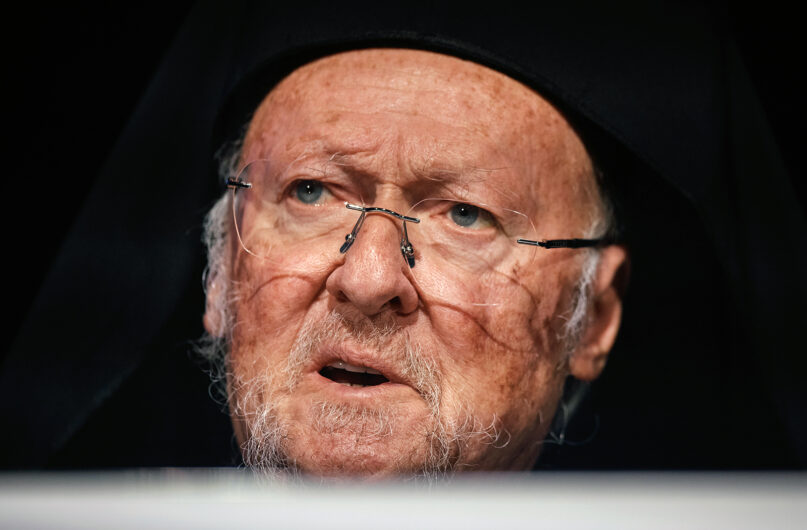
ISTANBUL (RNS) — “Antichrist in a Cassock,” “Antichrist of Constantinople” and “Devil Incarnate” were among the terms Russia’s foreign intelligence service used to attack the spiritual leader of Eastern Orthodox Christianity, Bartholomew I, accusing him of meddling in Ukraine and trying to push the Russian Orthodox Church out of the Baltic states.
In a statement released Jan. 12, the agency, known by its Russian initials SVR, wrote: “Patriarch Bartholomew of Constantinople, who dismembered Orthodox Ukraine, continues his schismatic activities within the Orthodox Church. Now he has set his dark eye on the Baltic states. This ‘devil incarnate’ is obsessed with ousting Russian Orthodoxy from the Baltic states, establishing in its place church structures completely under the control of the Phanar,” referring to the Istanbul neighborhood where Bartholomew is headquartered.
Bartholomew, the Ecumenical Patriarch of Constantinople, is traditionally considered “first among equals” of the world’s Orthodox Christian patriarchs. But what that title entails remains a matter of canonical debate, and in recent years Moscow has bitterly objected to his support for Orthodox national churches in Eastern Europe that have broken with the Russian church, overturning long-established spheres of influence.
Moscow declared itself in schism with Constantinople in 2018 after Bartholomew recognized an independent Ukrainian Orthodox Church untethered from the Russian Orthodox Church and its patriarch, Kirill. The Russian church leader has closely allied himself with Russian President Vladimir Putin and has provided a religious justification for the war in Ukraine, calling it a “holy war.”
While the antipathy between the Russian church and Bartholomew is not new, the latest attack is unique in coming directly from an organ of the Russian state, bolstering accusations that the church is acting at the behest of the Kremlin. The Russian Orthodox Church has not itself made any statements acknowledging the SVR statement since its release.

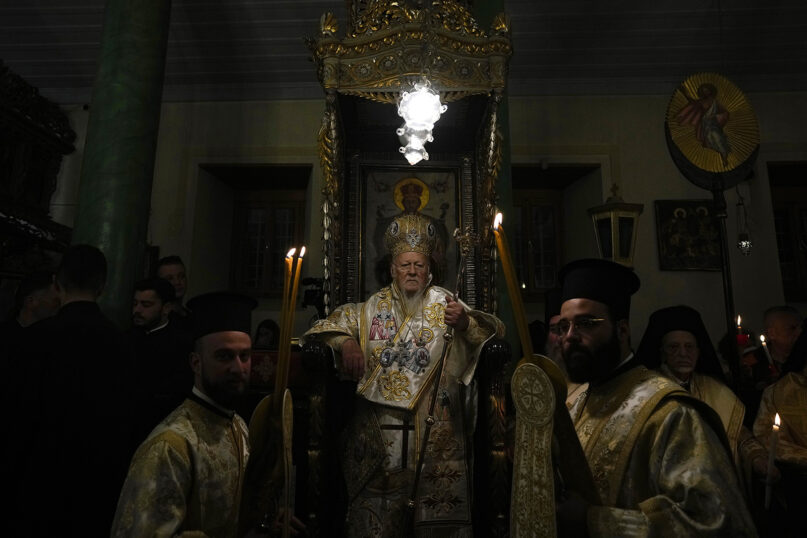
Bartholomew responded in a communique, saying, “The Mother Church of Constantinople — Mother of this Church of Russia — expresses its deepest sorrow for the new Russian attack against the person of His Holiness the Ecumenical Patriarch Bartholomew, which was launched, this time, by state services of the country.” The patriarch dismissed the attack as an extension of Russian complaints about Bartholomew’s recognition of an independent Ukrainian church.
“The imaginative scenarios, fake news, insults and fabricated information of all kinds of propagandists do not discourage the Ecumenical Patriarchate from continuing its ministry and ecumenical mission,” he said.
The SVR’s statement said that Bartholomew was acting under the sway of British intelligence, which it accused of fueling “Russophobic sentiments in European countries.” Bartholomew, “mired in the mortal sin of schism, has found common ground with the authorities of the Baltic states in an effort to sow discord in the Russian Orthodox world,” it said.
“The Constantinople Antichrist’s aggressive ambitions are not limited to Ukraine and the Baltics,” the statement continued, “his treachery is gradually spreading to the lands of Eastern Europe. In order to strike a blow against the ‘particularly obstinate’ Serbian Orthodox Church, he intends to grant (independence) to the unrecognized ‘Montenegrin Orthodox Church.'”
The Ecumenical Patriarchate in Constantinople has backed establishment of Orthodox Church structures independent of Moscow in Lithuania and Latvia in recent years, and in Estonia since the 1990s, but the mention of Montenegro left Orthodox church scholars scratching their heads.
“The point where it first came to my attention because people started saying, ‘What, is there something going in Montenegro?’” said Samuel Noble, a scholar of Orthodox Christianity at Belgium’s University of Liège. “Complaining about the Ecumenical Patriarchate in the Baltics is a long-standing thing and nothing new, but it seems like the bit about Montenegro was just entirely made up to get attention from Serbs.”
Some 71% of Montenegrins identify as Orthodox Christians, and 90% of those consider themselves under the auspices of the Serbian Orthodox Church. However, a small portion are affiliated with the breakaway Montenegrin Orthodox Church, which has historically been opposed by both Belgrade and Constantinople.
“I’ll say it plainly: we have never had anything to do with this issue,” Metropolitan Emmanuel of Chalcedon, a high-ranking bishop and deputy of the Ecumenical Patriarchate, told Greek media. “It is not even a church structure — just some kind of group that cannot even be called schismatic. We have never had any contact with this group in Montenegro. This is simply informational noise on their part.”
Nonetheless, the Ecumenical Patriarchate in Istanbul appears intent on capitalizing on the Russian attack, keeping up a media blitz about the SVR statement for more than a week.
“The very mention of Russia’s Foreign Intelligence Service ultimately constitutes the most revealing ‘moment of truth’ for the Patriarchate of Moscow, as the ecclesiastical façade has completely collapsed,” Metropolitan Emmanuel told the Greek daily Kathimerini. “It dangerously legitimizes the fact that synodal decisions, sacred canons, and authentic ecclesial ethos have been set aside and replaced by ‘services’ and secular mechanisms, thus demonstrating the absolute secularization and complete alienation of the ecclesiastical mindset.”
Emanuel also noted that the specific language of the statement might have more to say about Russia’s relationship with the West than with church disputes.
“In the narration of their imaginary storyline, an operation is being attempted that may escape the attention of many: whereas until recently responsibility was attributed to the Americans, now, quite suddenly, British intelligence services appear in their place,” he told Kathimerini. “It seems that the Russian leadership is attempting to test its relations with the new administration in Washington and is searching for another party to blame for the hardships it itself has caused, thus revealing a profound spiritual impoverishment.”
The Russian church’s purported ties to Russian intelligence have affected Orthodox communities around the region and world. In 2023, the highest-ranking Russian church leaders were expelled from Bulgaria on accusations of espionage, while religious-freedom advocates have expressed concern over crackdowns on Russian parishes in Ukraine and the Baltic states.
“The Russian church is such a big organization, and you can find anything in it,” Noble noted. “You can still very much find the people who are widely opposed to what the state’s doing, and you can also find people that want to make Rasputin a saint — you can find all kinds of stuff.
“Real connections between the Moscow Patriarchate and the state notwithstanding, I would be hard-pressed to think that anyone in the church would have wanted that statement to be made,” he added.
Original Source: