(RNS) — In his first appearance in a New York courtroom on Monday (Jan. 5), ousted Venezuelan President Nicolás Maduro reportedly uttered the words “In the name of God, you will see that I will be free” and “I am a man of God.”
As Maduro — who was arrested by the U.S. on federal drug trafficking charges on Saturday and has pleaded not guilty — hails from a Catholic-majority nation and was born Catholic, one might assume his faith fits neatly into that box. But a number of prominent Venezuelan politicians — including Maduro; his wife, Cilia Flores, who is former president of the country’s National Assembly; and acting President Delcy Rodriguez — are devotees of the late Indian guru Sri Sathya Sai Baba. Known as a “man of miracles” with tens of millions of followers worldwide, he was believed by devotees to have abilities ranging from healing the sick to materializing objects seemingly out of nowhere.
Visitors to Maduro’s private office in Miraflores Palace in Caracas would have seen a large framed portrait of Sai Baba alongside those of former leaders Hugo Chávez and Simón Bolívar. A 2005 photograph shows Maduro and Flores — who was the first of the duo to follow Sai Baba — kneeling on the floor in a visit with the guru at his Prasanthi Nilayam Ashram in the the southern state of Andhra Pradesh, India. And several photos and videos show Rodriguez at the ashram in 2023 and 2024, bowing in respect to the spiritual leader.
When Sai Baba died in 2011 at age 84, Maduro had the Venezuelan government issue an official condolence resolution and declare a national day of mourning. And most recently, on Sai Baba’s birthday in November 2025, just weeks before the collapse of Maduro’s regime, he issued a public statement — one of his last with a nonpolitical message.

“I always remember him when we met. … May the wisdom of this great teacher continue to enlighten us,” Maduro said, describing the guru as a “being of light.”
Sathya Sai Baba, born Sathyanarayana Raju in 1926, was reportedly 14 years old when he announced to his parents that he was the reincarnation of the revered 19th-century Hindu and Muslim saint Shirdi Sai Baba.
Often recognized by his curly hair, Sathya Sai Baba preached “love all, serve all,” “help ever, hurt never” and similar messages that pointed to service, or seva, as central to spiritual growth. Importantly, his message extends beyond religious affiliation. He is followed by people of all backgrounds who use bhajans, chants and psalms in their weekly worship. The widely used logo for Sai Baba and his organizations contains the symbols of five major religions.
But the “God-man” has also been accused of sexual misconduct by several young male devotees, as reported in a 2006 BBC documentary. In 1993, six young male devotees were allegedly killed by police in the bedroom of Sai Baba, in a highly speculative case where the police claimed they shot in self-defense.
But today, the Sri Sathya Sai International Organization operates several foundations, trusts and charities in more than 120 countries, providing humanitarian relief through free hospitals, schools, ashrams, universities and clean drinking-water projects. There are almost 2,000 Sathya Sai Centers worldwide.
And in the Americas, the organization has found a special appeal, having an official presence in 22 Latin American countries. Many point to Venezuela as having the highest concentration of followers. More than 30 small groups or official centers are located in Venezuela, with devotees everywhere from the Andes Mountains to within Amazonian tribes at the southernmost tip. Official organizational talks and meetings are regularly conducted in Spanish, and a devotional song titled “Mi Destino” was introduced by a Sri Sathya youth group in Venezuela in 2016.
The first, unofficial Sai Center opened in Caracas in 1974. In 1988, Ana Elena Diaz-Viana was elected the center’s inaugural president.
Diaz-Viana said many devotees, including herself, have encountered spiritual miracles that drew them to the man. She told RNS she saw a man in white robes and a “big afro” in a dream when she was 25 and then recognized him in a documentary called “The Lost Years of Jesus” five years later. She then envisioned Sai Baba comforting her in a hospital room where her child was sick with pneumonia, and before a surgery to remove a brain tumor later in her life.
For Venezuelans at a time of economic downturn, she said, Sai Baba’s miracles provided hope. Her son, for example, seemingly got better overnight. “I have goosebumps when I remember that because I felt so humble, and I still feel, after so many years, that this person who I didn’t know he was took care of me and my family,” she said.
In 1988, Diaz-Viana joined a group of 64 Venezuelans to meet the leader at the ashram. She had written a letter asking him to help the poor of the country, she said, and watched in awe as a red light gleamed under his hand as he materialized a lingam, or a symbol of divine energy, in the palm of his hand. He walked to Diaz-Viana and gave her the lingam, telling her to wash it and “give the water to the poor people of Venezuela who do not have money to buy medicines and for those who are going to die.”
For years, Diaz-Viana and others saw a “revolution” as they passed the lingam throughout the country’s Sai Centers, allowing anyone who wished to take a drink from the blessed water, she said. At that point, she said, most people knew of Sai Baba. “No one felt like they they were traitors to their own religion or family faith,” she said.
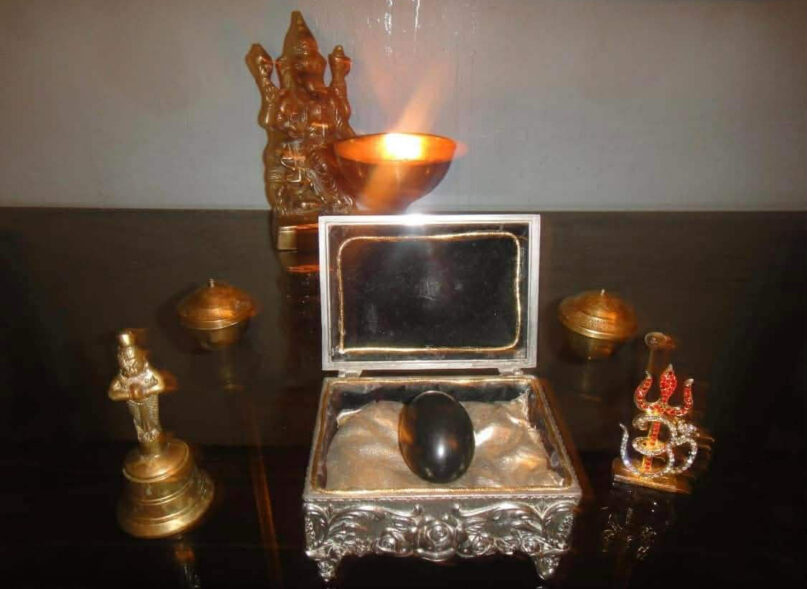
But things changed when Maduro was introduced to Sai Baba, she said. “Someone spoke to Maduro about Sai Baba, about this powerful guru who does miracles, who give gifts to people. And I think he thought it’s a great idea to meet this guru who is so powerful.”
A well-circulated story suggests that during the 2005 visit, Sai Baba materialized a green ring for Maduro after rejecting the leader’s ask for a red ring, saying it was the color of violence, Diaz-Viana said. After Maduro’s visit, many of his supporters got “addicted to” Sai Baba and took control of his legacy centers, she said. Her beloved lingam’s waters stopped flowing, she said, as the new crop of devotees “retained it for their own purposes.”
It is complicated, Diaz-Viana said, to be devoted to the same guru as “problematic” people who are accused of engaging in criminal activity. Yet it is a “spiritual vision” to see politicians as “children of God.” Divine justice, she said, will find them.
“Swami said once that in his life, demons will come to him, same as they did with Krishna,” she said. “Yes, they are criminals. Yes, they are devotees, and yes, they are children of Swami. They have done so much damage to so many people. Our own truth and our own dharma, that’s the only thing that we can hold now.”
Still, she asked, “Can you say to a family that has suffered, to a family that has been starving, that these people who ruined their lives are children of God?”
Ravi Lakshminarayan, a lifelong devotee who has lived at the ashram in India since retirement, said he believes that Sai Baba’s blessings only work on those who truly make good.
“Baba blesses everyone profusely,” he said, “but if the person so blessed steps on to wrong path in life, all the blessings from Baba which protects from adversaries starts getting eroded and over time becomes zero. The person becomes vulnerable to circumstances of his or her own making. I have personally seen many stalwarts and celebrities who have fallen from grace.”
Original Source: