(RNS) — Noelle Cook arrived in Washington, D.C., on Jan. 6, 2021, to photograph the Stop the Steal rally, expecting to gather some images for a graduate thesis project in women’s and gender studies. She ended up chronicling an insurrection — and, more unexpectedly, growing close to some of the women who breached the U.S. Capitol that day.
In her new book, “The Conspiracists: Women, Extremism, and the Lure of Belonging,” Cook, 58, writes about two middle-aged white women from Idaho and Pennsylvania, Yvonne and Tammy, whose lives Cook became intimately familiar with and, eventually, a part of. She traces how they left Christianity for New Age conspiracy theories, believing that shape-shifting reptilians kill children to take their blood and that humans are enslaved within a computer simulation, not unlike in the 1999 film “The Matrix.”
Over more than three years, she came to understand how the trauma and isolation they suffered as a result of abuse, loss and family turmoil made these women susceptible to conspiratorial thinking, and explores the violent implications of these beliefs with curiosity and empathy. Cook spoke to RNS about the radicalization of American women in the five years since the insurrection. This interview has been edited for length and clarity.
You profile two women in your book, Yvonne and Tammy. What were these women doing at the Capitol on Jan. 6?
In Tammy’s own words, she was always looking to meet people, so she signed up to take a bus to D.C. to the Stop the Steal rally. Yvonne heard Trump say, “Come to DC. Is going to be wild.” In her own words, she told her husband, this is going to be an historic day, I want to be a part of it. And so they packed up their car in Boise and drove to D.C. cross-country. Both of them went with the intention of a rally. They did not know they were going to be directed to the Capitol.
Do they have any regrets about that day?
Tammy, in hindsight, knows that with the tear gas and alarms going off, she shouldn’t have been inside the Capitol. She was not remorseful, but she did accept that she would get a consequence. For Yvonne, I don’t think she ever intended to storm the Capitol, but when the call to action was to go to the Capitol, she was there in the front, and she lost her husband somewhere in the crowd. Again, there was no remorse. Yvonne, during her trial, saw the evidence on the police body-worn camera footage and the CCTV footage, and said she understood how the police would interpret it to be so chaotic. But her rationalization was that the crowd wasn’t angry until they made them angry.

What is conspirituality?
Conspirituality was coined in 2011 by two sociologists to explain the convergence of New Age spiritualism and conspiracies. Oftentimes, it starts in the alt-wellness community — a lot of anti-vaxxers. The pandemic created this perfect storm for different identities and belief systems to converge. There were already groups online set up to sell natural remedies. Now they just had to change the signaling to appeal to moms with the Save the Children slogans, and then signal to QAnon adherents. People from different populations ended up swimming in the same pool of spirituality, which now is New Age beliefs coupled with anti-government and anti-science conspiracies, on top of antisemitism and all the other stuff that’s always been there.
How does conspirituality operate like a religion?
It offers a clear cosmology of good and evil, a sense of chosen identity and a redemptive role for the believer. Politics becomes the sacred, and disagreement becomes a heresy. The spiritual language helps the political beliefs to feel divinely sanctioned. Yvonne believes that she was divinely guided to the Capitol that day. She believes that God, or she calls it now spirit, placed her there so that she could be the truth.
In many cases, it works as a coping mechanism. When people are in times of chaos and confusion, they do tend to look for something to put their faith in that is going to make the answers easier or more clear.
How would you describe Yvonne and Tammy’s spirituality before Jan. 6?
Prior to the Capitol, they both dabbled in online spaces that were wellness and anti-vax-related. Yvonne was an evangelical Christian prior to Jan. 6, in a small church in Idaho. It was really during the pandemic, when the church announced they were closing their in-person gatherings, that the light bulb in her head went off. She decided they were a manmade institution designed to control people. She started dabbling in different ideologies. Church used to provide community and support systems for people, and as fewer people go to physical churches, anyone can become a preacher from their living room. The pandemic accelerated that. QAnon and conspiracies became more like a faith-based belief system.
It’s middle-aged women who embrace conspirituality. Why is that?
The pandemic touched everything within the sphere of womanhood in the United States. Education, nutrition, health, keeping your family safe. Gen X women, often they spend a lot of time online. It becomes their social life. In Yvonne’s case, the more YouTube videos she watched and crazy documentaries she took in, the more isolated she became. She wanted to share this with people, and they would basically cut her off.
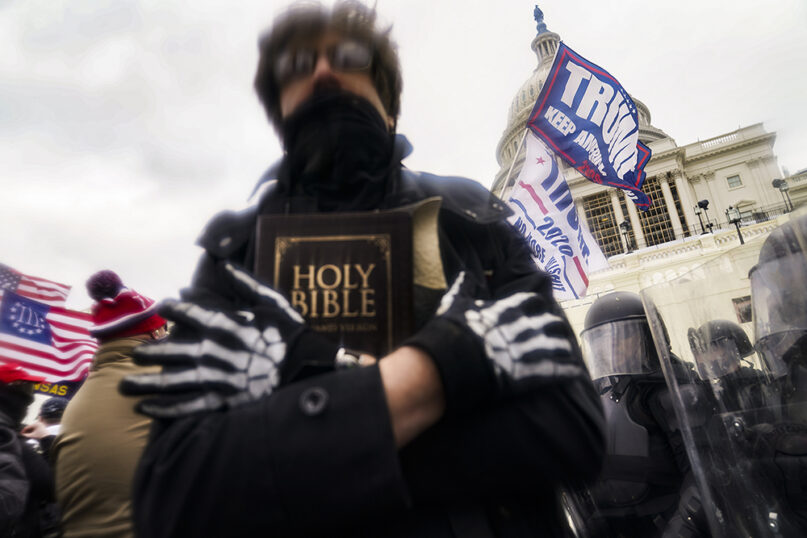
These conspiracy theories are often laden with antisemitism, xenophobia and racism. But you talk about how approaching these folks requires a measure of care and understanding.
They’ve already been told they’re crazy by everybody else they know, and it’s about feelings, not facts, for conspiracists. For me, there was genuine curiosity. I didn’t start out empathetic. I wanted to demonize them. It evolved because I started seeing them as people and developing relationships with these women.
In August 2022, Tammy’s sentencing was coming up, and she needed 15 character letters. She told me, I don’t have 15 friends. It hit me in that moment — at this age, in this stage, do I have 15 friends? I started having empathy. A few weeks later, I got a call about her child’s suicide. That’s when I had to shelve the academic piece because I needed to help this person. She had literally no one to help her.
Tammy and Yvonne were complicated. They have so much trauma in their lives. They started out as ordinary women with no affiliation to any kind of political movement. I didn’t excuse what they did. I still thought they deserved consequences. But I saw the other pieces of them.
This is also easy for me to say, because I’m privileged in many ways. I’m not a member of one of the marginalized communities that’s so often attacked by conspiracists. But I think there’s some value to talking to people so different than ourselves, if we can.
Original Source: