NEW YORK (RNS) — The organ arrived from Utah on a warm August morning. Greeted by holy water, incense and slide whistles, it came in a 53-foot-long truck that was double-parked on Manhattan’s Upper East Side.
The Church of the Epiphany’s priests clambered up on the truck’s loading dock, tossed on stoles and blessed the long-awaited instrument. Their prayers were punctuated by the sound of confetti cannons shot off by about 30 parishioners.
Then, for hours, children, adults and elders into their 90s hoisted pipes and boxes up flights of stairs to the church’s second-floor sanctuary. The biggest spectacle was the entrance of the 600-pound organ console, which parishioners and organ builders spent over 30 minutes wrangling up an external staircase.
“What has been the most beautiful part of this organ is the way it has brought our entire community together,” Denise Cruz, a vestry member, speech pathologist and mother of two, told RNS. “It was all hands on deck.”
Even with reports of declining worship attendance in the U.S. — and an overall reduction in the numbers of professional organists — some churches are investing in new versions of the age-old instrument to fill their sanctuaries with music and possibly attract community members to come inside. The new organ on East 74th Street joins others in New York City, where special concert series introduced new instruments at Trinity Church in September and at St. Thomas Church in 2018.
To the Rev. Matthew Dayton-Welch, the new, handcrafted organ at Church of the Epiphany represents more than a commitment to quality music; it’s emblematic of the final phase of a multiyear, $2.5 million effort to relocate and rebuild the Episcopal congregation, an investment in community as much as sound.
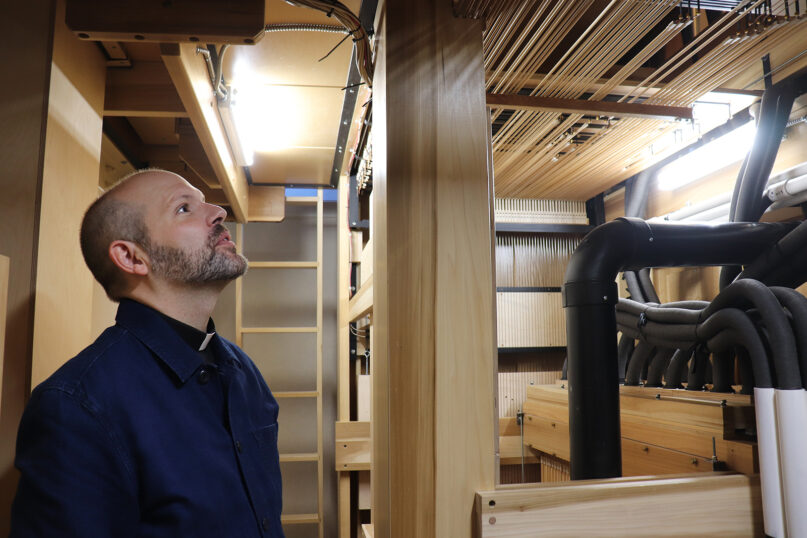
“So many churches make difficult decisions because they’re shrinking and they’re consolidating and they’re trying to survive. And that wasn’t the case here,” Dayton-Welch, the church’s rector, told RNS. “This was the church that was healthy, but it was still willing to risk everything it had in order to create an even better platform in a city where churches don’t get up and move.”
In 2018, space constraints led the nearly 200-year-old Episcopal parish to consider moving from its location at the time, on York Avenue. The congregation set its eyes on the former Jan Hus Presbyterian Church, a larger space just one block north that needed a remodel. But, as Dayton-Welch put it, “crossing First Avenue, for us, we might as well have been crossing the Red Sea.”
The church’s then-rector, the Rev. Jennifer Anne Reddall, was elected bishop of Arizona, propelling Church of the Epiphany into an unexpected rector search. Then, a 2020 excavation of the new property revealed that it sat over a natural creek, and the threat of flooding required a redesigned building foundation.
“We had things flood in the basement of the church,” said Christian Vanderbrouk, who has attended Epiphany for about a decade.
Located in the middle of a medical hub, the church’s community was also hit hard by the COVID-19 pandemic. Congregants recall refrigerated morgue trucks circling the neighborhood. And in 2021, hot steel beam rafters didn’t cool as expected, briefly setting the church ablaze.
“You had a flood, a fire and a plague,” said Dayton-Welch, who arrived at the church in 2023, by which time the church had officially moved to its current location on East 74th Street.
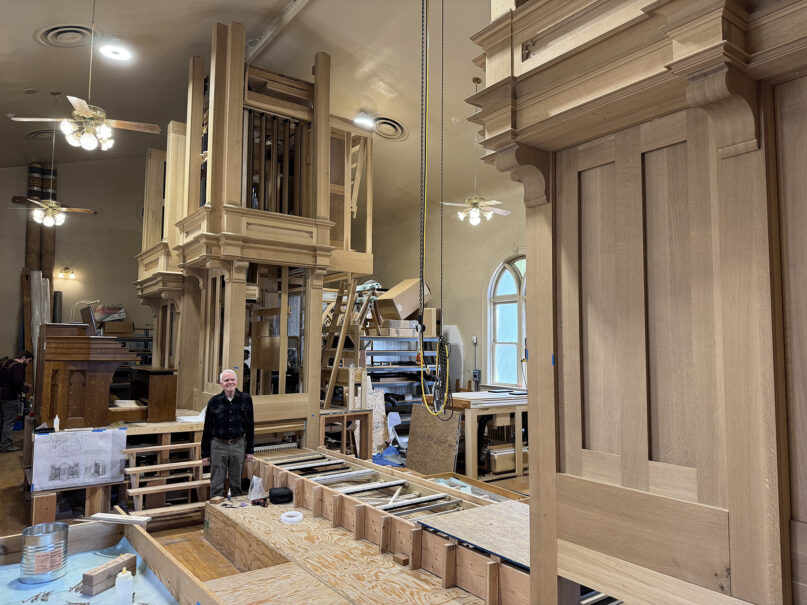
Meanwhile, Church of the Epiphany contracted with Bigelow & Co. Organ Builders in American Fork, Utah, in 2020 to design a new organ for the new space. Bigelow founder Michael Bigelow is a member of The Church of Jesus Christ of Latter-day Saints, and his workshop is in an old LDS church building whose tall ceilings allow for organ assembly.
In April, RNS visited Bigelow’s workshop, where builders were completing the trackers, the mechanical linkages that pull open the valves releasing air into the correct pipe. Like most of Bigelow’s organs, the Epiphany organ uses mechanical tracker action in contrast to electric-action pipe organs, where pressing a key sends an electric signal to open the valve under the corresponding pipe.
Initially, the organ’s sound had a German flair, focused on volume and power, but church leaders’ feedback led the builders to swap some of the neo-Baroque style stops in favor of producing a more expressive, versatile sound.
“That decision was made basically to better serve the Anglican style of liturgy,” said Conner Kunz, an experienced woodworker and member of the Bigelow team. He said Bigelow added a Flute Celeste stop, creating an “ethereal, sort of wavy, shimmery effect” that is “less boisterous than our shrieky little harmonic pipes that are sort of traditional in the neo-Baroque style.”
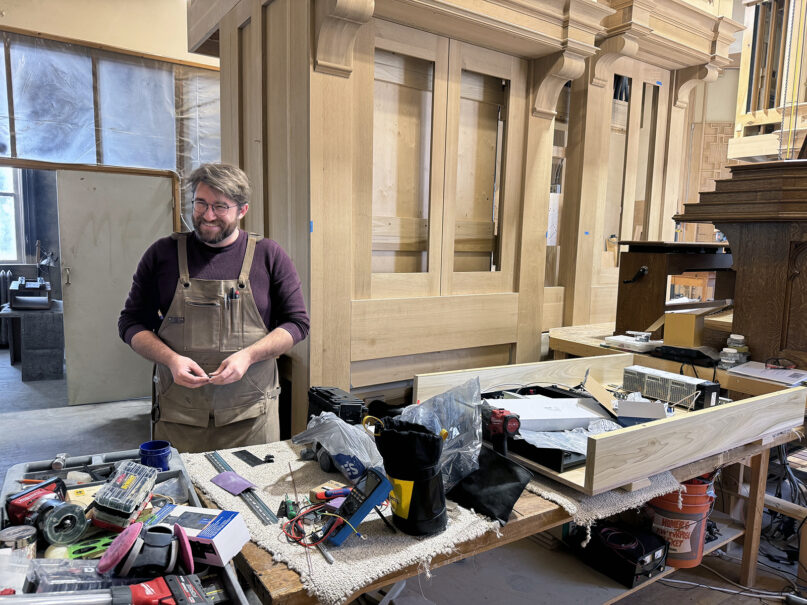
Builders were also completing an initial phase of voicing the pipes, cutting the ends, adjusting the openings and nicking the edges to shape the sound. David Chamberlin, the tonal director and vice president of Bigelow, is also an organist, with a master’s degree in organ performance. He oversaw the voicing, blowing on each pipe to test the sound quality.
“We want to do something that will create, uplift, enrich, spiritually, the lives of our listeners,” he said.
By late summer, the organ had been disassembled and loaded into tractor-trailers. To prepare for its arrival, the church building underwent a litany of preparations. A team of engineers and HVAC workers reset electrical lines, adjusted the temperature and humidity, and excavated holes in the 140-year-old brick wall to create pathways for the air system “so the organ’s lungs can breathe,” Dayton-Welch explained.
He said that, typically, you build an instrument after a room, but the construction of the new location created an opportunity for both to be designed in tandem. “The room is part of the organ, the room is part of the instrument,” he said.

Church of the Epiphany leaders envision the organ not solely as a source of music for their sanctuary, but as a tool to bring people in — and not solely for Sunday morning worship, where 60 to 80 people gather each week. They are hoping to build on already developed relationships, with decades-long members going to dinner with young couples who are newly attending, and the church continuing its Wednesday night dinner program that feeds housing-insecure neighbors, college students and others needing a meal.
“What we’re trying to do is meet the needs of our community by creating a place of belonging,” Dayton-Welch said. “And our hope is that the music program facilitates that.”
Alex Nguyen, who began as Epiphany’s new director of music in September, envisions using nontraditional ways to introduce the organ to the community, such as hosting jazz ensembles or multimedia events.
“Of course we will have recitals, but I think we’d like to try some different things, unconventional pairings with the organ, doing things with the kids to help create that interest,” he said.
Cruz, who lives near Epiphany and was first inspired to attend in 2023, after a hospitalization, said the church has “felt like home” since day one. Anticipating the organ, she said, has been part of what’s drawn the congregation together, and she compared the instrument’s arrival to a birth.
“The organ has almost breathed a new sense of life or purpose, and we get to share now this musical ministry with our community,” she said.
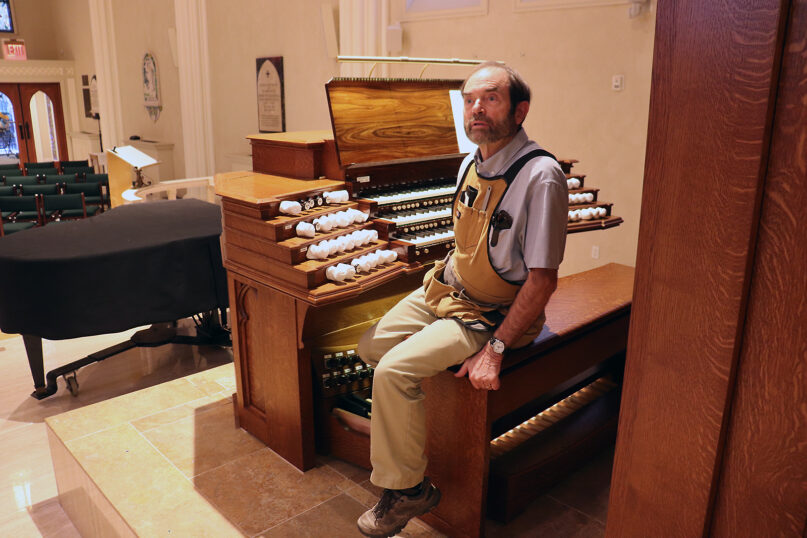
Andrew Gingery, vice president of Associated Pipe Organ Builders of America, a trade organization, said some churches — often Catholic, Episcopal, Lutheran or Presbyterian — continue to appreciate pipe organs. And high-quality organ building companies are “all very busy right now,” since the end of the height of the pandemic.
“There are still churches with means, and they want to have good music,” said Gingery, who is also executive vice president of C.B. Fisk, a pipe organ builder based in Gloucester, Massachusetts, which is developing an organ for the St. Vartan Armenian Cathedral in New York for 2027. “That’s one of the things that makes them an active church. Frankly, you put on a good show and people are likely to come.”
This past fall, Epiphany’s congregation heard the organ played during worship for the first time. Though the voicing of the organ pipes wasn’t yet complete, parishioners told RNS that even hearing the unfinished organ was profoundly moving. On Tuesday (Jan. 6), the Feast of Epiphany, which celebrates the wise men’s visit to the infant Jesus, the voicing process was nearing completion. The organ will be blessed Tuesday by the bishop of New York.
Cruz said that for her Puerto Rican family, Epiphany, also known as Three Kings Day, is “almost bigger than Christmas.”
“We’re all like little kids waiting to see how is it going to sound that day when it’s absolutely, fully complete,” she said.

Vanderbrouk, who served as junior warden when the plans for the organ were first made, noted that Epiphany’s congregation has moved numerous times over the nearly two centuries it’s been around. To him, the organ is now like an anchor for the “itinerant” church.
“It’s a signal to the parish and to our neighbors that after all that moving and construction, we’re fully invested, and we’re here to stay,” he said. “There’s a sense of permanence.”
Original Source: