VATICAN CITY (RNS) — In a solemn ceremony on Tuesday morning (Jan. 6), the Feast of the Epiphany, Pope Leo XIV will close the last Holy Door in St. Peter’s Basilica to mark the end of the Jubilee Year, which saw profound transformations in the church with the death of Pope Francis and the beginning of a new papacy.
“With a simple yet symbolic gesture, the closing of the Holy Door will close the Ordinary Jubilee of 2025,” said Mons. Rino Fisichella, the pro-prefect of the Vatican department for evangelization who oversaw the Jubilee celebration, during a Vatican press conference on Monday. “Inevitably, such an event also leads to an evaluation of this year, which was in many ways extraordinary,” he added.
The Jubilee Year is a tradition that began in the Catholic Church in 1300 but is inspired by a Jewish tradition from the biblical book of Leviticus that occurred every 50 years and included the elimination of debt and the redistribution of property. The Catholic Jubilee has evolved into a celebration occurring every 25 years to allow pilgrims to come to the major basilicas in Rome and obtain forgiveness of their sins by crossing through the holy doors.
Pope Francis opened the 2025 Holy Year on Christmas Eve of 2024 with the theme “Pilgrims of Hope.” Despite uncertainty about the future, Francis wrote in the bull announcing the start of the Jubilee that the Holy Year was meant to “help us to recover the confident trust that we require, in the Church and in society, in our interpersonal relationships, in international relations, and in our task of promoting the dignity of all persons and respect for God’s gift of creation.”
Francis opened a door in each of the four major Basilicas in Rome: St. Peter’s, St. Mary Major, St. John Lateran and St. Paul Outside the Walls. Already struggling with his health and in a wheelchair, he also opened a fifth door in the Roman prison of Rebibbia, as a symbol of redemption for all. On Feb. 14, Francis was taken to the hospital for a severe respiratory infection.
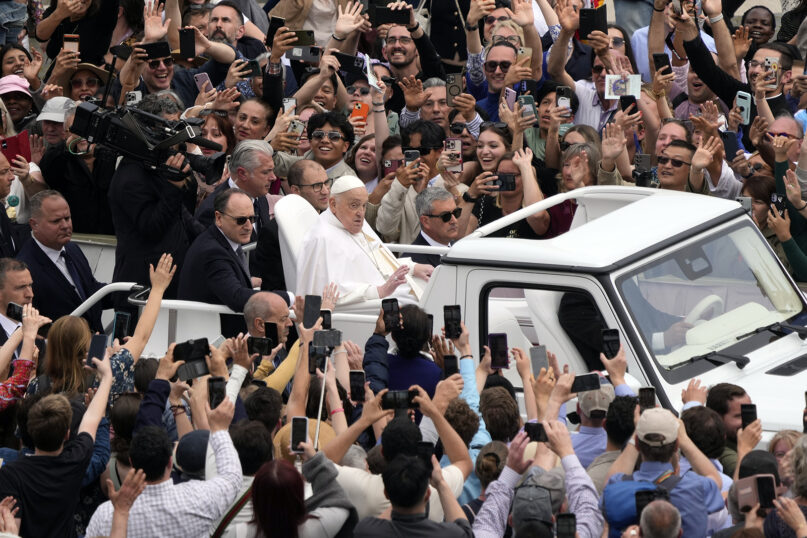
Crowds of faithful gathered beneath the window at the Gemelli Hospital where he was being treated, offering flowers and prayers for his recovery. When Francis was discharged from the hospital in March, faithful had the chance to see him one last time as he greeted crowds gathered in St. Peter’s Square for Easter. He died the day after, following a cerebral stroke and subsequent heart failure.
Immediately, preparations for the conclave that would elect his successor began. According to Vatican data, an additional 3.9 million pilgrims came to the Vatican during the transition period between March and May. Those pilgrims were there to witness the election and inauguration of Pope Leo XIV as the 267th pontiff and the first to be born in the United States.
The last time a Jubilee year saw the death of a pope and the election of another was in 1700, with the death of Innocent XII and the election of Clement XI.
The unexpected transition, organizers said at the press conference, put an additional strain on the Jubilee year organization, adding safety and logistical concerns. “The entire world came to Rome. Pilgrims came from 185 countries. The city was in the spotlight of the international press for a whole year, and was still capable of overcoming the challenge,” Fisichella said.
A total of 33.8 million pilgrims came to Rome to celebrate the Jubilee events and the major shifts in the church, according to Vatican estimates. Over 62% of pilgrims came from Europe, 16.5% from North America and 9.4% from South America, officials said, followed by Asia, Oceania, Central America and the Caribbean, Africa and the Middle East.

Most of the pilgrims, 36.3%, came from Italy, followed by pilgrims from the U.S. (12.6%), Spain (6.2%), Brazil (4.7%), Poland (3.7%) and Germany (3.2%), the Vatican announced. “The Jubilee was truly a moment of grace,” Fisichella said, adding that religious places in Rome saw an unprecedented attendance, with a significant rise in the number of confessions.
He also said the Jubilee had repercussions outside of Rome, with churches in other countries registering great “enthusiasm and participation.” He said that in Ho Chi Minh City, Vietnam, more than 1,500 people celebrated the end of the Jubilee.
Throughout the year, the Vatican and Rome hosted 35 special Jubilee events, dedicated to specific groups such as politicians, health care professionals, people living with disabilities, and even social media influencers. Over 5,000 volunteers of all ages and backgrounds offered their service throughout the year, including 2,000 members of the Sovereign Military Order of Malta.
A major highlight was the Jubilee of Young People, July 28 to Aug. 3, in the Roman suburb of Tor Vergata where 250,000 youth gathered to pray with the newly elected Pope Leo in what was considered a first test of his papacy. “It was a Jubilee that sowed, and the fruits will be visible in the future,” Fisichella said.
According to Vatican figures, an additional 13 million pilgrims, mostly young people, came to Rome for the Jubilee of Youth between June and September.
A team that included members from the Italian government, the Lazio region, the mayor of Rome and a special commissioner worked alongside the Vatican to provide security measures for the large crowds. The funerals of Pope Francis, the election of a new pope and the Catholic youth festival put significant stress on the organizers to ensure security.

Two young women died during the Jubilee of Youth, the Egyptian Pascale Rafic Mounir, 18, who died of cardiac arrest, and Maria Cobo Vergara from Spain, 20, who died due to preexisting conditions.
Despite the positive report by Vatican and Italian government organizers, the Jubilee was considered “disappointing” and “mediocre” in terms of financial gains, according to Italian media reports. Shops near the Vatican showed only a 3% rise in income over the year, according to representatives of the trade association of bars, restaurants and other public-facing businesses in Rome. According to some, the influx of pilgrims disincentivized other tourists from coming to the city, though Fisichella denied the connection.
“The presence of the pilgrims didn’t take anything away from anyone,” Fisichella said. “The fear, held by some, that the presence of the pilgrims would scare tourists away was completely denied.” The monsignor added that the Jubilee raised the visibility of the city, which will bear fruit in the coming years.
Speaking at the same press conference, the mayor of Rome, Roberto Gualtieri, said there are no official figures available regarding the income generated by the Holy Year, but he believes it was a positive year for the city overall. Rome was transformed during the Jubilee Year, with 108 city construction sites completed, he added.
But for political and bureaucratic reasons, the Vatican and the Italian authorities were late to start preparing for the Jubilee, Gualtieri said. That must not be the case for the next Jubilee Year, scheduled to take place in 2033, the 2,000th anniversary of the death and resurrection of Christ, according to Christian tradition.
“We raced against time and we were repaid,” said the president of the Lazio region, Francesco Rocca, at the press conference. “Today we know we must arrive prepared for 2033.”
Original Source: