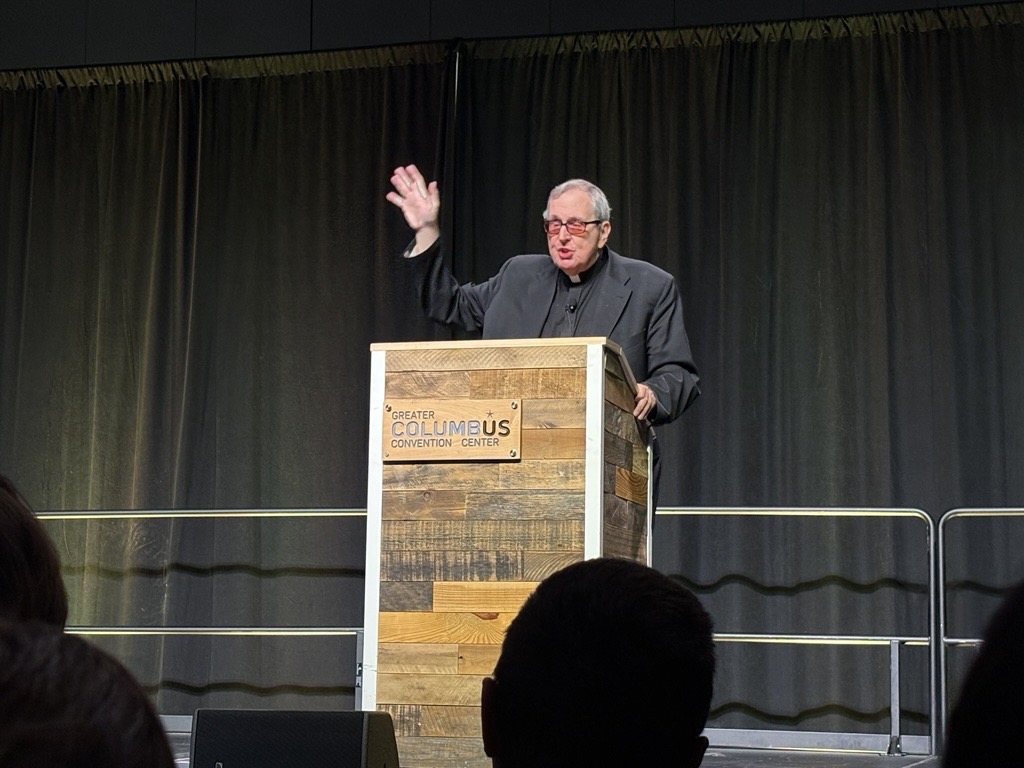
 Father Robert Spitzer, SJ, speaks on faith, miracles and science at SEEK 2026, Saturday, Jan. 3, 2026
Jan 3, 2026 / 20:45 pm (CNA).
As the SEEK Conference continues this week in Columbus, Ohio — one of three locations alongside Denver and Fort Worth — college students selecting from dozens of breakout sessions packed a hall to hear Father Robert Spitzer, SJ, examine scientific research into Eucharistic miracles and the tilma of Our Lady of Guadalupe.
Father Spitzer, host of EWTN’s “ Father Spitzer’s Universe” and founder of the Magis Center, is known for addressing questions at the intersection of faith, reason, and science. The Magis Center launched MagisAI in 2025, an artificial intelligence tool designed to answer questions about theology, morality, Scripture, and science — a resource Spitzer highlighted during his presentation.
“I want to be very clear,” Spitzer told the audience. “My objective is to offer good, scientific evidence of the Real Presence of Jesus in the Eucharist.”
The talk focused on three Eucharistic miracles: Buenos Aires (1996), Tixtla, Mexico (2006), and Sokółka, Poland (2008). Each has been investigated rigorously by independent scientists, though only some have received local ecclesial recognition, and none are formally approved by the Vatican.
Signs of the Real Presence
In Buenos Aires, a consecrated host that had been discarded on a candle holder was later placed in water to dissolve according to Church protocol. Local accounts reported that the host fragments did not dissolve within a week as expected but rather remained largely intact even after more than three years. Over time, a strange substance appeared on its surface, showing morphological features characteristic of human cardiac muscle.
Scientific analysis, approved by then-Archbishop Jorge Mario Bergoglio (later Pope Francis), then involved Dr. Ricardo Castañon Gómez. He reported that the tissue was indeed human cardiac muscle from the left ventricle and, astonishingly, contained living white blood cells that would normally die within hours outside the body.
The samples were sent to famous cardiologist and forensic pathologist Dr. Frederick Zugibe, who confirmed Castañon Gómez’s findings without knowing that they had come from a consecrated host.
“When [Zugibe] was told that it came from a Eucharistic host, he said the findings were scientifically inexplicable,” Spitzer said.
In Tixtla, Mexico, a consecrated host appeared to bleed during Mass in 2006. Investigators, again including Dr. Castañon Gómez, discovered living cardiac tissue embedded in the host, exuding fresh blood. Molecular and histological analysis revealed that the tissue contained cardiac fibers and white blood cells performing their usual immune functions.
Spitzer described the findings as unequivocal: “This was living human cardiac tissue, producing living blood, without any sign of decomposition. These phenomena are naturalistically baffling.” Re-examination years later showed that the host continued to exhibit signs of life.
In Sokółka, Poland, electron microscopy of a host that bled during Mass in 2008 reportedly revealed that the consecrated bread molecules and the cardiac tissue were fused at the microscopic level, down to the myofibril filaments. Spitzer emphasized that it could not be produced by any biological, chemical, or mechanical means known to humans.
“Their conclusion was striking,” Spitzer said. “While these findings are reported to be naturalistically inexplicable, their purpose is not to coerce belief, but to show that faith and reason are complementary.”
Speaking to a ‘scientifically skeptical generation’
Spitzer also spoke on the tilma of Our Lady of Guadalupe, which has survived for nearly 500 years. Made from agave cactus fibers, which normally decompose within decades, the image has never cracked or faded, and its colors are embedded in the fibers themselves with no brush strokes, primers, or protective coatings. “The colors behave optically like butterfly wings, changing with angles and distance. No pigments — then or now — can account for this,” he noted.
High-magnification studies of the Virgin’s eyes reportedly revealed reflections of the scene that occurred when Juan Diego first unfurled the tilma, including the saint himself, Archbishop Zumárraga, an interpreter, and others present. Spitzer added that the stars on her mantle correspond precisely to the night sky over Mexico on December 12, 1531, from a perspective no human observer could have had.
He emphasized that these phenomena are not meant to coerce belief but to show the extraordinary ways God can intersect with human experience. “It seems that God is speaking to a scientifically skeptical generation in the language of science itself,” he told the audience. “Without modern science, we would never have known any of this. And perhaps that is the point.”
Pointing to God
Speaking with CNA, Spitzer reflected on the broader significance of these studies. “There’s a widespread viewpoint today that science has somehow disproved God. Nothing could be further from the truth. In fact, there is more scientific evidence pointing to God today than ever before,” he said.
He noted that recent surveys indicate 68% of young scientists believe in God or a higher power, compared with around 15% identifying as atheists.
“Because of science’s credibility today, God is allowing scientific discoveries to open new doors to belief.” Dr. Castañon Gómez, a former atheist, for instance, converted to Catholicism after what he discovered in his studies.
“You can’t force faith, and you can’t prove it in a way that overrides freedom,” Spitzer said. “But you can provide enough evidence so that a person who wants to believe can do so reasonably and responsibly.”
Spitzer especially highlighted the example of St. Carlo Acutis, who cataloged all the world’s Eucharistic miracles online before his death in 2006.
“He teaches us that faith and science are not contradictory; in fact, they are deeply compatible. Science has made all this information accessible and compelling, and that makes it a powerful ally in the pursuit of faith,” he said. “Faith and reason must ultimately be consistent because they come from the same source — God Himself.”
In that sense, according to Spitzer, St. Carlo shows young people at SEEK and beyond that “holiness, intellectual engagement, and love for the Eucharist can — and should — go together perfectly.”
Original Source: